


The Problem OpenSRE Solves
In modern cloud-native systems, software development velocity often conflicts with system stability. Without a unified framework to measure and manage reliability, engineering teams face critical challenges:
- Undefined Reliability Targets: Deploying code without knowing what level of availability is actually required by the business.
- Alert Fatigue: Flooding on-call engineers with non-actionable notifications, leading to burnout and missed critical events.
- Blame-Heavy Cultures: Treating system outages as individual developer errors rather than systematic process deficiencies.
- Uncontrolled Toil: Allowing repetitive, manual operational tasks to consume more than 50% of engineering resources.
OpenSRE addresses these issues by standardizing the metrics, workflows, and culture needed to build, measure, and scale reliable systems using open standards.
What Is OpenSRE?
OpenSRE is an open-source framework and collection of resources designed to democratize Site Reliability Engineering practices. Instead of keeping SRE methodologies locked within big-tech silos, OpenSRE offers structured templates, definitions, and operational blueprints that any engineering organization can implement.
At its core, OpenSRE operationalizes system reliability through a data-driven feedback loop: measuring actual performance against defined business tolerances and dynamically adjusting deployment velocity.
Core Concepts
Service Level Indicators (SLIs) and Service Level Objectives (SLOs)
An SLI is a quantifiable metric that measures the service performance from the user's perspective (e.g., latency of HTTP requests). An SLO is the target reliability level defined for that indicator (e.g., 99.9% of HTTP requests must return in under 200ms).
Here is how you define a Service Level Objective declaratively using Prometheus rules:
apiVersion: [monitoring.coreos.com/v1](https://monitoring.coreos.com/v1)
kind: PrometheusRule
metadata:
  name: api-latency-slo
  namespace: monitoring
spec:
  groups:
  - name: api-slo-alerts
    rules:
    - alert: APILatencySLOBurnRateHigh
      expr: |
        (
          sum(rate(http_request_duration_seconds_count{status=~"5.*"}[1h]))
          /
          sum(rate(http_request_duration_seconds_count[1h]))
        ) > 0.02
      for: 5m
      labels:
        severity: critical
        tier: platform
      annotations:
        summary: "High error budget burn rate detected on API gateway"
        description: "The 1-hour error rate is currently above 2%, rapidly depleting the weekly error budget."
Error Budgets
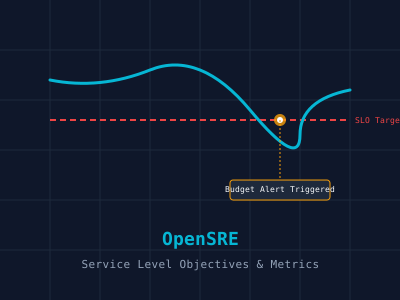
The error budget is the allowable space for failure, calculated as 100% - SLO. For a 99.9% SLO, the error budget is 0.1%. This budget acts as a formal contract between development and operations:
- Green (Budget Intact): High deployment velocity. The team can focus on shipping new features and running experimental configurations.
- Red (Budget Depleted): Feature freeze. The engineering focus must pivot entirely to reliability, bug fixes, and system hardening until the budget recovers.
def calculate_error_budget(total_requests, failed_requests, target_slo=0.999):
    actual_reliability = (total_requests - failed_requests) / total_requests
    budget_remaining = 1.0 - ((target_slo - actual_reliability) / (1.0 - target_slo))

    return {
        "actual_reliability": actual_reliability,
        "budget_remaining_percent": max(0.0, budget_remaining * 100),
        "status": "GREEN" if actual_reliability >= target_slo else "RED"
    }

# Usage example for a high-traffic service
print(calculate_error_budget(total_requests=1000000, failed_requests=850))
Observability Architecture
OpenSRE recommends utilizing open-source collection pipelines. Using OpenTelemetry allows you to decouple telemetry generation from backend vendor systems.
receivers:
  otlp:
    protocols:
      grpc:
      http:
processors:
  batch:
exporters:
  prometheus:
    endpoint: "0.0.0.0:8889"
    namespace: "opensre"
service:
  pipelines:
    metrics:
      receivers: [otlp]
      processors: [batch]
      exporters: [prometheus]
The OpenSRE Workflow
The operational lifecycle under the OpenSRE framework progresses through a repeatable four-stage cycle:
1. Instrument
Deploy OpenTelemetry SDKs inside the application codebase to collect golden signals: Latency, Traffic, Errors, and Saturation.
2. Alert on Burn Rate
Do not trigger pages on instantaneous CPU spikes. Instead, alert when the rate of error budget consumption (burn rate) indicates the SLO will be breached within a critical window (e.g., 2 hours or 12 hours).
3. Mitigate and Triage
Utilize automated runbooks to route traffic away from failing regions or gracefully degrade non-critical features.
4. Postmortem Analysis
Conduct a blameless postmortem. Document the root organizational, architectural, and procedural causes of the incident, then assign action items to prevent recurrence.
Best Practices
- Cap Toil at 50%: Ensure SREs spend at least 50% of their time on engineering work (automation, architecture) rather than manual operations.
- Design for Blamelessness: Write postmortems assuming that engineers made the best decisions possible with the information they had at the time.
- Verify with Chaos: Regularly inject failure modes (using tools like LitmusChaos or Chaos Mesh) to verify that your alerting pipelines and SLO models function under load.
- Keep Code Close: Store SLO definitions, dashboards, and alerting rules in Git alongside the application code (Config-as-Code).
Getting Started
To adopt the OpenSRE standard, start small. Select a single tier-1 service, instrument it with OpenTelemetry, calculate its baseline latency profiles over a 14-day window, and draft your first SLO contract. By treating reliability as a primary feature, you align technical goals directly with business outcomes.