

The Anatomy of a Tragicomic Production Outage
System failures in enterprise cloud environments are often attributed to complex distributed anomalies—such as split-brain network partitions, hardware degradation, or zero-day exploits. However, some of the most catastrophic production outages stem from seemingly trivial interface elements that lack defensive engineering controls.
In a recent security and architecture audit of a high-growth logistics SaaS dashboard, three public-facing submission endpoints were evaluated: a contact form, a user comment input, and a newsletter subscription widget. The newsletter service was configured to accept an email string and immediately dispatch a transactional verification email via Resend.com.
The audit explicitly flagged the absence of API rate limiting across these public endpoints as a high-severity operational risk. The engineering recommendation was straightforward: enforce immediate rate limits at both the network edge and the application controller.
However, the organization's leadership downgraded the ticket to low priority. Their rationale was rooted in a common engineering fallacy: the form is simple, and frontend validation combined with backend regex checks makes the endpoint low risk.
For two months, the system operated normally under baseline traffic. But as the company scaled advertising campaigns and onboarded enterprise freight partners, public visibility surged. In the middle of the night, disaster struck:
- Automated Scraping and Spam Attacks: Malicious bots and distributed scrapers discovered the unthrottled public endpoint and began hammering it with tens of thousands of automated POST requests per minute.
- Synchronous Downstream Saturation: Because the subscription handler processed database insertions and Resend.com API dispatches synchronously within the request-response loop, third-party rate limits were instantly breached. Resend returned HTTP 429 (Too Many Requests) errors, which the application failed to handle gracefully.
- Database Connection Pool Starvation: Each incoming request held open an active PostgreSQL database connection while awaiting external network I/O. As requests backed up, the application's connection pool was exhausted, causing cascading timeouts across core logistics services.
- Autoscaling Cascade and Crash: Horizontal Pod Autoscalers (HPA) detected elevated CPU and memory usage, scaling compute instances to maximum capacity. However, adding more application containers merely multiplied the connection pressure on the central database.
The entire platform collapsed—not from an infrastructure flaw in the core logistics routing engine, but from an unthrottled newsletter subscription input.
The Mechanics of Failure: Synchronous Side-Effects & Unbounded Ingestion
The catastrophic failure of this endpoint was driven by two architectural anti-patterns:
[ Unthrottled Malicious Requests ]
                 │
                 ▼
┌────────────────────────────────────────────────────────┐
│  Express Application Handler (Vulnerable)              │
│  ├── 1. Regex Validation (Passes)                      │
│  ├── 2. INSERT INTO subscribers (Acquires DB Conn)     │
│  └── 3. AWAIT resend.emails.send() (Synchronous HTTP)  │
└───────────────────────────┬────────────────────────────┘
                            │
       ┌────────────────────┴────────────────────┐
       ▼                                         ▼
┌──────────────────────────────┐  ┌──────────────────────────────┐
│ PostgreSQL Connection Pool   │  │ Resend API                   │
│ STATUS: EXHAUSTED (Timeouts) │  │ STATUS: 429 RATE LIMITED     │
└──────────────────────────────┘  └──────────────────────────────┘
- Synchronous External Dependencies: External third-party APIs must never be executed synchronously inside a public web request. Network latency variations and upstream rate limits directly couple your application's uptime to an external vendor.
- Unbounded Database Ingestion: Relational databases enforce hard connection limits ($N$). When client request concurrency exceeds connection availability ($C > N$), connection queues saturate, resulting in request queuing, P99 latency deterioration, and thread starvation across unrelated routes.
- Denial of Wallet (DoW): Attackers do not need to breach authentication to inflict financial damage. Incurring bandwidth costs, server autoscaling bills, and third-party transactional email charges at scale turns an unthrottled endpoint into a financial drain.
Architectural Solution: Multi-Layered Defense and Decoupled Queues
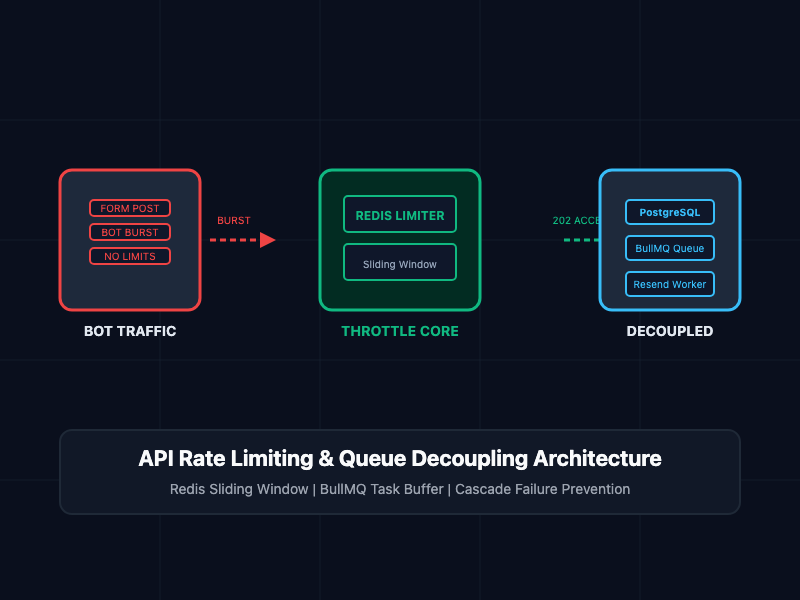
To safeguard production APIs against traffic surges and resource exhaustion, systems must implement Layered Rate Limiting combined with an Asynchronous Task Queue:
[ Incoming Public Traffic ]
                 │
                 ▼
┌────────────────────────────────────────────────────────┐
│  Edge Layer: WAF / Reverse Proxy (Cloudflare / Nginx)  │
│  - IP Reputation, Geo-Blocking, DDoS Mitigation        │
└───────────────────────────┬────────────────────────────┘
                            │
                            ▼
┌────────────────────────────────────────────────────────┐
│  Application Layer: Redis Sliding Window Rate Limiter  │
│  - Token Bucket / Sliding Log (e.g., 5 req / 10 min)   │
└───────────────────────────┬────────────────────────────┘
                            │
               Accepted (HTTP 202 Accepted)
                            │
                            ▼
┌────────────────────────────────────────────────────────┐
│  PostgreSQL Storage Engine                             │
│  - Idempotent Insert (ON CONFLICT DO NOTHING)          │
└───────────────────────────┬────────────────────────────┘
                            │
                            ▼
┌────────────────────────────────────────────────────────┐
│  Redis Message Broker (BullMQ Queue)                   │
│  - Job: { email, subscriber_id, timestamp }            │
└───────────────────────────┬────────────────────────────┘
                            │
                            ▼
┌────────────────────────────────────────────────────────┐
│  Asynchronous Worker Daemon                            │
│  - Managed Concurrency & Exponential Backoff           │
│  - Dispatches to Resend API Safely                     │
└────────────────────────────────────────────────────────┘
Core Concepts and Implementation
1. Redis-Backed Sliding Window Rate Limiter (TypeScript / Express)
Using in-memory counters in application memory fails when scaling horizontally across multiple container replicas. Rate limiting state must reside inside a distributed store like Redis.
The following implementation utilizes a Redis sliding window log to track request timestamps, ensuring burst protection:
// middleware/rateLimiter.ts
import { Request, Response, NextFunction } from 'express';
import Redis from 'ioredis';

const redis = new Redis(process.env.REDIS_URL || 'redis://localhost:6379');

interface RateLimitOptions {
  windowMs: number;
  maxRequests: number;
  keyPrefix: string;
}

export function createSlidingWindowLimiter(options: RateLimitOptions) {
  const { windowMs, maxRequests, keyPrefix } = options;

  return async (req: Request, res: Response, next: NextFunction) => {
    // Identify client by IP address or validated session header
    const clientIdentifier = req.ip || req.headers['x-forwarded-for'] || 'unknown_client';
    const redisKey = `${keyPrefix}:${clientIdentifier}`;

    const now = Date.now();
    const windowStart = now - windowMs;

    try {
      // Atomic Redis Transaction using multi pipeline
      const pipeline = redis.multi();

      // Remove timestamps older than the sliding window threshold
      pipeline.zremrangebyscore(redisKey, 0, windowStart);

      // Add current request timestamp
      pipeline.zadd(redisKey, now, `${now}-${Math.random()}`);

      // Count operations remaining in window
      pipeline.zcard(redisKey);

      // Set key expiration to clear memory automatically
      pipeline.pexpire(redisKey, windowMs);

      const results = await pipeline.exec();

      if (!results) {
        return res.status(500).json({ error: 'Rate limiting validation error' });
      }

      // Extract request count from zcard execution (index 2)
      const requestCount = results[2][1] as number;

      // Set rate limit headers
      res.setHeader('X-RateLimit-Limit', maxRequests);
      res.setHeader('X-RateLimit-Remaining', Math.max(0, maxRequests - requestCount));

      if (requestCount > maxRequests) {
        res.setHeader('Retry-After', Math.ceil(windowMs / 1000));
        return res.status(429).json({
          error: 'Too Many Requests',
          message: 'Rate limit exceeded. Please retry later.'
        });
      }

      return next();
    } catch (error) {
      console.error('Redis Rate Limiting Failure:', error);
      // Fallback strategy: Fail closed or fail open based on compliance requirements
      return next();
    }
  };
}
2. Decoupled Asynchronous Email Ingestion (BullMQ & Resend)
To prevent third-party rate limits and connection exhaustion, split the subscription request from email dispatch. The API saves the user and pushes a task to BullMQ, returning an HTTP 202 Accepted status immediately.
The Producer (Express Controller):
// controllers/newsletter.controller.ts
import { Request, Response } from 'express';
import { Queue } from 'bullmq';
import { Pool } from 'pg';
import Redis from 'ioredis';

const redisConnection = new Redis(process.env.REDIS_URL || 'redis://localhost:6379', {
  maxRetriesPerRequest: null
});

const newsletterQueue = new Queue('newsletter-delivery', { connection: redisConnection });
const dbPool = new Pool({ connectionString: process.env.DATABASE_URL });

export async function handleNewsletterSubscription(req: Request, res: Response) {
  const { email } = req.body;

  // Basic payload sanity check
  if (!email || typeof email !== 'string') {
    return res.status(400).json({ error: 'Valid email address required' });
  }

  const normalizedEmail = email.trim().toLowerCase();

  try {
    // 1. Idempotent insert into PostgreSQL database
    const insertQuery = `
      INSERT INTO newsletter_subscribers (email, status, created_at)
      VALUES ($1, 'PENDING_CONFIRMATION', CURRENT_TIMESTAMP)
      ON CONFLICT (email) DO NOTHING
      RETURNING id;
    `;
    const dbResult = await dbPool.query(insertQuery, [normalizedEmail]);

    // 2. Queue the email job only if a new subscriber was inserted
    if (dbResult.rowCount && dbResult.rowCount > 0) {
      const subscriberId = dbResult.rows[0].id;

      await newsletterQueue.add(
        'send-welcome-confirmation',
        { subscriberId, email: normalizedEmail },
        {
          jobId: `newsletter-${subscriberId}`, // Enforce task deduplication
          attempts: 5,
          backoff: {
            type: 'exponential',
            delay: 3000 // Initial retry backoff of 3 seconds
          },
          removeOnComplete: true,
          removeOnFail: false
        }
      );
    }

    // 3. Respond immediately to avoid holding open client connections
    return res.status(202).json({
      status: 'ACCEPTED',
      message: 'Subscription received. Confirmation email scheduled.'
    });
  } catch (error) {
    console.error('Subscription handler error:', error);
    return res.status(500).json({ error: 'Internal processing error' });
  }
}
The Consumer (Background Worker):
// workers/emailWorker.ts
import { Worker, Job } from 'bullmq';
import { Resend } from 'resend';
import Redis from 'ioredis';

const resend = new Resend(process.env.RESEND_API_KEY);
const redisConnection = new Redis(process.env.REDIS_URL || 'redis://localhost:6379', {
  maxRetriesPerRequest: null
});

export const emailWorker = new Worker(
  'newsletter-delivery',
  async (job: Job) => {
    const { email } = job.data;

    console.log(`Processing confirmation email for: ${email} (Job ID: ${job.id})`);

    // Dispatch email through Resend API
    const response = await resend.emails.send({
      from: 'Logistics Platform <newsletter@yourdomain.com>',
      to: email,
      subject: 'Please Confirm Your Subscription',
      html: '<p>Thank you for subscribing to our industry insights.</p>'
    });

    if (response.error) {
      throw new Error(`Resend rejected delivery: ${response.error.message}`);
    }

    return { deliveryId: response.data?.id };
  },
  {
    connection: redisConnection,
    concurrency: 5, // Managed rate: Process max 5 transactions concurrently
    limiter: {
      max: 10,       // Never exceed 10 outbound calls...
      duration: 1000 // ...per 1 second (respecting Resend tier limitations)
    }
  }
);

emailWorker.on('failed', (job, err) => {
  console.error(`Job ${job?.id} failed with error: ${err.message}`);
});
Architectural Comparison Matrix
| Architectural Dimension | Direct Unthrottled Endpoint | Rate-Limited & Decoupled Queue |
| Edge Protection | None | WAF + IP Reputation Analysis |
| Concurrency Ingestion | Unbounded | Controlled via Redis Sliding Window |
| Database Blast Radius | High (Connection starvation) | Minimal (Indexed, idempotent, short transactions) |
| Third-Party API Coupling | Synchronous (Failure cascades) | Asynchronous (Worker retry & backoff) |
| Resilience to Bot Floods | Collapses under sustained volume | Throttles at boundary (HTTP 429) |
| Cost Predictability | High financial runaway risk | Bounded by rate limits and queue capacity |
SRE and Production Best Practices
- Layer Rate Limits Across Architecture: Never rely solely on application middleware. Enforce coarse-grained volumetric rate limits at the edge (e.g., Cloudflare WAF, AWS WAF, or Nginx) and fine-grained, business-context limits inside your application via Redis.
- Deploy Invisible Bot Verification: Implement zero-friction bot deterrence mechanisms like Cloudflare Turnstile or invisible reCAPTCHA v3 on all public inputs. Additionally, include a hidden "honeypot" field that legitimate human users cannot see; if the honeypot contains data, discard the request immediately.
- Enforce Database-Level Idempotency: Add strict unique constraints on user input fields (e.g., CREATE UNIQUE INDEX idx_subscribers_email ON newsletter_subscribers (email);). Combine this with ON CONFLICT DO NOTHING to prevent repeated insert churn.
- Isolate Connection Pools: Configure dedicated, partitioned database connection pools for public-facing guest endpoints. This prevents a burst of unauthenticated requests from consuming database pools required by authenticated customer transactions.
- Implement Circuit Breakers on Outbound Adapters: If downstream vendors like Resend begin returning HTTP 500 or 429 status codes, an automated circuit breaker should trip, temporarily pausing background workers to allow upstream APIs to recover without dropping jobs.
Getting Started
To test and verify a rate-limited queue architecture in your local development environment:
# Step 1: Launch Redis and PostgreSQL containers
docker run -d --name local-redis -p 6379:6379 redis:7-alpine
docker run -d --name local-postgres -e POSTGRES_PASSWORD=postgres -e POSTGRES_DB=app_db -p 5432:5432 postgres:16-alpine

# Step 2: Initialize project and install dependencies
npm init -y
npm install express ioredis bullmq pg resend dotenv
npm install -D typescript @types/express @types/node @types/pg

# Step 3: Launch the API server and worker daemon
npx ts-node server.ts &
npx ts-node worker.ts

# Step 4: Execute a high-concurrency load test to verify rate limiting
# Install autocannon or Apache Bench
npx autocannon -c 50 -d 10 -m POST \
  --headers "content-type=application/json" \
  --body '{"email":"loadtest@example.com"}' \
  http://localhost:3000/api/v1/newsletter/subscribe
By transitioning away from fragile synchronous handlers and implementing multi-layered rate limiting with asynchronous queues, engineering teams eliminate single points of failure, preserve database stability, and insulate critical production systems against malicious traffic.