


The Operational Challenge of Petabyte-Scale Database Sharding
In global payment processing, database downtime directly translates to business disruption. When a payment processing API drops below five nines of availability, transactions fail in flight, leading to severe downstream business impacts. At Stripe's operating scale—processing over $1 trillion in annual payment volume across millions of global merchants—the database tier must remain continuously available and resilient against traffic surges.
Historically, Stripe's document storage layer relied on a self-managed fleet of MongoDB instances deployed in the cloud, known internally as DocDB. As transaction volumes expanded, the database architecture encountered severe operational boundaries:
- Massive Shard Monoliths: Early cluster topologies concentrated tens of terabytes of data into a small number of oversized database shards. Managing multi-terabyte shards introduced severe operational friction during maintenance, backup snapshots, and node recoveries.
- Hotspots and Uneven Load Distribution: Specific merchant accounts or sudden transaction spikes frequently overwhelmed individual physical shards, causing localized CPU starvation and elevated P99 write latency while neighboring shards remained underutilized.
- Hardware Ceilings on Vertical Scaling: Upgrading compute and storage instances to the largest cloud virtual machines merely postponed architectural limits rather than solving throughput constraints.
- The Imperative for Zero-Downtime Resharding: Standard database migration patterns—such as maintenance windows, DNS cutovers, or read-only operational periods—are non-viable for uninterrupted financial infrastructure. Even momentary connection drops can exceed client retry budgets and drop transactions.
To transition from monolithic shards to an elastic fleet of thousands of smaller database shards, Stripe engineered the Data Movement Platform (DMP)—an automated, online migration engine capable of moving petabytes of live data with zero downtime.
What Is Stripe's DocDB and the Data Movement Platform?
DocDB is Stripe's internal Database-as-a-Service (DBaaS) built on top of the MongoDB Community storage engine. It provides application teams with a managed document storage layer serving over 5 million queries per second (QPS) with sub-millisecond baseline latencies.
Rather than exposing raw database connection strings to application services, DocDB introduces an abstraction layer:
- Logical Databases: Application containers provision logical collections representing related business documents (e.g., charges, refund records, or account states).
- Physical Shards: The underlying storage infrastructure partitions logical data into smaller subsets called chunks, distributed across thousands of physical MongoDB replica sets (shards) comprising a primary node and multiple secondary nodes.
- Database Proxy Fleet: Client applications route queries through an intelligent, highly distributed proxy tier. The proxy fleet handles query validation, traffic routing, access control, connection pooling, and live request retries.
The Data Movement Platform (DMP) serves as the orchestration plane within DocDB. It automates horizontal shard splits during traffic surges and consolidates underutilized shards through bin-packing during baseline periods, all without application downtime.
Core Architecture: The 6-Step Online Migration Lifecycle
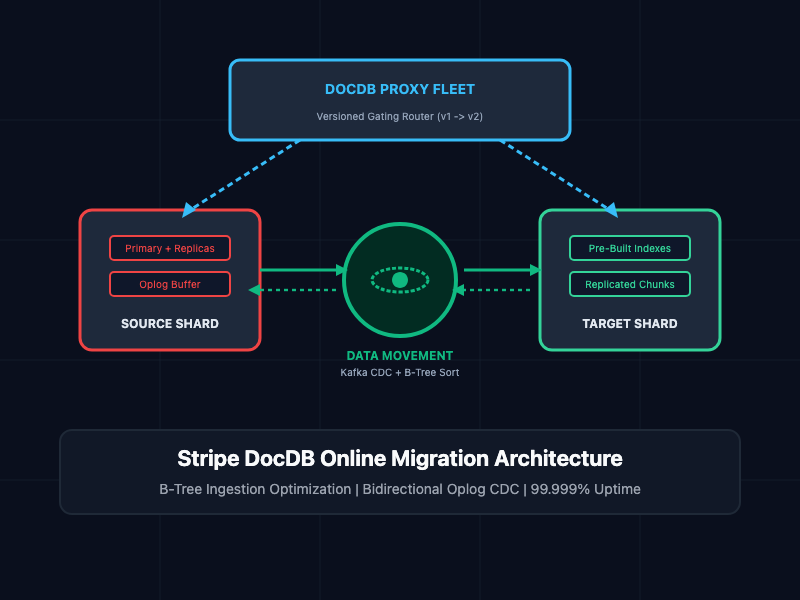
To migrate live data chunks between source and target shards without dropping client queries, the Data Movement Platform coordinates a six-phase execution lifecycle:
┌────────────────────────────────────────────────────────────────────────┐
│                      Stripe DocDB Proxy Fleet                          │
│               (Versioned Gating & Connection Routing)                  │
└──────────────────────────────────┬─────────────────────────────────────┘
                                   │
                     Traffic Cutover (Version N -> N+1)
                                   │
         ┌─────────────────────────┴─────────────────────────┐
         ▼                                                   ▼
┌──────────────────┐                               ┌──────────────────┐
│   Source Shard   │ ──── Oplog CDC Streaming ───► │   Target Shard   │
│ (Primary + Sec)  │                               │ (Primary + Sec)  │
│  - B-Tree Store  │ ◄─── Bidirectional Sync ───── │  - Pre-Indexed   │
└──────────────────┘                               └──────────────────┘
Step 1: Chunk Migration Registration
The migration coordinator writes an entry to the centralized Chunk Metadata Service, declaring the intent to migrate specific key ranges from the source shard to target shards. Before data transfer begins, the platform provisions the necessary collections on the target shard and builds all supporting secondary indexes upfront, ensuring that imported data is instantly queryable.
Step 2: Bulk Data Import with B-Tree Write Optimization
The platform captures a point-in-time snapshot of the target chunk on the source shard at timestamp T. A bulk import worker extracts and streams the data into the target shard.
During initial development, bulk loading millions of records caused severe disk I/O bottlenecks. Because the underlying storage engine utilizes a B-tree data structure to index documents, inserting randomly ordered keys forces continuous page splits, index fragmentation, and high random I/O write latency.
Stripe resolved this bottleneck by pre-sorting the data stream based on the collection's primary index keys prior to insertion. Inserting keys in sequential B-tree order maintains high spatial locality in memory, avoiding redundant page fetches and boosting write ingestion throughput by 10X.
Step 3: Asynchronous Change Data Capture (CDC) Replication
While the bulk import proceeds, the source shard continues serving live application writes. To reconcile modifications made after snapshot timestamp T, a dedicated asynchronous replication service reads mutations from the shard's operations log (oplog).
- Decoupled Event Transport: Rather than continuously querying the source shard directly—which would consume read capacity needed by production traffic—DocDB extracts the oplog via CDC pipelines into Apache Kafka and Amazon S3.
- Bidirectional Replication: The replication engine syncs mutations bidirectionally (source to target, and target back to source). Each write is explicitly tagged to avoid cyclical loop conditions. This guarantees that if a migration must be aborted post-cutover, traffic can immediately fall back to the source shard without data loss.
Step 4: Non-Blocking Correctness Verification
Once replication lag approaches zero, an automated verification service runs comprehensive data consistency checks. To prevent performance degradation on live primary nodes, the verification engine compares isolated point-in-time snapshots of the source and target datasets, validating that document counts, attributes, and cryptographic hashes match exactly.
Step 5: Versioned Gating Traffic Switch
The cutover phase represents the most critical step of the migration process. Rather than relying on fragile distributed locking, DocDB utilizes Versioned Gating:
- Client proxies continuously tag queries with an internal route version token (e.g., Version 1).
- The coordinator updates the routing service metadata to Version 2 and verifies that asynchronous replication lag is within sub-second thresholds.
- The database proxy tier polls metadata updates, pauses outbound dispatch momentarily (buffering client requests within their connection retry budget), updates its local routing tables, and releases buffered traffic to the target shard under Version 2.
- The cutover executes in milliseconds to less than 2 seconds, safely below application retry timeouts, ensuring zero dropped requests.
Step 6: Chunk Deregistration and Cleanup
Following a burn-in period where the target shard serves live traffic, the coordinator updates the metadata store to mark the migration complete. Secondary reverse-replication tasks are terminated, and source chunk records are asynchronously reclaimed via background compactions.
Implementation Patterns and Code Demos
1. Simulating B-Tree Presorted Bulk Ingestion (Python)
To demonstrate the mechanical advantage of write locality on indexed stores, the following script models the B-tree insertion optimization by presorting document batches based on compound index keys prior to dispatch:
import time
import uuid
from typing import List, Dict, Any

class BulkIngestionEngine:
    def __init__(self, index_key: str):
        self.index_key = index_key

    def prepare_chunk_for_fast_load(self, raw_documents: List[Dict[str, Any]]) -> List[Dict[str, Any]]:
        """
        Sorts raw document chunks in-memory by primary index attribute.
        Inserting presorted data eliminates B-tree leaf fragmentation
        and maximizes buffer cache hits on the database engine.
        """
        start_sort = time.perf_counter()

        # Sort documents based on the primary index attribute
        sorted_documents = sorted(raw_documents, key=lambda doc: doc.get(self.index_key, ""))

        sort_duration = (time.perf_counter() - start_sort) * 1000
        print(f"Presorted {len(raw_documents)} documents in {sort_duration:.2f}ms for B-tree locality.")
        return sorted_documents

    def execute_batched_stream(self, documents: List[Dict[str, Any]], batch_size: int = 1000):
        """Simulate sequential batch insertion with preserved locality."""
        total_docs = len(documents)
        for offset in range(0, total_docs, batch_size):
            batch = documents[offset : offset + batch_size]
            # Write to database driver
            self._write_to_storage_engine(batch)

    def _write_to_storage_engine(self, batch: List[Dict[str, Any]]):
        # Simulated database bulk write call
        pass

# Example Execution
if __name__ == "__main__":
    engine = BulkIngestionEngine(index_key="merchant_id")

    # Generate mock unsorted chunk dataset
    unsorted_chunk = [
        {"id": str(uuid.uuid4()), "merchant_id": f"acct_{i % 100:04d}", "amount": 2500}
        for i in range(100000)
    ]

    presorted_batch = engine.prepare_chunk_for_fast_load(unsorted_chunk)
    engine.execute_batched_stream(presorted_batch)
2. Versioned Gating Routing Protocol (Go)
The following Go implementation models the proxy-level Versioned Gating state machine, demonstrating how incoming client queries are routed and safely switched across migration boundaries:
package main

import (
	"context"
	"errors"
	"fmt"
	"sync"
	"sync/atomic"
	"time"
)

type ShardDestination string

const (
	SourceShard ShardDestination = "shard-primary-01"
	TargetShard ShardDestination = "shard-target-08"
)

// MigrationRouteState represents the active route state in the proxy
type MigrationRouteState struct {
	RouteVersion uint64
	ActiveShard  ShardDestination
	IsPaused     bool
}

type ProxyRouteManager struct {
	mu           sync.RWMutex
	stateVersion atomic.Uint64
	activeShard  ShardDestination
	isPaused     atomic.Bool
}

func NewProxyRouteManager() *ProxyRouteManager {
	manager := &ProxyRouteManager{
		activeShard: SourceShard,
	}
	manager.stateVersion.Store(1)
	return manager
}

// RouteQuery evaluates incoming client operations against active routing version
func (p *ProxyRouteManager) RouteQuery(ctx context.Context, queryID string) (ShardDestination, error) {
	// If cutover is actively gating requests, buffer briefly within client retry budget
	timeout := time.After(2 * time.Second)
	ticker := time.NewTicker(10 * time.Millisecond)
	defer ticker.Stop()

	for {
		if !p.isPaused.Load() {
			p.mu.RLock()
			dest := p.activeShard
			p.mu.RUnlock()
			return dest, nil
		}

		select {
		case <-ctx.Done():
			return "", ctx.Err()
		case <-timeout:
			return "", errors.New("query buffer timeout during traffic switch cutover")
		case <-ticker.C:
			// Retry loop until unpaused
		}
	}
}

// ExecuteTrafficCutover coordinates the versioned traffic switch
func (p *ProxyRouteManager) ExecuteTrafficCutover(target ShardDestination) {
	fmt.Println("Initiating versioned gating traffic cutover...")

	// Step 1: Briefly pause proxy dispatch (milliseconds)
	p.isPaused.Store(true)

	p.mu.Lock()
	// Step 2: Atomic state update
	p.activeShard = target
	p.stateVersion.Add(1)
	p.mu.Unlock()

	// Step 3: Unpause and flush buffered queries
	p.isPaused.Store(false)
	fmt.Printf("Traffic switched to %s under Route Version %d\n", target, p.stateVersion.Load())
}

func main() {
	proxy := NewProxyRouteManager()
	ctx := context.Background()

	dest, _ := proxy.RouteQuery(ctx, "q_1001")
	fmt.Println("Initial query routed to:", dest)

	// Execute cutover to target shard
	proxy.ExecuteTrafficCutover(TargetShard)

	destPost, _ := proxy.RouteQuery(ctx, "q_1002")
	fmt.Println("Subsequent query routed to:", destPost)
}
Architectural Comparison Matrix
| Dimension | Monolithic Sharding (Pre-DMP) | Managed Cloud DB (Atlas/mongos) | Stripe DocDB + DMP |
| Shard Sizing | 10TB - 30TB per shard | Variable per cluster tier | 500GB - 2TB optimized chunks |
| Migration Downtime | Minutes to hours (Planned outage) | Brief replica step-downs | Zero (Milliseconds version switch) |
| Ingestion Optimization | Standard sequential append | Engine default | 10X faster (B-tree presorted) |
| Replication Strategy | Standard primary-secondary | Intra-cluster oplog fetch | Oplog to Kafka/S3 with bidirectional sync |
| Fleet Consolidation | Manual maintenance scripts | Instance resizing downtime | Automated bin-packing (75% shard reduction) |
| Blast Radius | High (Multi-tenant shard failure) | Moderate | Minimal (Isolated micro-shards) |
SRE and Production Best Practices
- Enforce Strict Write Idempotency: Network interruptions during bulk imports or replication catch-ups can re-transmit records. All write transactions must execute with deterministic primary keys (_id) to ensure upsert operations are idempotent.
- Decouple CDC Extraction from Live Primary Nodes: Never run heavy CDC extraction queries directly against active database primaries. Extract operations logs via secondary nodes or forward oplog streams directly to distributed log buffers (e.g., Apache Kafka) to isolate production read/write throughput.
- Maintain Symmetrical Reverse-Replication: During any online migration, continuously replicate writes from the target shard back to the source shard until cutover verification is fully settled. This ensures an instantaneous rollback path without state divergence if unexpected anomalies emerge.
- Set Verification Boundaries on Isolated Snapshots: Running continuous validation queries against active tables can exhaust database I/O. Perform correctness verification by executing checksum validations against point-in-time storage snapshots or decoupled analytical replicas.
Getting Started
To implement zero-downtime data migrations in your distributed database architecture:
- Decouple the Proxy Layer: Introduce a routing proxy fleet between application microservices and backend database clusters to decouple connection management from physical shard locations.
- Implement Oplog Event Streaming: Configure Change Data Capture (CDC) pipelines to stream database mutation logs into Kafka topics, enabling decoupled event replay across physical hosts.
- Incorporate Presorted Ingestion: When migrating massive datasets into indexed B-tree or LSM stores, sort data by primary access keys before write execution to maximize buffer pool efficiency.
- Automate Versioned Gating: Implement route version tokens inside proxy dispatch headers to coordinate millisecond cutovers within client retry budgets.
By deploying an automated data movement platform, engineering teams eliminate monolithic database bottlenecks, dynamically adapt to global traffic fluctuations, and achieve five-nines availability across high-throughput financial infrastructure.