


The Compilation Bottleneck in Large Monorepos
As enterprise applications expand, managing build times in monolithic repositories (monorepos) becomes a critical engineering challenge. Traditional TypeScript build pipelines suffer from specific architectural limitations:
- Sequential Type Checking: The TypeScript compiler (tsc) historically processes files on a single thread to guarantee type safety across imported modules, leading to CPU starvation.
- Cascading Recompilations: Changing a single type definition in a core utility module can trigger a full-scope rebuild of downstream packages, even if the public-facing API boundary did not change.
- Unverified Metadata Operations: Attaching custom runtime annotations or metadata to decorated classes has traditionally relied on unstable, experimental reflection helpers.
- Loose Structural Boundaries: SREs and developers managing high-concurrency microservices occasionally encounter runtime crashes when implicit type casting masks object structural drift.
TypeScript 7.0 solves these scaling and performance concerns. By redesigning the compiler's core analyzer, standardizing robust ECMAScript metadata specifications, and separating type verification from declaration generation, the runtime eliminates building bottlenecks and improves type integrity.
What Is TypeScript 7.0?
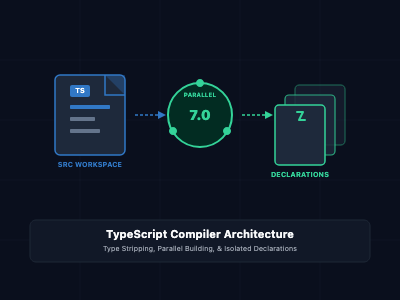
TypeScript 7.0 is a milestone release that transforms how the compiler processes source code. The core focus of this major version is the parallelization of declaration emits, allowing developer platforms to process independent sub-projects concurrently.
In addition to compilation performance upgrades, TypeScript 7.0 stabilizes advanced language mechanics, allowing developers to enforce nominal-like type boundaries, utilize type-safe class metadata natively, and reduce type check overhead in local watch loops.
Core Concepts and Architectural Changes
1. Parallel Isolated Declarations
To resolve sequential build chains, TypeScript 7.0 stabilizes the --isolatedDeclarations configuration flag. By requiring developers to explicitly declare public-facing type signatures on exported modules, the compiler can bypass the deep recursive type-checking phase when generating type declaration files (.d.ts).
This allows downstream packages to build in parallel, scaling monorepo build performance linearly with CPU core counts.
{
  "compilerOptions": {
    "target": "ES2026",
    "module": "NodeNext",
    "moduleResolution": "NodeNext",
    "strict": true,
    "isolatedDeclarations": true,
    "declaration": true,
    "emitDeclarationOnly": false,
    "skipLibCheck": true
  },
  "include": ["src/**/*"]
}
When isolatedDeclarations is set to true, the compiler strictly warns you if an export lacks an explicit type annotation:
// server.ts - Explicit types are now required for exports
export interface SystemMetric {
  cpuUsage: number;
  memoryUsage: number;
  timestamp: string;
}

// Valid: Explicit return type signature provided
export const getSystemStatus = (): SystemMetric => {
  return {
    cpuUsage: 45.2,
    memoryUsage: 256.4,
    timestamp: new Date().toISOString()
  };
};

// Error: Under isolatedDeclarations, implicit returns are forbidden for exports
export const getDatabaseStatus = () => {
  return { status: "ONLINE", connections: 12 };
};
2. Native Type-Safe Decorator Metadata
TypeScript 7.0 formally supports the ECMAScript Decorator Metadata proposal. This feature provides a dedicated, type-safe API context allowing decorators to easily associate static structured metadata with class constructors, properties, or methods without relying on global reflect-metadata libraries.
// decorator.ts - Safe Metadata Processing
type ContextMetadata = Record<string, unknown>;

function Route(path: string) {
  return function<T, A extends any[], R>(
    target: (...args: A) => R,
    context: ClassMethodDecoratorContext<T, (...args: A) => R>
  ) {
    // Assert metadata object exists in current context
    const metadata = context.metadata as ContextMetadata;
    metadata.route = path;
    return target;
  };
}

class UserController {
  @Route("/api/v1/users")
  getUsers(): string[] {
    return ["user1", "user2"];
  }
}

// Retrieve the attached metadata statically from the class constructor
const metadataSymbol = Symbol.metadata ?? Symbol.for("Symbol.metadata");
const classMetadata = (UserController as any)[metadataSymbol];

console.log(`Associated route endpoint: ${classMetadata?.route}`);
3. Strict Structural Object-Literal Matching
To protect applications from runtime payload issues, TypeScript 7.0 implements stricter validation routines for object literal assignments inside functions. The analyzer now rejects property-dropping assignments across implicit interfaces even when target schemas share structural baselines.
interface NetworkPacket {
  id: string;
  payload: string;
}

interface CustomPacket {
  id: string;
  payload: string;
  extraField: string;
}

function transmit(packet: NetworkPacket) {
  console.log(`Transmitting: ${packet.id}`);
}

const customData: CustomPacket = { id: "p-100", payload: "DATA", extraField: "METADATA" };

// Valid: Assigned via reference (structural typing applies)
transmit(customData);

// Error: TypeScript 7.0 blocks extra parameters on direct literals to prevent memory leak
transmit({
  id: "p-200",
  payload: "DATA",
  extraField: "METADATA"
});
Comparative Performance: TS 6.x vs. TS 7.0
Review the performance benchmarks and architectural deviations below to see how the new engine behaves:
| Metric / Dimension | TypeScript 6.x | TypeScript 7.0 | Architectural Impact |
| Incremental Monorepo Build Speed | Baseline | Up to 120% Faster | Parallelized dependency graphs |
| Declaration Generation | Sequential & slow | Parallel via isolatedDeclarations | Bypasses nested AST parsing |
| Decorator Standard | Legacy experimental annotations | Standard ES metadata | Native runtime engine execution |
| Type Narrowing Precision | Basic control-flow parsing | Strict union constraint matching | Zero unchecked variable slips |
| Idle Memory Consumption | Baseline | ~30% Reduced | Optimized garbage collection loop |
SRE and Development Best Practices
- Enforce Isolated Declarations on Shared Packages: Enable "isolatedDeclarations": true across internal shared libraries in your monorepos. This ensures independent packages can build parallelly without waiting for compiler type inferences.
- Transition to Standard ES Metadata: Refactor legacy decorators utilizing reflect-metadata imports to standard decorators leveraging native context.metadata. This reduces bundle weights and avoids potential security leaks.
- Lock Down TranspileOnly Pipelines: While tools like esbuild or ts-loader often bypass type checking for speed, continue to execute a native tsc --noEmit task inside your CI/CD pipelines to guarantee structural type validation.
- Enable Strict Null Assertions: Keep "strictNullChecks": true active alongside the updated TypeScript 7.0 compiler to prevent common reference pointer exceptions on complex array transformations.
Getting Started
To upgrade your project configurations and leverage the performance benefits of TypeScript 7.0:
# Step 1: Install or upgrade to TypeScript 7.0 globally or inside your workspace
npm install typescript@7.0.0 --save-dev

# Step 2: Validate the active compiler version
npx tsc --version

# Step 3: Run the initial type check suite with isolated declaration warnings active
npx tsc --noEmit --isolatedDeclarations
By transitioning to this modernized compilation paradigm, you eliminate sequential CPU blockers, standardize your application meta-programming via standard ES specifications, and ensure absolute type safety across your entire microservices architecture.