

The Problem of Cognitive Saturation and Narrow Context
Traditional large language models often struggle when deployed in complex workflows requiring both highly structured technical execution and deep, non-linear reasoning. When developer agents require models to manage large codebases, trace abstract dependencies, or write lengthy creative assets, older architectures suffer from cognitive saturation.
This saturation manifests as:
- Context Window Drift: Loss of adherence to initial system prompts over long conversations.
- High Latency Overhead: Slow processing of long-form outputs.
- Instruction Bleeding: Confusion when handling complex schemas alongside unstructured inputs.
- Inefficient Token Economics: High costs associated with re-transmitting static codebases or documentation on every API call.
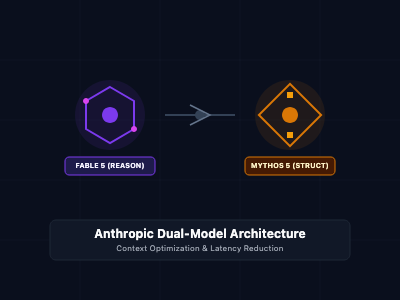
Anthropic solves these limitations with a dual-model release strategy, optimizing different neural paths for specific cognitive demands: Claude Fable 5 for long-form, highly contextual reasoning, and Mythos 5 for ultra-fast, deterministic agentic simulations.
Introducing Fable 5 and Mythos 5
Claude Fable 5: The Narrative and Deep Reasoning Engine
Claude Fable 5 is engineered for hyper-complex, multi-turn reasoning and synthetic data generation. It features an advanced attention mechanism that evaluates broad contextual relationships across a massive 500k token context window, making it the premier choice for parsing full software repositories, legal frameworks, and abstract system architectures.
Mythos 5: The Deterministic Agentic Optimizer
Mythos 5 is designed for latency-sensitive applications, structured output generation, and automated simulation loops. It features low-latency execution pipelines and high fidelity when adhering to rigid JSON schemas, allowing developers to run hundreds of autonomous operations per minute without sacrificing control.
Core Concepts and Integration Patterns
Implementing Prompt Caching for Financial Efficiency
To reduce API latency and minimize token consumption when working with static files (like API documentation, libraries, or base codebases), developers should leverage Anthropic's native prompt caching. This allows the system to cache large segments of the context window locally on the server side.
The following Python script demonstrates how to configure an API request utilizing prompt caching on Claude Fable 5:
import anthropic

client = anthropic.Anthropic()

# Configure system prompts with metadata designating the cache breakpoint
response = client.messages.create(
    model="claude-fable-5",
    max_tokens=4000,
    system=[
        {
            "type": "text",
            "text": "You are a senior systems architect. Analyze the provided codebase for architectural vulnerabilities.",
            "cache_control": {"type": "ephemeral"}
        }
    ],
    messages=[
        {
            "role": "user",
            "content": [
                {
                    "type": "text",
                    "text": "Review the following core server configuration file for security flaws: ... [Insert 100k lines of configuration here]"
                }
            ]
        }
    ]
)

print(response.content[0].text)
Enforcing Structured JSON Outlines on Mythos 5
When integrating Mythos 5 into automated agents, ensuring the response conforms to a strict database schema is critical. Mythos 5 supports native schema enforcement, preventing formatting discrepancies.
The following configuration example demonstrates how to enforce structured JSON output:
const Anthropic = require('@anthropic-ai/sdk');
const anthropic = new Anthropic();

async function main() {
  const msg = await anthropic.messages.create({
    model: "mythos-5",
    max_tokens: 1500,
    temperature: 0.1, // Low temperature for deterministic behavior
    system: "Return only valid JSON matching the requested schema.",
    messages: [
      {
        role: "user",
        content: "Analyze the database schema and identify indexes that need to be created. Output must be valid JSON."
      }
    ],
    response_format: {
      type: "json_object",
      schema: {
        type: "object",
        properties: {
          table_name: { type: "string" },
          missing_indexes: {
            type: "array",
            items: { type: "string" }
          },
          estimated_impact: { type: "string", enum: ["high", "medium", "low"] }
        },
        required: ["table_name", "missing_indexes", "estimated_impact"]
      }
    }
  });

  console.log(JSON.parse(msg.content[0].text));
}

main();
Comparative Analysis: Fable 5 vs. Mythos 5 vs. Legacy Models
To determine which model suits your application architecture, review the operational differences below:
| Dimension | Claude Fable 5 | Mythos 5 | Claude 3.5 Sonnet |
| Primary Focus | Deep reasoning, long-context analysis | Structured schemas, agentic speed | General purpose coding |
| Context Window | 500,000 tokens | 200,000 tokens | 200,000 tokens |
| Output Speed | Medium (~60 t/s) | Ultra-Fast (~150 t/s) | Fast (~80 t/s) |
| JSON Adherence | High | Flawless (Deterministic) | Moderate |
| Input Token Cost | $4.50 / Million | $2.00 / Million | $3.00 / Million |
| Output Token Cost | $18.00 / Million | $8.00 / Million | $15.00 / Million |
SRE and Development Best Practices
- Target Your Deployments: Route deep logical analysis, refactoring tasks, and planning phases to Claude Fable 5. Delegate execution tasks, quick-response operations, and structural formatting tasks to Mythos 5.
- Implement Strict Cache Boundaries: Ensure your largest static prompt blocks (e.g., framework docs, codebase maps, schema rules) are declared at the beginning of your system instructions and designated with cache headers.
- Set Low Temperature Metrics for Agents: When running Mythos 5 inside automated terminal tooling or CI/CD pipelines, keep temperatures below 0.3 to maximize format consistency and reduce hallucination rates.
- Sanitize Dynamic Contexts: Clear out system run-logs and previous multi-turn conversation steps that exceed immediate requirements to avoid carrying excessive state bloat across API calls.
Getting Started
To transition your development workflow to the new Anthropic suite, update your global SDK configurations to point to the newest models. Set your billing parameters, initialize your development environment, and configure your model routing wrapper to leverage both engines simultaneously for optimal balance between logic and speed.