


The Problem Go Solves
Before Go (Golang) emerged, systems engineers faced a difficult trade-off when selecting a development language:
- Compilation and Runtime Latency: Languages like Java or C++ offered execution speed but suffered from slow compilation times, heavy runtime footprints, or manual memory management complexities.
- Dynamic Language Performance Bottlenecks: Interpreted languages like Python or Node.js allowed rapid development but struggled to scale efficiently across multi-threaded, high-concurrency networked environments.
- Over-engineered Concurrency Models: Implementing multi-threading in older languages required complex thread locking, mutexes, and manual memory synchronization, creating critical race conditions and memory leak vectors.
Google designed Go in 2007 to eliminate these compromises. Go delivers the compilation and execution speed of C, the type safety of Java, and the clean readability of Python, combined with an elegant, built-in concurrency model designed for modern multicore processors.
What Is Go?
Go is an open-source, statically typed, compiled programming language. It is garbage-collected to prevent memory leaks but compiles directly to native machine code for maximum performance.
Go avoids complex object-oriented hierarchies in favor of composition via interfaces, keeping its language specification remarkably small (only 25 keywords). This simplicity makes Go exceptionally easy to learn and maintain, which is why it serves as the foundational language for the modern cloud-native ecosystem, powering tools like Docker, Kubernetes, Terraform, and Prometheus.
Core Concepts
1. Modules and Package Management
Go uses Go Modules to manage project dependencies. Instead of relying on global paths, every project defines its own dependency tree in a go.mod file.
Code Demo: Initializing a Module
# Initialize a new Go module inside your project directory
go mod init enterprise-api

# Add an external dependency (e.g., the Gin web framework)
go get -u github.com/gin-gonic/gin
This generates a go.mod file which declares your target dependencies deterministically:
// go.mod
module enterprise-api

go 1.26

require (
	github.com/gin-gonic/gin v1.10.0
)
2. Variables, Structs, and Static Typing
Go enforces strict type safety. You can declare variables explicitly or allow Go to infer the type during assignment using the short declaration operator (:=). Custom data schemas are defined using structures (struct).
Code Demo: Types and Struct Composition
package main

import "fmt"

// Define a structured model for server health
type ServerConfig struct {
	Port   int
	Secure bool
	Host   string
}

func main() {
	// Explicit declaration
	var isRunning bool = true

	// Implicit short declaration
	config := ServerConfig{
		Port:   8080,
		Secure: true,
		Host:   "127.0.0.1",
	}

	fmt.Printf("Server starting at %s:%d (Active: %t, Secure: %t)\n",
		config.Host, config.Port, isRunning, config.Secure)
}
3. Goroutines and Channels (Native Concurrency)
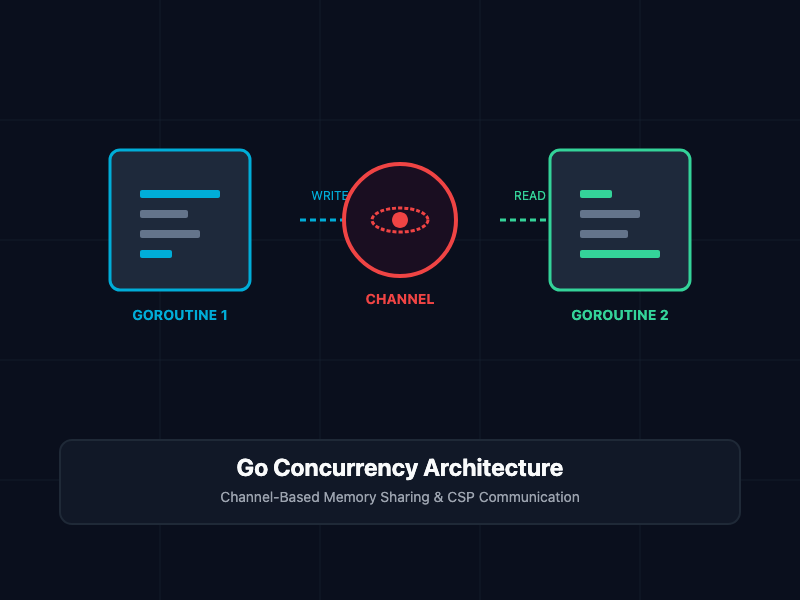
The defining feature of Go is its concurrency model, based on Communicating Sequential Processes (CSP). Instead of operating heavy OS-level threads, Go uses Goroutines — lightweight, green threads managed by the Go runtime that consume only a few kilobytes of memory.
Goroutines communicate safely without shared memory using Channels, preventing race conditions by design.
Code Demo: Concurrent Worker Pipelines
package main

import (
	"fmt"
	"time"
)

// Worker fetches metrics concurrently and sends them to a channel
func fetchMetrics(channel chan string) {
	time.Sleep(100 * time.Millisecond) // Simulate network call
	channel <- "Database metrics recovered: latency 5ms"
}

func main() {
	// Initialize a string-typed channel
	metricsChannel := make(chan string)

	// Launch a goroutine concurrently
	go fetchMetrics(metricsChannel)

	fmt.Println("Deploying independent worker...")

	// Block execution until data is received from the channel
	result := <-metricsChannel
	fmt.Println(result)
}
The Go Developer Workflow
The Go compiler ships with an integrated toolchain that handles formatting, testing, compiling, and running code out of the box:
1. go run
Compiles and runs your file immediately. Perfect for local prototyping and rapid verification loops:
go run main.go
2. go fmt
Enforces the official Go styling standard on all files in the directory, eliminating stylistic debates across development teams:
go fmt ./...
3. go build
Compiles your application into a single, self-contained binary executable containing all dependencies, requiring zero external runtimes to execute on the target server:
# Build for target host architecture
go build -o server_binary main.go

# Cross-compile for Linux from a different host OS
GOOS=linux GOARCH=amd64 go build -o server_linux main.go
Best Practices
- Keep Functions Small and Return Errors Explicitly: Go does not use try/catch blocks. Instead, functions return error values as their final return argument, which must be evaluated immediately.
- Never Share Memory to Communicate: Use channels to pass data between concurrent processes rather than using global variables locked behind mutexes.
- Avoid Overusing Interfaces: Declare interfaces only where composition is required, keeping abstraction layers thin and performance high.
- Set Explicit Concurrency Limits: When launching thousands of goroutines, manage worker pools to prevent resource exhaustion on downstream databases or API limits.
Getting Started
Install the Go toolchain from the official site, configure your terminal environment variables, and create your first directory. Initialize your module, write a simple main package, and run go build to generate your first native binary. Within minutes, you will have a high-performance system application that compiles instantly, runs safely, and consumes minimal compute overhead.