

The Challenge of Enterprise Telemetry and Key Management
As Node.js microservices scale across high-concurrency production clusters, engineering and SecOps teams run into structural runtime limitations:
- High-Overhead Application Profiling: Standard CPU and memory profiling tools introduce significant runtime latency, making deep event tracing difficult during live production incidents without distorting latency metrics.
- Hardware Security Module (HSM) Key Isolation: Managing cryptographic private keys stored inside external Hardware Security Modules (HSMs) or specialized PKCS#11 stores previously required complex C++ native bindings or raw system process calls.
- Resource Leakage in Custom Loaders: Dynamic module loaders and customized hooks frequently held onto open file descriptors and internal stream buffers without a standardized cleanup lifecycle.
- Incomplete Code Coverage Metrics: Native testing tools traditionally measured coverage based only on executed files, skewing metrics by omitting completely untested files from coverage reports.
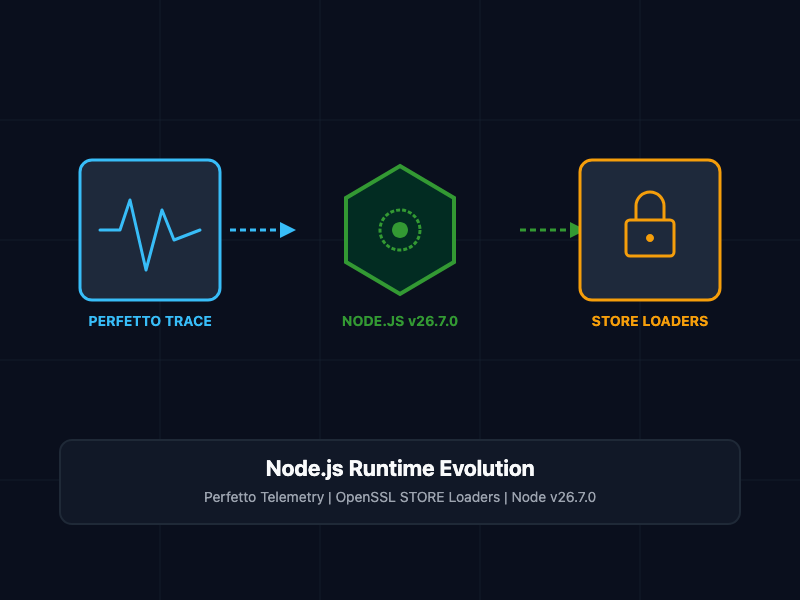
Node.js v26.7.0 addresses these operational challenges by embedding the Google Perfetto tracing SDK directly into the core binary, introducing OpenSSL STORE loader abstractions, supporting ECMAScript Explicit Resource Management in Module Hooks, and enhancing native testing harnesses.
What Is Node.js v26.7.0?
Node.js v26.7.0 is a feature update in the "Current" release line. It introduces several SEMVER-MINOR enhancements to core utilities, crypto bindings, performance profiling, and test harnesses.
By extending OpenSSL capabilities and embedding native system-level tracing, Node.js v26.7.0 equips SREs and backend engineers with fine-grained control over security hardware and low-overhead runtime diagnostic tools.
Core Concepts and Key Features
1. Native Perfetto Tracing Integration (lib)
Node.js v26.7.0 integrates the Google Perfetto SDK into the build pipeline. Perfetto provides a high-performance, low-overhead system-wide tracing infrastructure used across Linux, Android, and Chromium ecosystems.
This allows developers to capture low-level event traces across V8 garbage collection cycles, libuv event loop iterations, and asynchronous worker thread tasks with minimal performance penalty.
# Execute Node.js application with Perfetto tracing enabled
node --experimental-perfetto-trace server.mjs
2. Crypto Private Key Loading via STORE Loaders (node:crypto)
The node:crypto module now supports loading private keys directly through OpenSSL STORE loaders. This allows applications to reference keys stored in Hardware Security Modules (HSMs), smart cards, or PKCS#11 URIs without exposing raw private key buffers inside application heap memory.
// server_crypto.mjs - Loading keys via OpenSSL STORE loader URI
import { createSign } from 'node:crypto';

// Reference a private key stored inside a PKCS#11 HSM via STORE URI
const privateKeyUri = 'pkcs11:model=SecureHSM;token=ProductionKey;id=%01';

const signer = createSign('SHA256');
signer.update('Payload data needing cryptographic signature');

// Sign payload using the STORE loader reference
const signature = signer.sign({
  key: privateKeyUri,
  format: 'pem'
});

console.log(`Generated Signature Length: ${signature.length} bytes`);
3. Explicit Resource Management in Module Hooks (Symbol.dispose)
In alignment with the ECMAScript Explicit Resource Management specification, ModuleHooks in Node.js v26.7.0 implements Symbol.dispose. Custom module loaders can now automatically clean up background sockets, worker channels, and memory buffers when used alongside the JavaScript using keyword.
// loader_hooks.mjs - Explicit Resource Management in Module Hooks
import { register } from 'node:module';

class CustomModuleHook {
  constructor() {
    this.activeChannel = new MessageChannel();
  }

  // Symbol.dispose implementation for automatic resource cleanup
  [Symbol.dispose]() {
    this.activeChannel.port1.close();
    this.activeChannel.port2.close();
    console.log('ModuleHook resources released successfully.');
  }
}

// Scoped execution block utilizing explicit resource disposal
{
  using hook = new CustomModuleHook();
  // Execute module loading tasks within this block scope
}
// hook[Symbol.dispose]() is triggered automatically upon exiting the scope block
4. Extended Test Runner Coverage (--test-coverage-include-all)
The native Node.js test runner (node:test) now includes the --test-coverage-include-all flag. Previously, test coverage reports only included files that were imported during test execution. With this flag enabled, the test runner audits all matching source files in the workspace, accurately flagging completely untested source files.
# Execute native test runner including all unimported source files in coverage calculations
node --test --experimental-test-coverage --test-coverage-include-all
Comparative Feature Matrix
Review the architectural enhancements introduced in Node.js v26.7.0 compared to previous minor releases:
| Feature / Subsystem | Node.js v26.6.0 | Node.js v26.7.0 | Primary Operational Benefit |
| Performance Tracing | Standard V8 CPU profiler | Google Perfetto SDK integration | Low-overhead system-level tracing |
| Crypto Key Management | Memory buffer/PEM files | OpenSSL STORE URI loaders | Secure HSM and PKCS#11 key isolation |
| Module Hook Disposal | Manual cleanup calls | Native Symbol.dispose support | Prevents file descriptor and socket leaks |
| Test Coverage Auditing | Evaluated executed files only | --test-coverage-include-all | Accurate repository-wide coverage metrics |
| Root Certificates | Older NSS baseline | Updated NSS 3.125 trust store | Latest TLS root certificate validation |
Best Practices for Upgrading
- Isolate HSM Credentials: When utilizing OpenSSL STORE loaders, store PKCS#11 URIs and token descriptors in environment variables rather than hardcoding string paths inside application logic.
- Enforce Resource Disposal on Custom Loaders: Refactor dynamic loader plugins to implement Symbol.dispose to prevent memory leaks during hot-reloading development cycles.
- Integrate Full Coverage Flags into CI: Add --test-coverage-include-all to your continuous integration test suites to catch unimported dead code or missing test coverage early.
- Audit Perfetto Output Files: Store output Perfetto .trace files inside centralized observability stores (such as Grafana Tempo or Google Cloud Trace) for post-incident latency analysis.
Getting Started
To upgrade your local development workspace to Node.js v26.7.0 using Node Version Manager (nvm):
# Step 1: Install Node.js v26.7.0
nvm install 26.7.0

# Step 2: Set v26.7.0 as the active runtime version
nvm use 26.7.0

# Step 3: Confirm active binary version
node -v

# Step 4: Run test suite with full coverage reporting active
node --test --experimental-test-coverage --test-coverage-include-all
By leveraging these new low-level capabilities, you can build more secure cryptographic pipelines, analyze runtime latency with minimal overhead, and enforce accurate testing standards across your enterprise JavaScript services.