

Why Traditional Unit Testing Breaks Down for LLMs
In classical software engineering, testing functions is deterministic: given input X, assert that output Y equals an exact expected value (assert compute_discount(100) == 20).
When software integrates Large Language Models (LLMs), this verification paradigm breaks down completely:
- Non-Deterministic Outputs: Due to temperature sampling and token probability distributions, the same prompt can yield syntactically distinct yet semantically valid answers across different runs.
- Open-Ended Evaluation Space: A model might respond correctly to 95% of queries during demo trials, only to return confident hallucinations, invalid schema formatting, or unhelpful refusals when users introduce slight phrasing variations.
- Silent Quality Drift: Model provider updates, vector index adjustments in Retrieval-Augmented Generation (RAG), or prompt tweaks frequently introduce regressions in previously working edge cases without raising explicit runtime errors.
- The "Deploy and Pray" Anti-Pattern: Many teams build prototypes, test a few dozen queries manually, deploy to production, and discover critical failures only after customers report degraded experiences.
To build reliable AI products, engineering teams must transition from binary pass/fail assertions to continuous, automated evaluation pipelines that score outputs against calibrated benchmarks.
The Three-Layer Architecture of a Self-Evaluating AI System
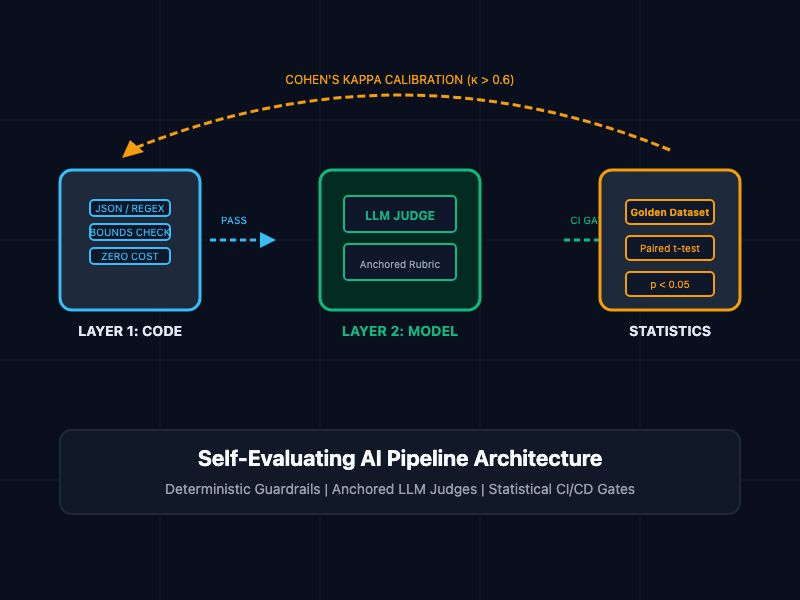
An enterprise-grade evaluation pipeline divides testing into three distinct layers, balancing execution speed, financial cost, and evaluative depth:
[ LLM Application Output ]
             │
             ▼
┌────────────────────────────────────────────────────────┐
│  Layer 1: Deterministic Checks (Code-Based)            │
│  - Instant, $0 cost, runs on 100% of outputs           │
│  - JSON schema validity, length bounds, regex, URLs    │
└───────────────────────────┬────────────────────────────┘
                            │ Pass
                            ▼
┌────────────────────────────────────────────────────────┐
│  Layer 2: LLM-as-a-Judge (Model-Graded)                │
│  - Evaluates relevance, accuracy, tone, and safety     │
│  - Structured JSON scoring against anchor rubrics      │
│  - Zero temperature, cheap judge model (gpt-4o-mini)   │
└───────────────────────────┬────────────────────────────┘
                            │ Periodic Sample
                            ▼
┌────────────────────────────────────────────────────────┐
│  Layer 3: Human Evaluation Loops (Calibration)         │
│  - Validates judge accuracy via Cohen's Kappa (κ > 0.6)│
│  - Curates and updates the regression golden dataset   │
└────────────────────────────────────────────────────────┘
- Layer 1: Deterministic Checks: Pure algorithmic assertions that run in milliseconds for zero API cost. These catch empty responses, token cutoff limits, malformed JSON, banned strings, and hallucinated links before spending compute on deeper evaluations.
- Layer 2: LLM-as-a-Judge: An automated model (typically an efficient, cost-effective reasoning engine like gpt-4o-mini or an isolated evaluator instance) scored against concrete, descriptive rubrics with fixed anchor points.
- Layer 3: Human-in-the-Loop Calibration: Periodic sampling where human domain experts score a subset of outputs to calibrate the automated judges using statistical agreement metrics such as Cohen's Kappa (K).
Core Concepts and Implementation
Layer 1: Building Deterministic and Heuristic Checks
Deterministic validation serves as the first line of defense. Skipping this step to rely solely on LLM judges wastes tokens on trivial syntax errors that standard Python logic can catch instantly.
The following Python class implements deterministic assertions checking for schema compliance, response boundaries, empty strings, and hallucinated URL domains:
# evals/layer1_deterministic.py
import json
import re
from typing import Dict, Any, List
from urllib.parse import urlparse

class DeterministicValidator:
    def __init__(self, allowed_domains: List[str] = None, min_length: int = 20, max_length: int = 2000):
        self.allowed_domains = allowed_domains or ["docs.yourcompany.com", "api.yourcompany.com"]
        self.min_length = min_length
        self.max_length = max_length

    def validate(self, output_text: str, expect_json: bool = False) -> Dict[str, Any]:
        """
        Executes zero-cost deterministic checks on model output.
        """
        issues = []

        # 1. Non-empty and length bounds check
        cleaned_text = output_text.strip()
        if not cleaned_text:
            return {"passed": False, "score": 0.0, "errors": ["Output is empty"]}

        if len(cleaned_text) < self.min_length:
            issues.append(f"Output too short ({len(cleaned_text)} chars; min is {self.min_length})")
        if len(cleaned_text) > self.max_length:
            issues.append(f"Output exceeded max length ({len(cleaned_text)} chars; max is {self.max_length})")

        # 2. JSON Syntax Validation (if requested)
        if expect_json:
            try:
                json.loads(cleaned_text)
            except json.JSONDecodeError as err:
                issues.append(f"Invalid JSON syntax: {str(err)}")

        # 3. Hallucinated URL and Link Verification
        extracted_urls = re.findall(r'https?://[^\s<>"]+|www\.[^\s<>"]+', cleaned_text)
        for url in extracted_urls:
            domain = urlparse(url).netloc
            if domain not in self.allowed_domains:
                issues.append(f"Unauthorized or potentially hallucinated domain detected: {domain}")

        # 4. Refusal and Token Truncation Checks
        refusal_patterns = [
            r"as an ai language model",
            r"i cannot fulfill this request",
            r"my knowledge cutoff"
        ]
        for pattern in refusal_patterns:
            if re.search(pattern, cleaned_text, re.IGNORECASE):
                issues.append(f"Generic model refusal detected matching pattern: '{pattern}'")

        has_passed = len(issues) == 0
        return {
            "passed": has_passed,
            "score": 1.0 if has_passed else 0.0,
            "errors": issues
        }
Layer 2: LLM-as-a-Judge with Anchored Rubrics
When evaluating subjective qualities—such as factual accuracy against a RAG retrieval context, clarity, and query adherence—model-graded evaluation is essential.
However, asking an LLM to "Rate this response from 1 to 5" without defined anchor points produces high variance: a score of 4 on one run may become a 2 on the next. Reliable LLM judges require three configuration rules:
- Temperature Zero: Force deterministic token selection to eliminate creative variance.
- Anchored Rubric Descriptions: Define explicit, observable criteria for every numerical score level.
- Structured JSON Output: Require reasoning fields before the numerical score so the judge constructs an evaluation chain-of-thought prior to scoring.
# evals/layer2_judge.py
import json
from openai import OpenAI
from typing import Dict, Any

class LLMJudge:
    def __init__(self, client: OpenAI = None, model: str = "gpt-4o-mini"):
        self.client = client or OpenAI()
        self.model = model

    def evaluate_response(self, query: str, context: str, response: str) -> Dict[str, Any]:
        """
        Grades an LLM output against an anchored factual accuracy rubric.
        """
        system_prompt = (
            "You are an impartial evaluation judge grading the factual accuracy and relevance "
            "of an AI assistant's response based strictly on the provided context.\n"
            "Score on a 1 to 5 scale using this exact rubric:\n"
            "Score 1: Completely incorrect, contradicts the context, or hallucinates core facts.\n"
            "Score 2: Contains major factual errors or misses the core question entirely.\n"
            "Score 3: Partially correct, but contains minor inaccuracies or unsupported extrapolations.\n"
            "Score 4: Factually accurate and supported by context, with minor omission of helpful detail.\n"
            "Score 5: Fully accurate, directly answers the query, and completely grounded in the context.\n\n"
            "You must respond with a JSON object containing:\n"
            "- reasoning: Step-by-step evaluation of the response against the rubric.\n"
            "- score: An integer value between 1 and 5.\n"
            "- passed: Boolean (true if score >= 4, false otherwise)."
        )

        user_content = f"""[Input Query]:
{query}

[Retrieved Context]:
{context}

[Model Response]:
{response}
"""

        api_response = self.client.chat.completions.create(
            model=self.model,
            temperature=0.0,
            response_format={"type": "json_object"},
            messages=[
                {"role": "system", "content": system_prompt},
                {"role": "user", "content": user_content}
            ]
        )

        raw_payload = api_response.choices[0].message.content
        return json.loads(raw_payload)
Layer 3: Regression Testing and Golden Dataset Management
A single test case cannot validate an AI system. Teams must curate a Golden Dataset representing:
- Core happy-path user questions (70%).
- Ambiguous or complex queries requiring deep synthesis (20%).
- Adversarial prompts, jailbreak attempts, and edge-case syntax (10%).
The complete evaluation orchestrator runs the full test suite across the golden dataset, collecting metrics into an aggregated execution report:
# evals/orchestrator.py
from typing import List, Dict, Any
from evals.layer1_deterministic import DeterministicValidator
from evals.layer2_judge import LLMJudge

class EvaluationOrchestrator:
    def __init__(self, validator: DeterministicValidator, judge: LLMJudge):
        self.validator = validator
        self.judge = judge

    def run_suite(self, test_cases: List[Dict[str, Any]], app_callback) -> Dict[str, Any]:
        results = []
        total_score = 0.0
        passed_count = 0

        for case in test_cases:
            query = case["query"]
            context = case.get("context", "")

            # Execute active application pipeline
            actual_response = app_callback(query, context)

            # 1. Run Layer 1 Deterministic Checks
            l1_result = self.validator.validate(actual_response)

            # If deterministic checks fail, fail fast without invoking judge
            if not l1_result["passed"]:
                results.append({
                    "query": query,
                    "response": actual_response,
                    "layer1": l1_result,
                    "layer2": None,
                    "final_score": 1.0,
                    "passed": False
                })
                total_score += 1.0
                continue

            # 2. Run Layer 2 LLM-as-a-Judge Evaluation
            l2_result = self.judge.evaluate_response(query, context, actual_response)
            final_score = l2_result["score"]
            is_passed = l2_result["passed"]

            if is_passed:
                passed_count += 1
            total_score += final_score

            results.append({
                "query": query,
                "response": actual_response,
                "layer1": l1_result,
                "layer2": l2_result,
                "final_score": final_score,
                "passed": is_passed
            })

        sample_size = len(test_cases)
        return {
            "total_cases": sample_size,
            "pass_rate": round((passed_count / sample_size) * 100, 2),
            "average_score": round(total_score / sample_size, 2),
            "case_results": results
        }
Verifying Improvements with Statistical Significance
When a prompt engineer adjusts a system instruction or changes the underlying model from Claude 3.5 Sonnet to GPT-4o, the average score across an 80-question golden dataset might increase from 3.85 to 4.02.
Is this a real performance upgrade, or is it random sampling noise?
To prevent shipping phantom improvements, apply a paired Student's t-test on identical question pairs before and after the modification. If the resulting P-value is below the standard threshold (P < 0.05), the performance delta is statistically significant.
# evals/statistical_testing.py
import numpy as np
from scipy import stats
from typing import List, Dict, Any

def verify_improvement_significance(baseline_scores: List[float], new_scores: List[float]) -> Dict[str, Any]:
    """
    Executes a two-sided paired t-test on identical test cases
    to confirm performance gains are statistically significant.
    """
    if len(baseline_scores) != len(new_scores):
        raise ValueError("Both evaluation runs must contain an identical number of test cases.")

    baseline_mean = np.mean(baseline_scores)
    new_mean = np.mean(new_scores)
    score_delta = new_mean - baseline_mean

    # Paired Student's t-test calculation
    t_stat, p_value = stats.ttest_rel(new_scores, baseline_scores)

    # p < 0.05 denotes a statistically significant delta
    is_significant = (p_value < 0.05) and (score_delta > 0)

    return {
        "baseline_mean": round(float(baseline_mean), 3),
        "new_mean": round(float(new_mean), 3),
        "score_delta": round(float(score_delta), 3),
        "t_statistic": round(float(t_stat), 4),
        "p_value": round(float(p_value), 5),
        "statistically_significant": is_significant,
        "verdict": "DEPLOY_UPGRADE" if is_significant else "NOISE_DETECTED"
    }

# Example Usage
if __name__ == "__main__":
    baseline = [4, 3, 5, 2, 4, 3, 5, 4, 3, 4] * 5  # 50 samples
    optimized = [5, 4, 5, 3, 4, 4, 5, 5, 4, 5] * 5 # 50 samples
    report = verify_improvement_significance(baseline, optimized)
    print(json.dumps(report, indent=2))
Calibrating the Judge with Cohen's Kappa
To ensure that your automated Layer 2 judge reflects human judgment, measure inter-annotator agreement between human reviewers and the LLM judge using Cohen's Kappa (K):

Where Po represents the relative observed agreement, and Pe is the hypothetical probability of chance agreement. A score of K > 0.60 denotes substantial agreement. If K < 0.40, the scoring rubric itself is ambiguous and must be refined with clearer anchor definitions before trusting the judge.
from sklearn.metrics import cohen_kappa_score

def calibrate_judge_alignment(human_scores: List[int], judge_scores: List[int]) -> float:
    """Calculates Cohen's Kappa to measure human vs LLM judge agreement."""
    return float(cohen_kappa_score(human_scores, judge_scores))
Architectural Comparison Matrix
| Evaluation Layer | Primary Goal | Latency Profile | Cost Profile | False-Negative Rate |
| Layer 1: Deterministic Checks | Syntax, format, length, refusals | Sub-millisecond (<5 ms) | $0.00 (Local CPU) | High (Misses semantics) |
| Layer 2: LLM-as-a-Judge | Accuracy, grounding, tone, intent | 500 ms - 2s | Low (~ $0.001/call) | Low (Rubric dependent) |
| Layer 3: Human Calibration | Ground truth, rubric calibration | Days / Scheduled reviews | High (Analyst salaries) | Near zero |
| End-to-End Suite | Full CI/CD regression protection | 1 - 3 minutes (batch) | Managed / predictable | Comprehensive |
SRE and Production Best Practices
- Fail Fast on Layer 1: Never call an expensive LLM judge if the application output fails basic JSON parsing or returns an empty string. Circuit-break the evaluation early to preserve API budgets.
- Isolate Evaluator Context: The model evaluating the response must never be the same runtime context that generated the response. Use an independent judge model (gpt-4o-mini, claude-3-haiku) with zero temperature.
- Wire Evals into CI/CD Merge Gates: Run the evaluation suite against your golden dataset on every Git pull request. Block merges if average scores drop by more than $0.1$ or if any hard safety checks fail.
- Enforce Logit / JSON Constraints on Evaluators: Set response_format={"type": "json_object"} on judge endpoints. Never parse numerical scores out of unstructured markdown text with regular expressions.
- Version Golden Datasets with Code: Store your golden evaluation dataset (golden_cases.jsonl) inside your repository under version control. When fixing bugs, commit new edge cases alongside the code changes.
Getting Started
To launch an automated evaluation pipeline locally:
# Step 1: Install core evaluation dependencies
pip install openai scipy scikit-learn numpy

# Step 2: Configure API access for the judge model
export OPENAI_API_KEY="sk-proj-your-key-here"

# Step 3: Run the local test evaluation runner
python -m evals.orchestrator

# Step 4: Run statistical validation comparing two prompt iterations
python -m evals.statistical_testing
By decoupling generative output generation from multi-tier evaluation, engineering teams eliminate guesswork, protect against silent regressions, and deploy LLM applications with deterministic reliability.