

The Problem: Why One Processor Can No Longer Do It All
In the early days of computing, the Central Processing Unit (CPU) handled every computation—from OS orchestration to math calculations. However, the rise of modern Artificial Intelligence and Large Language Models (LLMs) exposed critical hardware bottlenecks:
- Sequential execution limits: Traditional CPUs process instructions sequentially or across a small number of cores, making them painfully slow for massive matrix multiplication.
- Extreme energy & cost consumption: Training multi-billion parameter models on general-purpose hardware burns massive amounts of power and stalls time-to-market.
- Latency spikes in real-time inference: Serving LLMs to millions of concurrent users requires deterministic, low-latency processing that traditional caching layers cannot support.
- Host CPU overhead: Network encryption, packet filtering, and storage routing consume CPU cycles that should be dedicated to application logic and model orchestration.
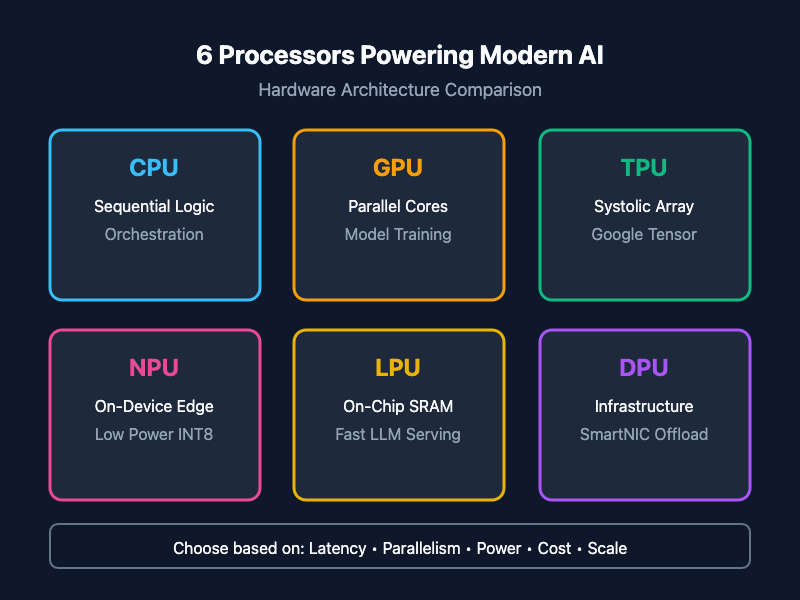
To solve these distinct compute challenges, modern AI infrastructure relies on a specialized silicon ecosystem across 6 core processor types: CPU, GPU, TPU, NPU, LPU, and DPU.
Deep-Dive: The 6 AI Silicon Architectures
+-------------------------------------------------------------------------+
|                              CPU (Backbone)                             |
|          General Purpose • Sequential Processing • Orchestration        |
+-------------------------------------------------------------------------+
       │                      │                      │              │
       v                      v                      v              v
+--------------+       +--------------+       +--------------+ +--------------+
|     GPU      |       |     TPU      |       |     LPU      | |     NPU      |
| Parallel Dev |       | Tensor Math  |       | Real-Time    | | Edge / Mobile|
| & Training   |       | Google-Scale |       | Deterministic| | Low Power    |
+--------------+       +--------------+       +--------------+ +--------------+
                                                     │
                                                     v
                                              +---------------+
                                              |     DPU       |
                                              | Infrastructure|
                                              | SmartNIC      |
                                              +---------------+
1. CPU (Central Processing Unit) — The Backbone
The CPU is the general-purpose brain of the computer. It excels at complex single-thread logic, operating system execution, and orchestrating work across secondary hardware accelerators.
- Workflow: User Request => CPU Schedules => Routes to correct processor => Manages I/O => Returns Result
- Pros:Handles any general computing task.Best single-threaded execution performance.Runs the primary operating system and pipeline orchestration.
- Handles any general computing task.
- Best single-threaded execution performance.
- Runs the primary operating system and pipeline orchestration.
- Cons:Slow at parallel linear algebra and matrix math.Cannot efficiently train large neural networks.Low throughput for high-dimensional AI workloads.
- Slow at parallel linear algebra and matrix math.
- Cannot efficiently train large neural networks.
- Low throughput for high-dimensional AI workloads.
2. GPU (Graphics Processing Unit) — Massive Parallelism
Dominated by NVIDIA (CUDA ecosystem), GPUs pack thousands of smaller cores designed to execute floating-point operations in parallel. They are the gold standard for deep learning model training and heavy inference.
- Workflow: Load Model => Distribute across 16,896 cores => Matrix Multiply => Backpropagate => Update Weights
- Pros:Massive parallel execution capabilities.Suitable for both training and complex inference.Mature software ecosystem (NVIDIA CUDA, PyTorch, TensorRT).
- Massive parallel execution capabilities.
- Suitable for both training and complex inference.
- Mature software ecosystem (NVIDIA CUDA, PyTorch, TensorRT).
- Cons:High power consumption (~700W per flagship chip).Extremely expensive ($30,000 + per H100 GPU).Overkill and power-inefficient for small edge tasks.
- High power consumption (~700W per flagship chip).
- Extremely expensive ($30,000 + per H100 GPU).
- Overkill and power-inefficient for small edge tasks.
3. TPU (Tensor Processing Unit) — Google's Custom Silicon
Designed by Google specifically for neural network machine learning, TPUs utilize a Systolic Array architecture to stream matrix math across hardware in lockstep without constantly reading from memory registers.
- Workflow: Load Model => Systolic Array processes data in lockstep => Matrix ops on-chip => Pod scales to 9,216 TPUs => Trained Model
- Pros:Up to 2X cheaper than traditional GPU clusters.2 X - 3X better performance-per-watt efficiency.Scalable up to 9,216 TPUs in a single pod architecture.
- Up to 2X cheaper than traditional GPU clusters.
- 2 X - 3X better performance-per-watt efficiency.
- Scalable up to 9,216 TPUs in a single pod architecture.
- Cons:Vendor lock-in (Google Cloud Platform only).Less general-purpose flexibility than GPUs.Limited custom framework support outside PyTorch/XLA and TensorFlow.
- Vendor lock-in (Google Cloud Platform only).
- Less general-purpose flexibility than GPUs.
- Limited custom framework support outside PyTorch/XLA and TensorFlow.
4. NPU (Neural Processing Unit) — AI in Your Pocket
NPUs are specialized, low-power chips integrated into mobile devices, laptops, and IoT hardware (e.g., Apple Neural Engine, Qualcomm Hexagon) for handling quantized, on-device AI tasks.
- Workflow: User Input => On-device NPU activates (no cloud) => INT8/INT4 Quantized Execution => Inference in ms => Instant Response
- Pros:Extremely efficient single-digit watt power draw.Ultra-low cloud latency (~5ms local turnaround).Privacy-first design: personal user data never leaves the device.
- Extremely efficient single-digit watt power draw.
- Ultra-low cloud latency (~5ms local turnaround).
- Privacy-first design: personal user data never leaves the device.
- Cons:Dedicated to inference only (cannot train models).Strictly limited memory and model size boundaries.Slightly lower output accuracy due to INT8/INT4 quantization.
- Dedicated to inference only (cannot train models).
- Strictly limited memory and model size boundaries.
- Slightly lower output accuracy due to INT8/INT4 quantization.
5. LPU (Language Processing Unit) — Ultra-Fast Real-Time Inference
Developed by Groq, LPUs replace traditional DRAM/HBM memory channels with massive on-chip SRAM memory ($230\text{MB}$ per chip). This eliminates memory bandwidth bottlenecks, providing deterministic, lightning-fast LLM token generation.
- Workflow: Prompt Input => Weights loaded from on-chip SRAM (zero cache miss) =>Deterministic Execution => 241 tokens/sec => 500 words in ~1s
- Pros:World-record real-time inference speed (241 + tokens/sec).Zero cache misses and zero memory access bottlenecks.Deterministic execution timing.
- World-record real-time inference speed (241 + tokens/sec).
- Zero cache misses and zero memory access bottlenecks.
- Deterministic execution timing.
- Cons:Designed exclusively for inference (no training).Small SRAM memory capacity per chip requires linking hundreds of chips for large LLMs.
- Designed exclusively for inference (no training).
- Small SRAM memory capacity per chip requires linking hundreds of chips for large LLMs.
6. DPU (Data Processing Unit) — The Invisible Infrastructure Layer
Also known as SmartNICs, DPUs offload networking, security, storage routing, and virtualization management tasks away from the main host CPU, freeing system memory and compute cycles strictly for AI logic.
- Workflow: Network Traffic => DPU intercepts at hardware level => Hardware Encryption & Firewall => Storage I/O Routing => CPU freed for AI Workloads
- Pros:Reclaims host CPU performance for core application logic.Hardware-isolated security, zero-trust firewalls, and line-rate encryption.Supports high-throughput 400Gb/s datacenter networking.
- Reclaims host CPU performance for core application logic.
- Hardware-isolated security, zero-trust firewalls, and line-rate encryption.
- Supports high-throughput 400Gb/s datacenter networking.
- Cons:Not applicable for consumer or edge hardware.Complex low-level system configuration.Highly specialized datacenter use case.
- Not applicable for consumer or edge hardware.
- Complex low-level system configuration.
- Highly specialized datacenter use case.
Quick Comparison Matrix
| Processor | Primary Strength | Power Draw | Key Architecture Feature | Primary Use Case |
| CPU | General purpose & sequential logic | Moderate (65W-350W) | High clock speed, complex registers | OS Orchestration & Preprocessing |
| GPU | Massive parallel computation | Very High (300W-700W) | Thousands of CUDA/Stream Cores | Deep Learning Training & Heavy Inference |
| TPU | Ultra-efficient matrix math | Moderate to High | Systolic Array Matrix Multiplication | Google-Scale Model Workloads |
| NPU | Low-power on-device execution | Minimal (1W-15W) | INT8/INT4 Quantized Tensor Cores | Edge & Mobile AI Inference |
| LPU | High-speed LLM generation | High (Cluster-scale) | On-chip SRAM (230MB/chip) | Real-Time LLM Token Serving |
| DPU | Infrastructure offloading | Low to Moderate | SmartNIC Hardware Acceleration | Datacenter Networking & Security |
Decision Matrix: When Should You Use Which?
Selecting the right processor depends directly on your system constraints regarding latency, parallelism, power budget, and infrastructure scale:
- Use CPU when: You are managing overall application logic, API routing, database interactions, and preprocessing inputs before sending them to accelerators.
- Use GPU when: You need to train complex generative models from scratch, fine-tune open weights (e.g., Llama, Mistral), or require maximum software ecosystem support.
- Use TPU when: You operate primarily on Google Cloud Platform and need high-throughput, cost-efficient matrix math scaling across huge clusters.
- Use NPU when: You are shipping on-device mobile applications, smart wearables, or privacy-sensitive desktop software where data must remain local.
- Use LPU when: You are building real-time interactive conversational AI, voice agents, or auto-complete tools requiring zero-latency response times.
- Use DPU when: You are managing high-density AI cloud infrastructure or hyperscale datacenters that require hardware-level security, encryption, and 400Gb/s packet routing.
Getting Started
To optimize your AI stack, audit your current bottlenecks:
- Offload heavy model training and batched inference to GPUs or TPUs.
- Deploy real-time user-facing chat applications to LPU endpoints or quantized NPUs.
- Reclaim system overhead on your cloud servers using DPUs for networking, leaving your CPUs free to coordinate orchestrations cleanly!