

The Danger of Dual-Writes in Distributed Microservices
In event-driven microservice architectures, application services frequently need to update a local database and publish an event notification to a message broker (such as Kafka, RabbitMQ, or AWS SNS) within the same logical workflow.
Executing both operations sequentially inside a standard HTTP request handler—known as the dual-write anti-pattern—introduces critical failure modes:
- Broker Unavailability After DB Commit: The application successfully commits changes to the primary database, but the network request to the message broker fails or times out. Downstream services never receive the event, resulting in lost data synchronization.
- Process Crashes Between Writes: The application publishes the message event successfully, but the Node.js process crashes (or loses database connectivity) before executing the local database commit. Downstream services process a ghost event that does not exist in the primary ledger.
- Partial Transaction Failure: Neither databases nor standard message brokers share a unified distributed transaction boundary (2PC/Two-Phase Commit). Without atomic coordination, distributed state drift is inevitable.
To achieve reliable eventual consistency without heavy, slow distributed transaction locks, software engineers implement the Transactional Outbox Pattern.
What Is the Transactional Outbox Pattern?
The Transactional Outbox Pattern eliminates dual-write race conditions by leveraging the ACID guarantees of relational databases (such as PostgreSQL or MySQL).
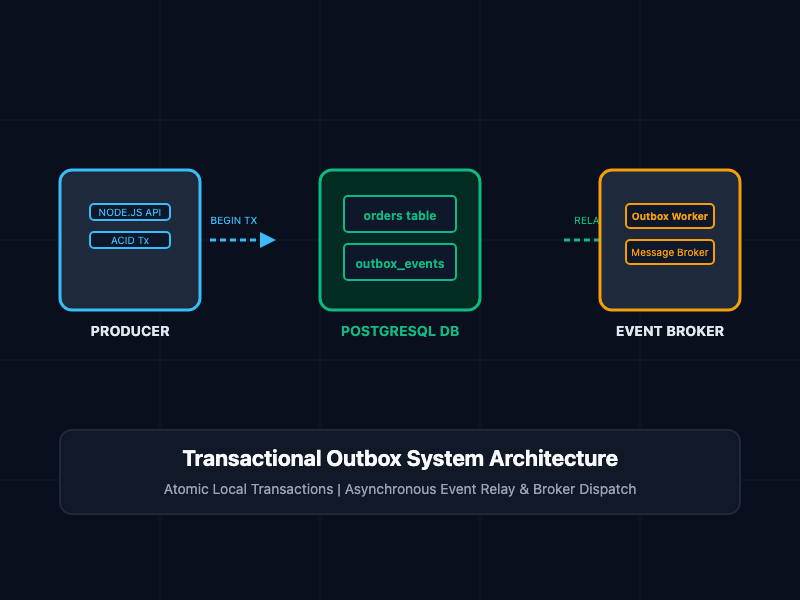
Instead of sending messages directly to an external broker during the HTTP request lifecycle, the application writes both the primary business record and the outbound event payload into a dedicated outbox_events database table within a single atomic database transaction.
A separate, asynchronous background process (the Outbox Relay Worker) continuously polls or streams events from the outbox_events table, publishes them to the message broker, and marks them as processed upon successful delivery.
[ HTTP Request ]
       │
       ▼
┌────────────────────────────────────────────────────────┐
│  Node.js API Handler                                   │
│  BEGIN DB TRANSACTION                                  │
│    ├── 1. INSERT INTO orders (...)                     │
│    └── 2. INSERT INTO outbox_events (...)              │
│  COMMIT DB TRANSACTION                                 │
└────────────────────────────────────────────────────────┘
       │
       ▼ (ACID Guaranteed)
┌────────────────────────────────────────────────────────┐
│  PostgreSQL Storage Engine                             │
│    ├── Table: orders                                   │
│    └── Table: outbox_events (Status: PENDING)          │
└────────────────────────────────────────────────────────┘
       ▲
       │ Polling / CDC
┌────────────────────────────────────────────────────────┐
│  Outbox Relay Worker (Node.js Process)                 │
│    ├── 1. Read PENDING outbox_events                   │
│    ├── 2. Publish to RabbitMQ / Kafka                  │
│    └── 3. UPDATE outbox_events SET status = 'PUBLISHED'│
└────────────────────────────────────────────────────────┘
Core Concepts and Implementation
1. Defining the Database Schema (PostgreSQL)
To track outbound state transitions, establish a dedicated outbox_events table alongside your primary business tables.
-- Migration: Create orders and outbox_events schema
CREATE TABLE orders (
    id UUID PRIMARY KEY,
    customer_id VARCHAR(64) NOT NULL,
    amount NUMERIC(10, 2) NOT NULL,
    status VARCHAR(32) NOT NULL,
    created_at TIMESTAMPTZ DEFAULT CURRENT_TIMESTAMP
);

CREATE TABLE outbox_events (
    id UUID PRIMARY KEY DEFAULT gen_random_uuid(),
    aggregate_type VARCHAR(64) NOT NULL,
    aggregate_id VARCHAR(64) NOT NULL,
    event_type VARCHAR(64) NOT NULL,
    payload JSONB NOT NULL,
    status VARCHAR(32) DEFAULT 'PENDING' NOT NULL,
    retry_count INT DEFAULT 0 NOT NULL,
    error_message TEXT,
    created_at TIMESTAMPTZ DEFAULT CURRENT_TIMESTAMP,
    processed_at TIMESTAMPTZ
);

-- Index to optimize outbox worker polling queries
CREATE INDEX idx_outbox_pending ON outbox_events (status, created_at)
WHERE status = 'PENDING';
2. Atomic Order Creation and Outbox Event Insertion
In the Node.js API service, execute order insertion and outbox event persistence inside a single PostgreSQL client transaction using pg or an ORM/query builder.
// src/services/order.service.ts
import { Pool, PoolClient } from 'pg';
import { v4 as uuidv4 } from 'uuid';

export class OrderService {
  constructor(private readonly dbPool: Pool) {}

  async createOrder(customerId: string, amount: number): Promise(string) {
    const orderId = uuidv4();
    const client: PoolClient = await this.dbPool.connect();

    try {
      // 1. Begin atomic database transaction
      await client.query('BEGIN');

      // 2. Insert order entity
      const insertOrderQuery = `
        INSERT INTO orders (id, customer_id, amount, status)
        VALUES ($1, $2, $3, $4)
      `;
      await client.query(insertOrderQuery, [orderId, customerId, amount, 'CREATED']);

      // 3. Insert outbox event payload into the SAME transaction
      const outboxPayload = {
        orderId,
        customerId,
        amount,
        timestamp: new Date().toISOString()
      };

      const insertOutboxQuery = `
        INSERT INTO outbox_events (aggregate_type, aggregate_id, event_type, payload)
        VALUES ($1, $2, $3, $4)
      `;
      await client.query(insertOutboxQuery, [
        'ORDER',
        orderId,
        'ORDER_CREATED',
        JSON.stringify(outboxPayload)
      ]);

      // 4. Commit atomic transaction
      await client.query('COMMIT');
      return orderId;
    } catch (error) {
      // Roll back both operations if either step fails
      await client.query('ROLLBACK');
      console.error('Failed to create order and outbox event atomically:', error);
      throw error;
    } finally {
      client.release();
    }
  }
}
3. The Asynchronous Outbox Relay Worker Process
The outbox relay process runs independently from the HTTP API. It polls the database for PENDING records, dispatches payloads to RabbitMQ with confirmation checks, and marks events as PUBLISHED.
// src/workers/outbox-relay.ts
import { Pool } from 'pg';
import amqp, { Channel } from 'amqplib';

export class OutboxRelayWorker {
  private isRunning = false;

  constructor(
    private readonly dbPool: Pool,
    private readonly amqpChannel: Channel,
    private readonly exchangeName: string
  ) {}

  async start(pollIntervalMs = 2000): Promise<void> {
    this.isRunning = true;
    console.log('Outbox Relay Worker initialized successfully.');

    while (this.isRunning) {
      try {
        await this.processPendingEvents();
      } catch (error) {
        console.error('Error in outbox processing loop:', error);
      }
      await new Promise((resolve) => setTimeout(resolve, pollIntervalMs));
    }
  }

  private async processPendingEvents(): Promise(void) {
    // Select pending events with explicit row locking (SKIP LOCKED prevents concurrent worker race conditions)
    const selectQuery = `
      SELECT id, aggregate_type, event_type, payload
      FROM outbox_events
      WHERE status = 'PENDING'
      ORDER BY created_at ASC
      LIMIT 50
      FOR UPDATE SKIP LOCKED
    `;

    const client = await this.dbPool.connect();

    try {
      await client.query('BEGIN');
      const result = await client.query(selectQuery);

      for (const event of result.rows) {
        const routingKey = `${event.aggregate_type.toLowerCase()}.${event.event_type.toLowerCase()}`;
        const messageBuffer = Buffer.from(JSON.stringify(event.payload));

        // Publish to message broker
        const published = this.amqpChannel.publish(
          this.exchangeName,
          routingKey,
          messageBuffer,
          {
            persistent: true,
            messageId: event.id,
            contentType: 'application/json'
          }
        );

        if (published) {
          // Update event status to PUBLISHED upon successful dispatch
          const updateQuery = `
            UPDATE outbox_events
            SET status = 'PUBLISHED', processed_at = CURRENT_TIMESTAMP
            WHERE id = $1
          `;
          await client.query(updateQuery, [event.id]);
        } else {
          throw new Error(`Broker rejected publish for outbox event ID: ${event.id}`);
        }
      }

      await client.query('COMMIT');
    } catch (error) {
      await client.query('ROLLBACK');
      throw error;
    } finally {
      client.release();
    }
  }

  stop(): void {
    this.isRunning = false;
  }
}
Comparative Analysis: Direct Dual-Write vs. Transactional Outbox
| Architectural Dimension | Direct Dual-Write Pattern | Transactional Outbox Pattern |
|---|---|---|
| Data Consistency | Volatile (High risk of state drift) | Eventually Consistent (Guaranteed) |
| Transaction Boundary | Non-existent (Two separate systems) | Atomic Local Database Transaction |
| Failure Mode Impact | Lost events or ghost database records | Retained pending events in outbox table |
| API Latency Overhead | High (Waits for broker ACK) | Low (Only waits for local DB commit) |
| Message Delivery Guarantee | Best-effort | At-Least-Once Delivery |
| System Complexity | Low initial code complexity | Moderate (Requires relay process & cleanup) |
SRE and Production Best Practices
- Enforce At-Least-Once Consumer Idempotency: Because the outbox relay guarantees at-least-once delivery, consumers may occasionally receive duplicate messages during network retries. Ensure all downstream event handlers check an event ID deduplication cache (e.g., Redis SETNX) before executing business operations.
- Use FOR UPDATE SKIP LOCKED: When scaling out outbox relay worker instances across multiple nodes, always append FOR UPDATE SKIP LOCKED to your database polling queries to prevent worker lock contention and duplicate publishing attempts.
- Implement Outbox Partitioning or Archiving: Retaining millions of PUBLISHED rows in the outbox_events table slows down index lookups. Schedule a automated cleanup task (or partition table by date) to purge processed records older than 7 days.
- Transition to Change Data Capture (CDC) at Scale: For high-throughput applications processing tens of thousands of transactions per second, replace polling loops with Change Data Capture tools (such as Debezium) that stream PostgreSQL Write-Ahead Logs (WAL) directly into Kafka without hitting query engines.
Getting Started
To launch a local sandbox testing environment with PostgreSQL and RabbitMQ using Docker Compose:
# Step 1: Initialize local environment stack
docker run -d --name postgres-outbox \
  -e POSTGRES_PASSWORD=postgres \
  -e POSTGRES_DB=orders_db \
  -p 5432:5432 postgres:16-alpine

docker run -d --name rabbitmq-outbox \
  -p 5672:5672 -p 15672:15672 \
  rabbitmq:3-management-alpine

# Step 2: Install Node.js dependencies
npm install pg amqplib uuid
npm install -D typescript @types/node @types/pg @types/amqplib @types/uuid

# Step 3: Run database migrations and execute the API and relay worker
npx ts-node src/index.ts
By decoupling message publishing from the HTTP request lifecycle and leveraging ACID transactions, you eliminate data loss vectors, maintain audit trails, and ensure absolute consistency across your distributed services.