

The Shift in Google Play Store Publishing Rules
Historically, mobile developers could register a personal Google Play Console account, upload an Android App Bundle (.aab), and publish directly to production within a few hours. In response to an influx of low-quality, untested, or fraudulent applications, Google updated its developer policies for personal accounts created after November 13, 2023.
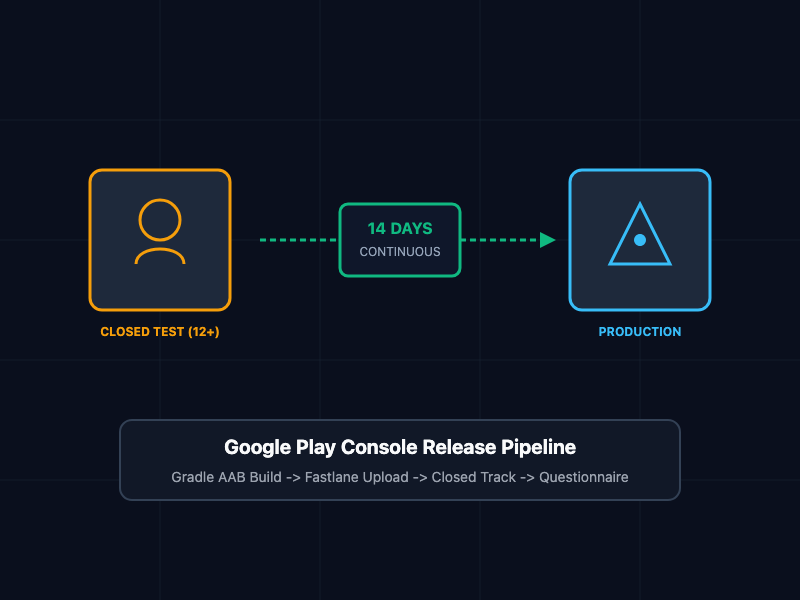
Under current policy guidelines, individual developers must successfully run a Closed Testing release that satisfies three strict criteria before they can apply for production access:
- Minimum Tester Threshold: At least 12 distinct testers must opt into your closed test.
- Continuous Duration: All 12 (or more) testers must remain continuously opted in for at least 14 consecutive days.
- Production Application Questionnaire: Developers must complete a formal questionnaire summarizing tester feedback, bug fixes, and engagement metrics.
Failure to keep 12 active opted-in testers across the full 14-day window breaks the consecutive streak, resetting the timer and delaying production launch.
Architectural Overview of Google Play Testing Tracks
Google Play Console provides four separate deployment tracks, each designed for a specific phase of the software development lifecycle:
┌────────────────────────────────────────────────────────┐
│               1. Internal Testing Track                │
│    (Fast distribution for up to 100 internal users)    │
└───────────────────────────┬────────────────────────────┘
                            │
                            ▼
┌────────────────────────────────────────────────────────┐
│               2. Closed Testing Track                  │
│  ★ GATEWAY: 12+ Testers for 14 Consecutive Days ★      │
└───────────────────────────┬────────────────────────────┘
                            │ (Submit Production Application)
                            ▼
┌────────────────────────────────────────────────────────┐
│                 3. Open Testing Track                  │
│    (Public opt-in beta testing on the Play Store)      │
└───────────────────────────┬────────────────────────────┘
                            │
                            ▼
┌────────────────────────────────────────────────────────┐
│                   4. Production Track                  │
│     (Full public distribution to billions of users)    │
└────────────────────────────────────────────────────────┘
Why Internal Testing Does Not Satisfy the Rule
Many developers mistakenly run an Internal Test track for 14 days and wonder why the Play Console does not allow them to apply for production access.
Internal testing tracks bypass Google’s app review process to allow rapid iterative distribution to up to 100 pre-approved developers. Because internal builds do not undergo complete policy compliance checks or public safety reviews, Google explicitly excludes internal testing from fulfilling the production access gate.
Only builds uploaded to a Closed Testing track count toward the 14-day continuous requirement.
Understanding the 12-Tester 14-Day Clock Mechanics
The 14-day timeline operates under deterministic, state-monitored rules:
- Opt-In Trigger: The clock begins only when at least 12 distinct Google accounts have clicked the opt-in invite link, selected “Become a tester”, and installed the application on a compatible physical device.
- Consecutive Streak Requirement: The opt-in state must remain active and continuous. If 2 testers opt out on day 11, reducing your active count to 10, the continuous streak resets to zero, requiring another full 14-day period once replacement testers are recruited.
- Active Engagement Tracking: Google evaluates telemetry to confirm that testers launch the application, navigate primary user flows, and generate crash reports or feedback. Distributing test links to inactive accounts or automated farms often results in rejection during production review.
Step-by-Step Implementation and Verification
Step 1: Manage Testers via Google Groups
Instead of manually adding individual email addresses as a static list (which can lead to accidental resets if the list is updated), establish a dedicated Google Group.
- Create a Google Group (e.g., app-closed-beta@googlegroups.com).
- Set the group access settings so invited testers can join easily.
- In Google Play Console, navigate to Testing > Closed testing.
- Create a new closed track, select the Testers tab, choose Google Groups, and enter your group’s email address.
Step 2: Build and Sign the Release Bundle
Build a signed production release bundle (.aab) in Android Studio or via Gradle CLI:
# Clean project and generate release AAB
./gradlew clean bundleRelease
Upload the generated bundle (app/build/outputs/bundle/release/app-release.aab) to your Closed Testing track, complete the release notes, and submit the track for Google review.
Step 3: Distribute Opt-In Links and Monitor Dashboard Status
Once the closed release is approved by Google, retrieve the opt-in URL:
- Web Link: https://play.google.com/apps/testing/com.yourcompany.app
- Android Link: Direct Play Store deep-link for mobile devices.
Instruct testers to accept the web link first and then install the app from the Play Store.
To track your progress, check Google Play Console > Dashboard > Apply for access to production:
- Publish a closed testing release (Checked green).
- Have at least 12 testers opted in to your closed test (Checked green).
- Run your closed test with at least 12 testers, for at least 14 days (Tracks current consecutive streak, e.g., “12 testers have currently been opted in for 4 days continuously”).
Answering the Production Access Questionnaire
When your app hits 14 continuous days with 12+ active testers, the Apply for production button unlocks. Google requires developers to complete a three-part questionnaire before approving production access:
Part 1: About Your Closed Test
- Tester Recruitment: Describe how you recruited your testers. (Example: “Recruited 18 beta testers from our existing user mailing list and a private Android developer testing community. Verified that testers used a mix of Android 12, 13, and 14 physical devices.”)
- Tester Engagement: Explain how users interacted with the app. (Example: “Testers engaged in daily 5-minute sessions exploring the checkout workflow, search filtering, and profile editing features.”)
- Feedback Summary: Summarize reported bugs and feature requests. (Example: “Testers identified an issue with slow image loading on low-bandwidth networks and a crash on Android 11 during token refresh. Both issues were patched in version 1.0.2.”)
Part 2: About Your App
- Target Audience: Specify target demographics, geographic focus, and use cases.
- Value Proposition: Provide a detailed explanation of the core problem your application solves and how it delivers value over alternatives.
Part 3: Production Readiness
- Iterative Improvements: Detail specific code updates, dependency upgrades, or UI redesigns committed during the 14-day testing period.
- Quality Verification: Explain how you confirmed production readiness (e.g., verifying a 99.8% crash-free session rate via Firebase Crashlytics).
Automating Closed Testing Deployments with Fastlane
To streamline building, uploading, and managing closed testing tracks, automate the workflow using Fastlane in your Android project repository.
1. Configure Appfile
Create fastlane/Appfile:
json_key_file("fastlane/play-console-api-key.json") # Google Service Account Key
package_name("com.company.myapp")                    # Application Package Name
2. Configure Fastfile
Define automated deployment lanes in fastlane/Fastfile:
default_platform(:android)

platform :android do
  desc "Build and deploy release bundle to Google Play Closed Testing Track"
  lane :deploy_closed_test do
    # Ensure local git workspace has no uncommitted changes
    ensure_git_status_clean

    # Increment Gradle Version Code automatically
    increment_version_code(
      gradle_file_path: "app/build.gradle.kts"
    )

    # Build signed Android App Bundle (AAB)
    gradle(
      task: "bundle",
      build_type: "Release"
    )

    # Upload AAB to Play Console Closed Track
    upload_to_play_store(
      track: "closed",
      aab: "app/build/outputs/bundle/release/app-release.aab",
      skip_upload_apk: true,
      skip_upload_metadata: false,
      skip_upload_images: true,
      skip_upload_screenshots: true,
      release_status: "completed"
    )
  end
end
Run the lane via command line:
bundle exec fastlane android deploy_closed_test
Architectural Comparison Matrix: Google Play Tracks
| Operational Dimension | Internal Testing | Closed Testing | Open Testing | Production Track |
|---|---|---|---|---|
| Max Testers | 100 | Up to 2,000 per list | Unlimited | Billions (Public) |
| Google Policy Review | Bypassed (Fast) | Mandatory full review | Mandatory full review | Mandatory full review |
| Play Store Visibility | Direct link only | Direct link to opted-in users | Searchable on Play Store | Fully public on Play Store |
| Public User Reviews | No (Private only) | No (Private developer feedback) | Public beta feedback | Public star ratings & reviews |
| Satisfies 14-Day Gate | No | Yes (Mandatory) | No | Target Destination |
Production Best Practices & Review Verification
- Maintain a 15–20 Tester Buffer: Never maintain exactly 12 testers. If a single user changes devices, uninstalls the app, or leaves the Google Group, your count drops below the threshold and the 14-day timer resets immediately.
- Push Intermediate Updates: Do not leave a single build static for 14 days. Ship at least 1 or 2 minor patch releases during the testing window to demonstrate active response to tester feedback.
- Integrate Crash Reporting: Embed Firebase Crashlytics or Sentry into your closed testing build to collect production telemetry, stack traces, and device hardware profiles.
- Avoid One-Line Survey Answers: Human reviewers assess the production questionnaire. Providing thorough, professional descriptions of testing protocols, feedback summaries, and architecture changes significantly reduces the risk of rejection.
Getting Started
To launch your closed testing track and begin the 14-day production review countdown:
# Step 1: Install Fastlane tooling
gem install fastlane -NV

# Step 2: Validate service account credentials
bundle exec fastlane run validate_play_store_json_key json_key:"fastlane/play-console-api-key.json"

# Step 3: Deploy initial closed testing bundle
bundle exec fastlane android deploy_closed_test

# Step 4: Verify opt-in count in Google Play Console Dashboard
# Testing ? Closed testing > Manage track > Testers
By establishing a disciplined testing group, actively resolving feedback during the 14-day window, and automating deployments through Fastlane, developers can satisfy Google Play Console closed testing rules and transition to production smoothly.