


The Operational Risk of Authenticated Privilege Escalation
In modern database administration, the principle of least privilege is the cornerstone of multi-tenant security. Application microservices, analytical dashboards, and third-party integrations are provisioned with restricted database roles that allow them to read or write specific tables without granting administrative superuser control.
However, when a vulnerability exists in the database engine's core execution planner, these internal boundaries collapse. CVE-2026-6460 is a newly disclosed, high-severity privilege escalation vulnerability (CVSS v4.0: 8.8) affecting all actively supported PostgreSQL release branches.
This flaw demonstrates a critical security axiom: authenticated vulnerabilities can be just as dangerous as unauthenticated ones. If an attacker compromises a low-privileged read/write application credential (e.g., via a leaked .env file or SQL injection), they can weaponize this CVE to break out of their sandbox, execute arbitrary commands as the postgres operating system user, and gain total control over the host infrastructure.
What is CVE-2026-6460?
CVE-2026-6460 is an authenticated privilege escalation vulnerability rooted in how PostgreSQL handles execution permissions during concurrent index creation.
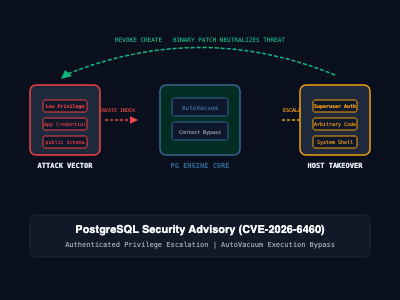
Specifically, the vulnerability triggers when an attacker with basic CREATE privileges crafts a malicious functional index (an index based on a dynamically executed function rather than a static column). Due to a flaw in how the query planner caches and evaluates security contexts during the ANALYZE or CREATE INDEX CONCURRENTLY phases, the malicious function is executed under the identity of the superuser running the background vacuum or maintenance process, rather than the identity of the user who defined the index.
┌────────────────────────────────────────────────────────┐
│  Attacker (Compromised Low-Privilege Application Role) │
└───────────────────────────┬────────────────────────────┘
                            │ 1. CREATE INDEX with Malicious Function
                            ▼
┌────────────────────────────────────────────────────────┐
│  PostgreSQL Query Planner & System Catalogs            │
│  - Stores the index definition without evaluating      │
│    the payload's security context properly.            │
└───────────────────────────┬────────────────────────────┘
                            │ 2. Background Maintenance Triggered
                            ▼
┌────────────────────────────────────────────────────────┐
│  PostgreSQL AutoVacuum / Superuser Maintenance Daemon  │
│  - Executes the index expression to update statistics  │
│  - Fails to drop privileges during execution           │
└───────────────────────────┬────────────────────────────┘
                            │ 3. Privilege Escalation
                            ▼
┌────────────────────────────────────────────────────────┐
│  Arbitrary Code Execution as `postgres` Superuser      │
│  (Total Database and OS Host Compromise)               │
└────────────────────────────────────────────────────────┘
Scope of Exposure and Vulnerable Versions
If your PostgreSQL environment allows standard users to create tables, indexes, or temporary objects in shared schemas (such as the default public schema), you are highly exposed.
The PostgreSQL Global Development Group has released emergency patches across all supported major versions:
- PostgreSQL 17: Upgrade to 17.3
- PostgreSQL 16: Upgrade to 16.7
- PostgreSQL 15: Upgrade to 15.11
- PostgreSQL 14: Upgrade to 14.16
- PostgreSQL 13: Upgrade to 13.20
(Note: PostgreSQL 12 and older are End-of-Life and will not receive official patches.)
Core Mitigation and Patching Strategies
1. Immediate Configuration Mitigation (Zero-Downtime)
If you cannot immediately restart your production database clusters to apply the binary patch, you must revoke untrusted CREATE privileges. By default, PostgreSQL historically granted CREATE privileges on the public schema to the PUBLIC role (everyone).
Execute the following SQL block as a superuser to audit and revoke these dangerous default permissions, preventing the exploit chain from beginning:
-- Step 1: Audit schemas where PUBLIC has CREATE privileges
SELECT nspname AS schema_name
FROM pg_namespace
WHERE has_schema_privilege('PUBLIC', nspname, 'CREATE');

-- Step 2: Revoke CREATE privilege from the PUBLIC role on the public schema
REVOKE CREATE ON SCHEMA public FROM PUBLIC;

-- Step 3: Explicitly grant CREATE only to trusted, designated application owners
GRANT CREATE ON SCHEMA public TO trusted_app_owner;
2. Fleet-Wide Binary Upgrades
The only definitive resolution to the memory and context-switching flaw is applying the official point release. The following Bash script automates the upgrade process for Debian/Ubuntu-based systems utilizing the official PostgreSQL APT repository:
#!/usr/bin/env bash
# postgres_cve_2026_6460_patch.sh - Automates PG binary upgrades
set -euo pipefail

echo "=== [1/3] Detecting Active PostgreSQL Version ==="
CURRENT_VERSION=$(psql -V | awk '{print $3}')
echo "[*] Active Version: $CURRENT_VERSION"

echo "=== [2/3] Updating System Packages ==="
export DEBIAN_FRONTEND=noninteractive
sudo apt-get update -y

# Upgrade all installed PostgreSQL components to secure point releases
sudo apt-get --only-upgrade install -y \
    postgresql \
    postgresql-client \
    postgresql-contrib \
    libpq5

echo "=== [3/3] Restarting PostgreSQL Service ==="
# A restart is strictly required to load the newly patched binaries into memory
sudo systemctl restart postgresql

# Verify the updated version
NEW_VERSION=$(psql -V | awk '{print $3}')
echo "[OK] Upgrade complete. New Version: $NEW_VERSION"
3. Kubernetes / Docker Container Mitigation
If you are running PostgreSQL inside Kubernetes using the official Docker images (e.g., bitnami/postgresql or postgres), you must update your manifest tags to pull the newly published secure SHAs and trigger a rolling restart of your StatefulSets.
# kubernetes-statefulset.yaml snippet
apiVersion: apps/v1
kind: StatefulSet
metadata:
  name: production-db
spec:
  template:
    spec:
      containers:
      - name: postgres
        # Update image tag to the patched point release immediately
        image: postgres:16.7-alpine
Execute the rollout:
kubectl apply -f kubernetes-statefulset.yaml
kubectl rollout status statefulset/production-db
Architectural Comparison Matrix
| Defensive Posture | Unpatched (Default public Schema) | Mitigated (Revoked CREATE) | Fully Patched (e.g., v16.7) |
| Vulnerability Status | Highly Vulnerable | Partially Protected | Fully Resolved |
| Exploit Prerequisite | Any basic DB login credential | Administrative DB credential | N/A (Flaw removed) |
| Operational Impact | Total cluster/host takeover | Disrupts legacy app deployments | Standard secure operation |
| Downtime Required | N/A | Zero Downtime | Brief restart during binary swap |
SRE and DBA Best Practices
- Abandon the public Schema: Modern database architecture dictates that the default public schema should not be used for production application tables. Create isolated, purpose-built schemas (e.g., app_inventory, app_billing) and tightly control ownership.
- Enforce Password Rotation: Because this is an authenticated exploit, compromised credentials are the entry point. Enforce automated rotation of application database passwords via tools like HashiCorp Vault.
- Isolate Database Compute: Ensure your PostgreSQL instances are running in isolated environments (dedicated VMs, restricted Kubernetes nodes, or AWS RDS). This ensures that even if an attacker achieves execution as the postgres user, their lateral movement across the internal network is blocked by strict egress firewall rules.
- Monitor pg_stat_activity: Set up Datadog or Prometheus alerts looking for anomalous CREATE INDEX CONCURRENTLY operations executed by non-administrative service accounts.
Getting Started
To secure your infrastructure today:
- Connect to your database clusters and immediately run the REVOKE CREATE ON SCHEMA public FROM PUBLIC; mitigation.
- Audit your pg_hba.conf to ensure no overly permissive IP blocks are granted unauthenticated access.
- Schedule a brief maintenance window to execute the apt-get upgrade or container image swap to bring your binaries up to the secured 17.3, 16.7, or 15.11 versions.
By securing schema permissions and maintaining aggressive patch cadences, engineering teams neutralize the threat of internal privilege escalation and safeguard enterprise data.