

The Fallacy of the Zero-Developer Company
With the rapid emergence of autonomous coding agents, LLM-powered command-line tools, and automated code completion engines, an engineering narrative has gained widespread traction among startup founders and leadership teams: AI can write code, so we can replace full engineering squads with one or two prompt engineers.
This assumption reflects a fundamental misunderstanding of software engineering.
Writing syntax has always been the lowest-friction phase of building resilient software. The historical bottlenecks in enterprise computing—race conditions, distributed consensus, memory leaks, security posture, and domain modeling—do not vanish because an LLM generated the function body. In fact, injecting unvetted, probabilistic code into production at scale actively compounds architectural debt:
- The Hallucination Vector in Complex Domains: Large Language Models operate on token probability, not deterministic semantic proof. They generate code that appears syntactically pristine while quietly misinterpreting core business constraints or edge-case state machines.
- Context Fragmentation and Monolithic Sprawl: AI models struggle with cross-service context boundaries. An agent can optimize an isolated function while inadvertently breaking event contracts, saturating downstream database pools, or violating distributed transaction guarantees.
- The Illusion of Velocity: Generating 1,000 lines of unverified code in seconds shifts the engineering bottleneck entirely onto code review, integration testing, and production triage.
To thrive and maintain relevance in this paradigm, software engineers must transition from syntax implementers to system orchestrators and verification authorities.
The Shift: Core Competencies for the AI-Augmented Engineer
When code syntax is commoditized, an engineer's market value shifts toward foundational system architecture, rigorous logical analysis, and deterministic orchestration.
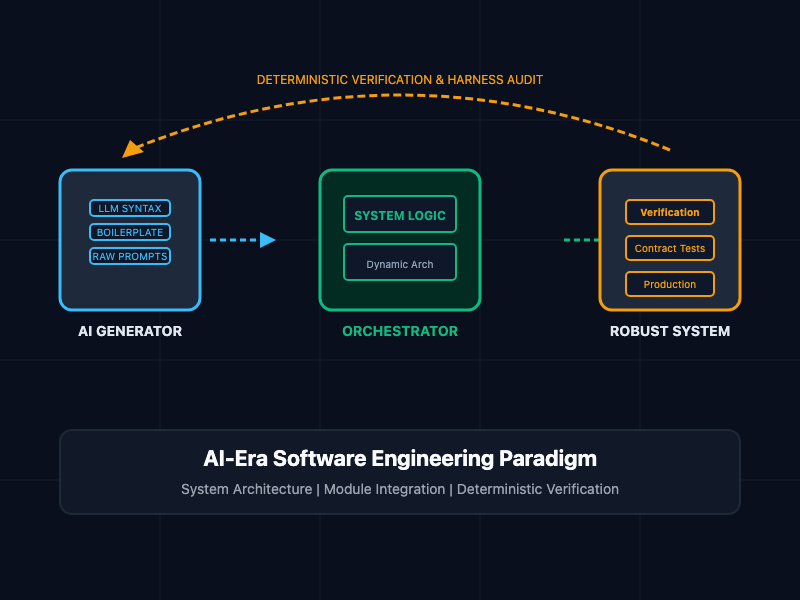
┌────────────────────────────────────────────────────────┐
│  AI Code Generation Layer (Probabilistic Engine)       │
│  - Boilerplate, CRUD endpoints, syntax translation     │
└───────────────────────────┬────────────────────────────┘
                            │ Raw Output
                            ▼
┌────────────────────────────────────────────────────────┐
│  Software Engineer Orchestration Layer                 │
│  ├── 1. System & Domain Architecture Modeling          │
│  ├── 2. Cross-Module & Inter-Service Integration       │
│  ├── 3. Dynamic Programming & Algorithm Correctness    │
│  └── 4. Deterministic Verification & Contract Testing  │
└───────────────────────────┬────────────────────────────┘
                    Audited & Verified
                            ▼
┌────────────────────────────────────────────────────────┐
│  Production Infrastructure Fleet                       │
│  - High availability, zero-downtime, fault tolerance   │
└────────────────────────────────────────────────────────┘
1. System Thinking and High-Level Architecture
System thinking evaluates how isolated components behave as an integrated whole under adverse conditions. An LLM can generate an asynchronous task worker, but it cannot decide whether your business domain requires the Transactional Outbox Pattern, an event-sourced ledger, or an eventual consistency model. Engineers must define system boundaries, data flow topologies, and fault domains before issuing a single prompt.
2. Logical and Mathematical Foundations
Deep algorithmic understanding, dynamic programming principles, and discrete logic remain non-negotiable. When an AI generates an algorithm with hidden $O(N^2)$ time complexity or unconstrained recursive memory consumption, only an engineer with solid foundational training will spot the performance ceiling before it exhausts server resources under production loads.
3. Module Integration and Contract Governance
Enterprise systems are ecosystems of decoupled services communicating across network boundaries via gRPC, REST, and distributed event streams. The critical challenge is orchestrating these modules: aligning protobuf schemas, enforcing idempotency across payment gateways, preventing duplicate deliveries, and handling network partitions gracefully.
4. Verification, Guardrails, and AI Orchestration
Engineers should never trust generative AI blindly. Instead, they must treat AI agents as junior contributors whose output requires rigorous verification. The modern engineer designs the test matrices, writes deterministic evaluation suites, configures sandbox runtimes, and validates that model-generated artifacts strictly satisfy business requirements.
Implementation Patterns: Building an Automated AI Code Verification Pipeline
To safely utilize generative AI in development without compromising production integrity, engineering teams must wrap AI generation inside automated verification harnesses that combine static analysis, contract testing, and boundary checks.
The following Python implementation demonstrates an automated verification harness that intercepts AI-generated code, runs AST parsing to detect forbidden imports, and executes deterministic unit test assertions inside an isolated runner:
# verification/pipeline.py
import ast
import sys
import unittest
import importlib.util
from typing import Dict, Any, List

class CodeSafetyValidator(ast.NodeVisitor):
    """
    Parses Abstract Syntax Trees (AST) of AI-generated code
    to detect security violations and unauthorized package calls.
    """
    FORBIDDEN_CALLS = {"eval", "exec", "compile"}
    FORBIDDEN_MODULES = {"os", "subprocess", "socket"}

    def __init__(self):
        self.violations: List[str] = []

    def visit_Import(self, node):
        for alias in node.names:
            if alias.name in self.FORBIDDEN_MODULES:
                self.violations.append(f"Forbidden module import detected: {alias.name}")
        self.generic_visit(node)

    def visit_ImportFrom(self, node):
        if node.module in self.FORBIDDEN_MODULES:
            self.violations.append(f"Forbidden module import detected: {node.module}")
        self.generic_visit(node)

    def visit_Call(self, node):
        if isinstance(node.func, ast.Name) and node.func.id in self.FORBIDDEN_CALLS:
            self.violations.append(f"Forbidden execution function called: {node.func.id}")
        self.generic_visit(node)


class DeterministicAIVerifier:
    def __init__(self, generated_code: str, test_suite_code: str):
        self.generated_code = generated_code
        self.test_suite_code = test_suite_code

    def verify_safety(self) -> Dict[str, Any]:
        """Validates AST syntax structure before runtime execution."""
        try:
            tree = ast.parse(self.generated_code)
            validator = CodeSafetyValidator()
            validator.visit(tree)

            return {
                "syntax_valid": True,
                "passed_safety": len(validator.violations) == 0,
                "violations": validator.violations
            }
        except SyntaxError as err:
            return {
                "syntax_valid": False,
                "passed_safety": False,
                "violations": [f"Syntax error in generated code: {str(err)}"]
            }

    def execute_test_harness(self) -> Dict[str, Any]:
        """
        Dynamically executes deterministic unit tests against
        the AI-generated implementation in memory.
        """
        # 1. First ensure static safety rules pass
        safety_report = self.verify_safety()
        if not safety_report["passed_safety"]:
            return {
                "status": "REJECTED_UNSAFE",
                "details": safety_report["violations"]
            }

        # 2. Compile and link generated module in ephemeral namespace
        module_namespace = {}
        try:
            compiled_code = compile(self.generated_code, "<ai_generated_module>", "exec")
            exec(compiled_code, module_namespace)
        except Exception as e:
            return {"status": "EXECUTION_ERROR", "details": [str(e)]}

        # 3. Inject module under test into test execution environment
        test_namespace = {"__name__": "__main__"}
        test_namespace.update(module_namespace)

        try:
            compiled_tests = compile(self.test_suite_code, "<ai_test_suite>", "exec")
            exec(compiled_tests, test_namespace)
            return {"status": "VERIFIED_PASSED", "details": ["All deterministic contracts satisfied."]}
        except AssertionError as e:
            return {"status": "CONTRACT_FAILED", "details": [f"Assertion failed: {str(e)}"]}
        except Exception as e:
            return {"status": "TEST_CRASH", "details": [str(e)]}


# Operational Demonstration
if __name__ == "__main__":
    # Simulated output produced by an AI coding agent
    ai_candidate_code = """
def calculate_dynamic_discount(cart_total: float, tier: str) -> float:
    # Business rule: VIP gets 20%, Gold gets 10%, others 0%
    if cart_total < 0:
        raise ValueError("Cart total cannot be negative")

    if tier == "VIP":
        return cart_total * 0.20
    elif tier == "GOLD":
        return cart_total * 0.10
    return 0.0
"""

    # Human-authored, deterministic contract test suite
    contract_tests = """
assert calculate_dynamic_discount(100.0, "VIP") == 20.0
assert calculate_dynamic_discount(100.0, "GOLD") == 10.0
assert calculate_dynamic_discount(100.0, "STANDARD") == 0.0

try:
    calculate_dynamic_discount(-50.0, "VIP")
    assert False, "Should have thrown ValueError on negative total"
except ValueError:
    pass
"""

    verifier = DeterministicAIVerifier(ai_candidate_code, contract_tests)
    report = verifier.execute_test_harness()
    print("Verification Verdict:", report["status"])
    print("Details:", report["details"])
Architectural Comparison: The Evolution of the Developer Role
| Dimension | The Traditional Developer (Pre-AI) | The AI-Augmented System Architect (Present & Future) |
| Primary Day-to-Day Output | Manual syntax authoring, boilerplate CRUD | System topology, schema boundaries, prompt strategy |
| Cognitive Focus | Language semantics, API memory recall | Logic design, failure modes, data invariants |
| Testing Paradigm | Manual unit tests written alongside code | Strict behavioral contracts and verification harnesses |
| Bottleneck | Typing velocity and syntactic debugging | Holistic architecture and domain alignment |
| AI Relationship | Distraction or experimental novelty | Accelerated execution engine under strict human oversight |
| Value Differentiator | Speed of writing clean functions | Designing fault-tolerant, maintainable distributed systems |
SRE and Production Best Practices for Working with AI
- Never Ship Unchecked AI Output to Production: Enforce mandatory human-in-the-loop review for all model-generated modifications. AI can author pull requests, but senior engineers must review domain logic, security assumptions, and infrastructure impacts.
- Constrain the Blast Radius with Sandboxes: When executing code generated dynamically by autonomous agents, run evaluations inside unprivileged containers with disabled network interfaces, ephemeral filesystems, and strict CPU/memory limits.
- Treat the Domain Model as the Source of Truth: Invest time upfront refining your domain schemas, state diagrams, and API contracts. Clear, unambiguous interfaces allow AI tools to generate accurate implementations while minimizing logical drift.
- Automate Dynamic and Static Validation: Integrate static linters, AST security auditors, and mutation testing into your continuous integration (CI) pipelines to catch hallucinated functions or unhandled error paths automatically.
Strategic Conclusion
Generative AI does not eliminate the software engineer; it eliminates the illusion that typing syntax was ever the core of engineering.
By automating repetitive boilerplate, AI allows developers to focus on the high-leverage challenges that machines cannot autonomously solve: grasping customer business domains, orchestrating complex distributed modules, anticipating edge-case anomalies, and designing resilient platforms. Engineers who master system thinking, maintain rigorous verification standards, and treat AI as a force multiplier will not be replaced—they will lead the future of software development.