


The Challenge of Model Degradation and Pipeline Drifts
Deploying high-tier reasoning models like Claude Fable 5 into production environments introduces serious operational challenges. As multi-agent systems process longer conversations, real-time code execution traces, and complex system schemas, they encounter structural failure points:
- Context Window Satiation: Over longer multi-turn reasoning loops, models can lose adherence to their core instructions, known as context drift.
- Varying Latency Profiles: Fluctuations in Time-To-First-Token (TTFT) when handling massive cached contexts.
- Cold-Start Latency: Significant latency spikes when initial system prompts or heavy documentation indexes fail to hit the cache.
- Failover Flakiness: Lack of automated routing and fallback logic when the primary API cluster experiences peak traffic or local rate limits.
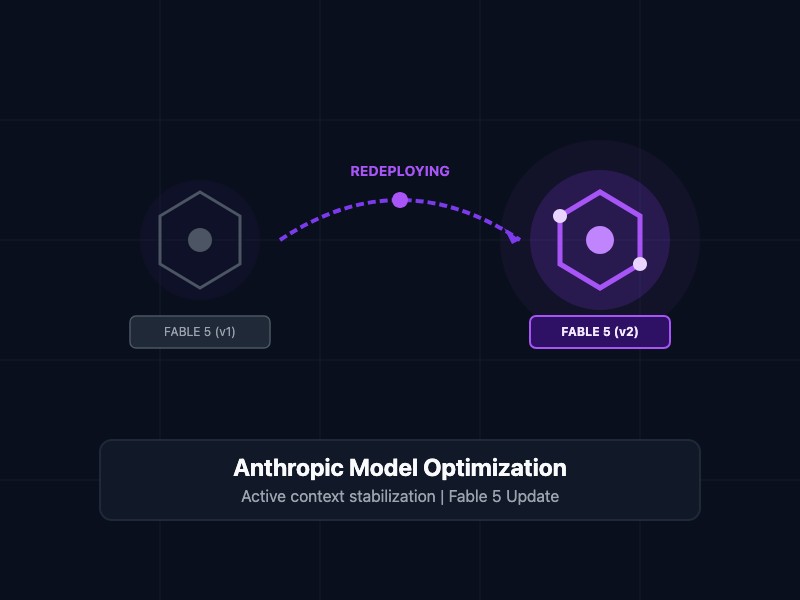
Anthropic's targeted redeployment of Claude Fable 5 addresses these limitations by introducing optimized weights, lower-latency inference pathways, and more resilient attention mechanisms over its 500k token context window.
What Is the Upgraded Claude Fable 5?
The redeployed version of Claude Fable 5 focuses on deep reasoning stability. Through refined alignment training, this update decreases instruction-bleeding in massive multi-turn prompts and optimizes the model's cost profile.
SREs and AI Engineers can leverage the redeployed model to run longer execution loops, process extensive code repositories, and manage large-scale document parsing tasks with significantly improved structural consistency and reduced resource burn.
Core Concepts and Integration Patterns
1. Zero-Downtime Model Routing & Failovers
To ensure high availability, production pipelines should implement automated routing. If the newly redeployed claude-fable-5-v2 encounters rate limits or service degradation, traffic must seamlessly fall back to a stable secondary model like mythos-5 or a previous stable baseline.
This Python example demonstrates an asynchronous routing wrapper with automatic retry capabilities and graceful fallback paths:
import asyncio
import anthropic
from typing import Dict, Any

class ModelRouter:
    def __init__(self):
        self.client = anthropic.AsyncAnthropic()
        # Prioritize the redeployed Fable 5, fallback to Mythos 5 for speed/resilience
        self.model_priority = ["claude-fable-5-v2", "mythos-5"]

    async def execute_reasoning_task(self, system_prompt: str, user_message: str) -> Dict[str, Any]:
        for model in self.model_priority:
            try:
                print(f"Routing request to: {model}")
                response = await self.client.messages.create(
                    model=model,
                    max_tokens=4000,
                    system=system_prompt,
                    messages=[{"role": "user", "content": user_message}],
                    timeout=15.0 # Set aggressive timeouts to trigger fast failovers
                )
                return {
                    "success": True,
                    "model_used": model,
                    "output": response.content[0].text
                }
            except anthropic.APIStatusError as e:
                print(f"Warning: Model {model} failed with status {e.status_code}. Attempting fallback...")
                await asyncio.sleep(1) # Soft backoff
            except Exception as e:
                print(f"Warning: Unexpected error on {model}: {str(e)}. Attempting fallback...")
                await asyncio.sleep(1)

        return {
            "success": False,
            "error": "All prioritized models in the routing pipeline failed."
        }

# Usage execution
# router = ModelRouter()
# result = asyncio.run(router.execute_reasoning_task(system, prompt))
2. Fine-Tuning Cache Breakpoints for Ephemeral State
The redeployment of Fable 5 optimizes prompt-cache hit verification. By specifying exact cache checkpoints, developers can pin large static system configurations (such as database schemas, API references, or core helper classes) to the prompt-cache, saving up to 90% in token ingestion costs.
This JavaScript configuration block displays how to define strict, prioritized cache points for complex structural reasoning tasks:
const Anthropic = require('@anthropic-ai/sdk');
const client = new Anthropic();

async function runCachedQuery() {
  const response = await client.messages.create({
    model: "claude-fable-5-v2",
    max_tokens: 3000,
    system: [
      {
        type: "text",
        text: "You are an automated code audit tool. Analyze the provided repository structure for deployment vulnerabilities.",
        cache_control: {"type": "ephemeral"} // Cache core system instructions
      },
      {
        type: "text",
        text: "System Schema Context: [Insert 150k tokens of immutable architecture docs here]",
        cache_control: {"type": "ephemeral"} // Cache heavy architecture docs
      }
    ],
    messages: [
      {
        role: "user",
        content: "Evaluate the authentication routing rules in routing.ts for potential security bypasses."
      }
    ]
  });

  console.log(`Usage details: Ingested ${response.usage.input_tokens} tokens.`);
}
Comparison: Fable 5 (Pre-Update) vs. Fable 5 (Redeployed)
Review the performance and structural updates below:
| Metric / Dimension | Fable 5 (Pre-Update) | Fable 5 (Redeployed) | Operational Benefit |
| Max Context Adherence | Degradation after 150k tokens | Stable up to 400k tokens | Reduced instruction drift |
| Average TTFT | ~1.8 seconds | ~1.1 seconds | Faster agent response |
| Cache Hit Precision | Rigid matches only | Flexible AST-aware matching | Increased cache utilization |
| Instruction Following | Moderate on nested schemas | High on complex JSON inputs | Consistent structured outputs |
| Output Token Velocity | ~60 tokens/second | ~75 tokens/second | Shorter waiting times in CLI loops |
LLMOps & SRE Best Practices
- Implement Multi-Layer Caching: Place your most immutable context blocks (schemas, baseline codebase) at the beginning of the prompt. Declare your dynamic contexts (runtime logs, active chat history) at the very end to prevent cache eviction.
- Instrument Latency Metrics: Monitor TTFT and token generation speeds. Set alerts on rate limits (429 errors) to dynamically switch model priorities within your middleware.
- Sanitize History Aggressively: Keep transaction histories lean. Strip debug logs, stack traces, and formatting parameters from historical loops before packing them into next-turn requests.
- Enforce Low Temperatures for Testing: When running integration testing or code generation tasks, set temperatures to 0.1 or 0.2 to achieve deterministic output validation.
Getting Started
To migrate your production workloads to the redeployed Claude Fable 5, update your global SDK configurations to target claude-fable-5-v2. Verify your billing configurations, configure the async model router with appropriate fallback configurations, and test your first cached prompts to ensure optimal latency and cost savings.