


The Operational Blast Radius of Ingress Vulnerabilities
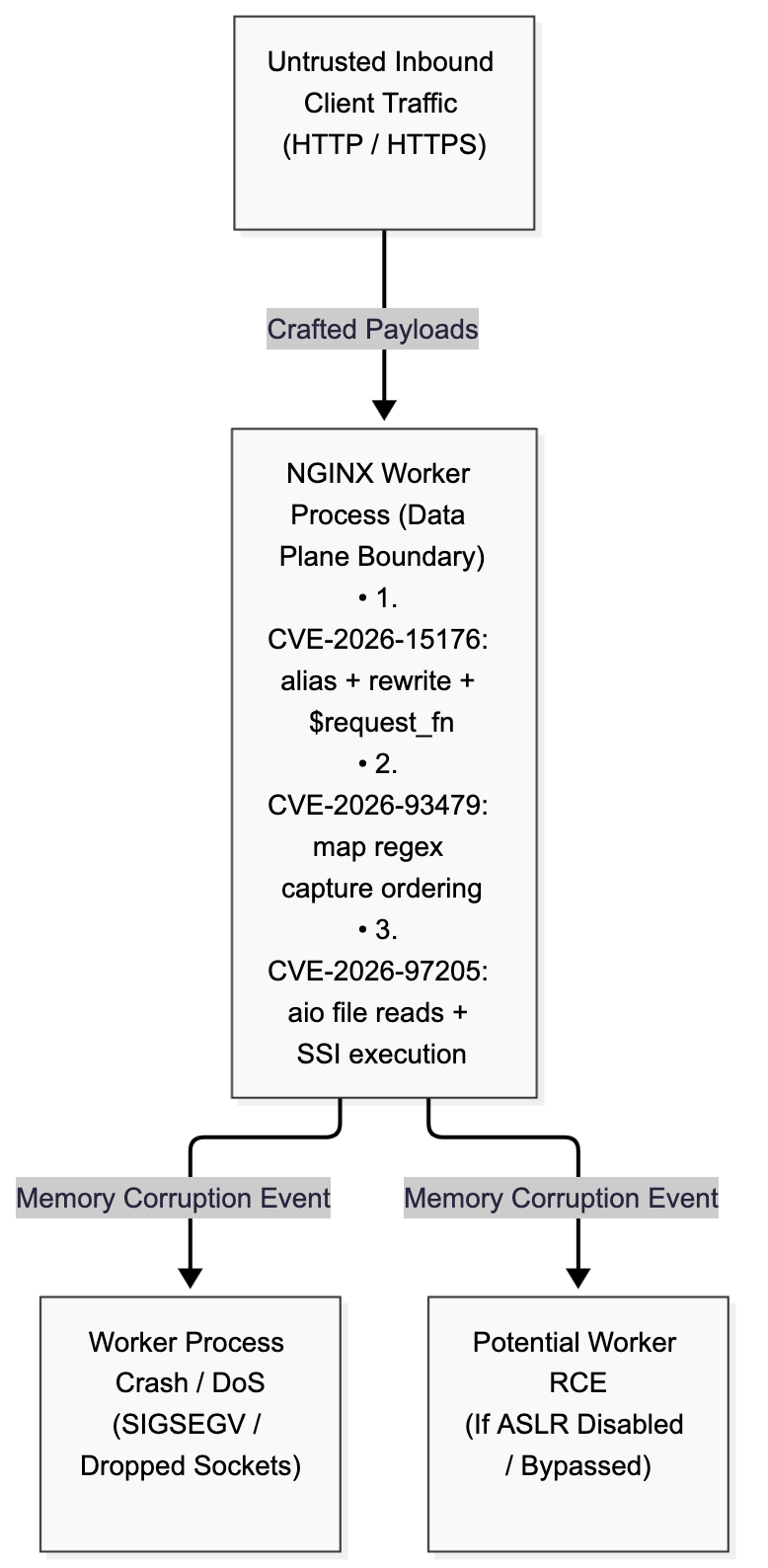
In modern cloud infrastructure, NGINX powers over a third of the world's busiest web servers and operates as the default edge reverse proxy, API gateway, and Kubernetes Ingress Controller across global enterprise fleets. Because reverse proxies sit directly at the network boundary terminating untrusted public traffic, memory corruption vulnerabilities in NGINX core modules carry critical operational risks:
- Remote Denial of Service (Worker Crashes): An unauthenticated attacker transmitting crafted HTTP requests can trigger segfaults in NGINX worker processes (nginx: worker process), dropping active TCP sockets and interrupting customer traffic.
- Potential Arbitrary Code Execution (RCE): When Address Space Layout Randomization (ASLR) is disabled, unaligned, or bypassed via memory layout leaks, heap-based buffer overflows and use-after-free flaws can be weaponized into remote code execution within the worker process security context.
- Data Plane Exposure: These flaws reside exclusively within the HTTP data plane, meaning standard Layer 7 traffic routing triggers the vulnerability without requiring access to administrative control planes or management APIs.
- Widespread Enterprise Exposure: Because vulnerable directives like alias, map, and aio represent standard performance and routing patterns, hundreds of thousands of production instances are exposed unless configuration audits are conducted immediately.
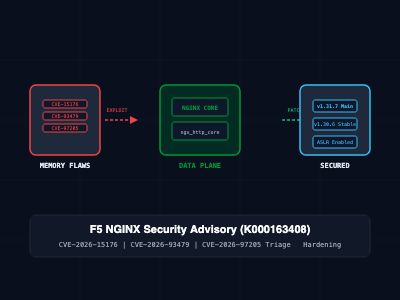
F5 addressed these risks in out-of-band security advisory K000163408, documenting three high-severity vulnerabilities affecting both NGINX Open Source and NGINX Plus.
Deep Technical Breakdown of the October 2026 CVEs
1. CVE-2026-15176: Heap-Based Buffer Overflow in ngx_http_core_module
- Vulnerability Type: CWE-122 (Heap-based Buffer Overflow)
- Severity Scores: CVSS v3.1: 8.1 (High) | CVSS v4.0: 9.2 (Critical)
- Vulnerable Versions: NGINX Open Source 0.1.29 through 1.30.5, and 1.31.0 through 1.31.6; NGINX Plus R33 through R36, 37.0.0 before 37.0.5.1, and 37.1.0 before 37.1.0.1.
Vulnerability Mechanism
The flaw triggers when a location block combines the alias directive with URI rewriting, and references the $request_filename variable inside a set or return directive.
When NGINX computes $request_filename under an alias directive, it recalculates the file path buffer length. If an internal rewrite rule modifies the request URI, the internal pointer offset calculation misaligns. The string concatenation routine writes past the boundary of the allocated heap pool, corrupting adjacent heap chunks.
Vulnerable Configuration Pattern
# VULNERABLE PATTERN: CVE-2026-15176
location /static/ {
    alias /var/www/assets/;
    rewrite ^/static/(.*)$ /files/$1 break;

    # Referencing $request_filename triggers buffer calculation mismatch
    set $audit_path $request_filename;
    return 200 "Target: $audit_path";
}
Mitigation Workaround
If patching cannot occur immediately, remove the $request_filename variable and replace alias with standard root mapping where possible:
# REMEDIATED PATTERN: Avoid alias + rewrite + $request_filename
location /static/ {
    root /var/www/assets;
    rewrite ^/static/(.*)$ /$1 break;
}
2. CVE-2026-93479: Heap-Based Buffer Overflow via map Regex Captures
- Vulnerability Type: CWE-122 (Heap-based Buffer Overflow)
- Severity Scores: CVSS v3.1: 8.1 (High) | CVSS v4.0: 9.2 (Critical)
- Vulnerable Versions: NGINX Open Source 1.30.0 through 1.30.5, and 1.31.2 through 1.31.6; NGINX Plus R33 through R36, 37.0.0 before 37.0.5.0, and 37.1.0 before 37.1.0.0.
Vulnerability Mechanism
This flaw occurs inside the regular expression evaluation handler of the map directive. When a map block utilizes regular expressions with positional (unnamed) captures (e.g., $1, $2), and either the root directive or the log_format access log specification evaluates those capture variables before referencing the output variable of the map itself, NGINX accesses uninitialized or undersized memory buffers.
Under sustained concurrent traffic, an attacker sending specially crafted HTTP headers or URIs causes the regex capture buffer to write out-of-bounds onto the heap.
Vulnerable Configuration Pattern
# VULNERABLE PATTERN: CVE-2026-93479
map $http_user_agent $client_category {
    ~*^Mozilla/5\.0.*(Mobile|Tablet)  mobile_device;
    default                           desktop_device;
}

server {
    listen 80;
    server_name example.com;

    # Positional capture $1 from map evaluated in root before $client_category
    root /var/www/sites/$1;

    location / {
        try_files $uri $uri/ =404;
    }
}
Mitigation Workaround
Avoid positional regex captures in map directives. Transition to explicit named captures and ensure captures are evaluated only within the immediate matching context:
# REMEDIATED PATTERN: Explicit named captures
map $http_user_agent $client_category {
    ~*^Mozilla/5\.0.*(?<devtype>Mobile|Tablet)  mobile_device;
    default                                    desktop_device;
}

server {
    listen 80;
    server_name example.com;

    # Reference the resolved map variable directly
    root /var/www/sites/$client_category;
}
3. CVE-2026-97205: Use-After-Free in ngx_http_core_module
- Vulnerability Type: CWE-416 (Use-After-Free)
- Severity Scores: CVSS v3.1: 8.1 (High) | CVSS v4.0: 9.2 (Critical)
- Vulnerable Versions: NGINX Open Source 1.30.0 through 1.30.5, and 1.31.0 through 1.31.6; NGINX Plus R33 through R36, 37.0.0 before 37.0.5.1, and 37.1.0 before 37.1.0.1.
Vulnerability Mechanism
CVE-2026-97205 is a use-after-free (UAF) race condition in NGINX core memory handling when asynchronous file I/O (aio) operates concurrently with Server-Side Includes (ssi).
When an HTTP response requires processing SSI virtual tags (<!--#include virtual="..." -->) and asynchronous file reading (aio on or aio threads) is active, NGINX suspends and resumes request filters across epoll events. If an asynchronous disk read completes after the parent SSI filter has already finalized and freed its internal request memory context (ngx_http_request_t), the thread attempts to write completed buffer pointers to previously deallocated memory.
This triggers immediate memory corruption, resulting in worker termination or potential code execution.
Vulnerable Configuration Pattern
# VULNERABLE PATTERN: CVE-2026-97205
server {
    listen 443 ssl;
    server_name portal.example.com;

    # Asynchronous File I/O enabled for static disk performance
    aio threads;

    # Server-Side Includes enabled
    ssi on;

    location / {
        root /var/www/html;
        index index.shtml;
    }
}
Mitigation Workaround
If an immediate binary upgrade cannot be performed, disable ssi or disable asynchronous file I/O across affected server blocks:
# REMEDIATED PATTERN: Disable AIO in SSI locations
server {
    listen 443 ssl;
    server_name portal.example.com;

    location / {
        root /var/www/html;
        index index.shtml;
        ssi on;

        # Disable AIO specifically where SSI is required
        aio off;
    }
}
Impact and Vulnerability Matrix
| CVE Identifier | Vulnerability Class | CVSS v3.1 / v4.0 | Trigger Directives / Conditions | Primary Operational Impact |
| CVE-2026-15176 | Heap Buffer Overflow (CWE-122) | 8.1 / 9.2 | alias + rewrite + $request_filename | Worker crash, DoS, potential RCE |
| CVE-2026-93479 | Heap Buffer Overflow (CWE-122) | 8.1 / 9.2 | map regex captures used in root or log_format | Out-of-bounds heap write, DoS |
| CVE-2026-97205 | Use-After-Free (CWE-416) | 8.1 / 9.2 | aio (threads/on) + ssi on | Memory corruption, DoS, potential RCE |
Step-by-Step Remediation and Audit Guide
To secure your fleet across standalone instances, Docker containers, and Kubernetes clusters, follow this structured remediation workflow:
Step 1: Scan Active NGINX Configuration Files for Vulnerable Directives
Run the following shell script across your server fleets to detect exposed directives before patching:
#!/usr/bin/env bash
# audit_nginx_cves.sh - Identify vulnerable directive combinations

echo "=== Auditing NGINX Configurations for CVE Risks ==="

NGINX_CONF_DIR="/etc/nginx"

echo "[1] Checking for CVE-2026-15176 (alias + $request_filename)..."
grep -rnE 'alias ' "$NGINX_CONF_DIR" | while read -r line; do
    file=$(echo "$line" | cut -d: -f1)
    if grep -q '\$request_filename' "$file"; then
        echo "  [!] Potential CVE-2026-15176 risk in: $file"
    fi
done

echo "[2] Checking for CVE-2026-93479 (map regex captures)..."
grep -rnE 'map .+\{' "$NGINX_CONF_DIR" | while read -r line; do
    file=$(echo "$line" | cut -d: -f1)
    if grep -q '\$[0-9]' "$file"; then
        echo "  [!] Positional regex capture in map: $file"
    fi
done

echo "[3] Checking for CVE-2026-97205 (aio + ssi)..."
grep -rnE 'aio (on|threads)' "$NGINX_CONF_DIR" | while read -r line; do
    file=$(echo "$line" | cut -d: -f1)
    if grep -qE 'ssi on' "$file"; then
        echo "  [!] Combined aio and ssi active in: $file"
    fi
done

echo "=== Audit Completed ==="
Step 2: Upgrade NGINX Binaries to Patched Releases
Upgrade your installations to fixed releases immediately:
- NGINX Open Source: Upgrade to 1.31.7 (Mainline) or 1.30.6 (Stable).
- NGINX Plus: Upgrade to 37.1.0.1 or 37.0.5.1 (or updated builds for R33–R36).
On Ubuntu / Debian:
# Update repository package indexes
sudo apt-get update

# Upgrade nginx package
sudo apt-get --only-upgrade install nginx

# Verify patched binary release
nginx -v
On RHEL / Rocky Linux:
# Refresh DNF repository cache
sudo dnf clean all
sudo dnf makecache

# Upgrade nginx package
sudo dnf upgrade nginx -y

# Verify running version
nginx -v
Step 3: Zero-Downtime Binary Reload
To apply the updated NGINX binary in production without dropping active customer connections, execute a zero-downtime master process replacement:
# 1. Test configuration syntax integrity
sudo nginx -t

# 2. Instruct active master to spawn new binary executable
sudo kill -USR2 $(cat /var/run/nginx.pid)

# 3. Gracefully terminate old workers once new workers spawn
sudo kill -WINCH $(cat /var/run/nginx.pid.oldbin)

# 4. Terminate the old master process
sudo kill -QUIT $(cat /var/run/nginx.pid.oldbin)
SRE and Production Hardening Best Practices
- Enforce Strict Host-Level ASLR: While these memory corruption bugs allow DoS by default, successful code execution requires predictable memory addresses. Ensure Address Space Layout Randomization is set to full randomization mode (2):sudo sysctl -w kernel.randomize_va_space=2 echo "kernel.randomize_va_space=2" | sudo tee -a /etc/sysctl.d/99-aslr.conf
- Audit Ingress Controller Images: If operating Kubernetes clusters (such as ingress-nginx or F5 NGINX Ingress Controller), verify container base images. Update Helm charts to versions embedding patched NGINX binaries.
- Implement Core Dump Protections: Prevent sensitive memory allocations from persisting to disk if an exploit payload successfully triggers a worker segfault:# Enforce inside /etc/nginx/nginx.conf working_directory /var/empty;
- Deploy WAF Inspection Rules: If patching cannot be deployed immediately across thousands of distributed edge nodes, enforce Web Application Firewall (WAF) signatures filtering requests with deep URI directory traversals and malformed SSI include headers.
Getting Started
To verify your infrastructure posture and resolve exposures:
# Step 1: Verify your current installed NGINX version
nginx -V

# Step 2: Execute configuration syntax validation
nginx -t

# Step 3: Check host ASLR enforcement level
cat /proc/sys/kernel/randomize_va_space

# Step 4: If vulnerable and unable to patch immediately,
# apply the configuration mitigations detailed above and reload:
sudo systemctl reload nginx
By systematically identifying vulnerable directives, applying configuration workarounds, and deploying official F5 patches, engineering teams eliminate critical memory corruption attack surfaces and ensure reliable uptime across high-throughput production environments.