


The Operational Blast Radius of Web Runtime Exploits
PHP powers over 75% of websites with known server-side programming languages, serving as the core execution engine for enterprise content management systems, e-commerce engines, and modern microservice APIs built with frameworks like Laravel and Symfony. When vulnerabilities occur in the PHP runtime core rather than application-layer code, every application hosted on that interpreter inherits the risk immediately.
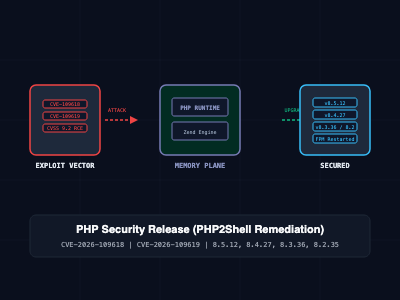
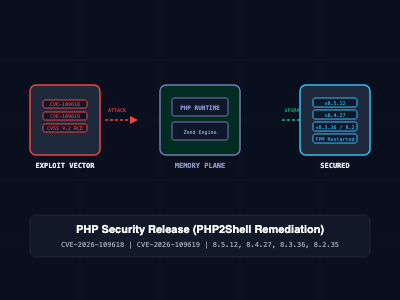
On October 21, 2026, the PHP development team published synchronized, out-of-band security releases across all actively supported branches: PHP 8.5.12, PHP 8.4.27, PHP 8.3.36, and PHP 8.2.35.
These updates remediate two critical vulnerabilities categorized under the threat identifier PHP2Shell (CVE-2026-109618 and CVE-2026-109619), each carrying a CVSS v4.0 score of 9.2 (Critical). Because both vulnerabilities permit unauthenticated attackers to execute arbitrary system code remotely through standard web requests, there are no effective configuration-only workarounds; binary patching is required immediately across all production fleets.
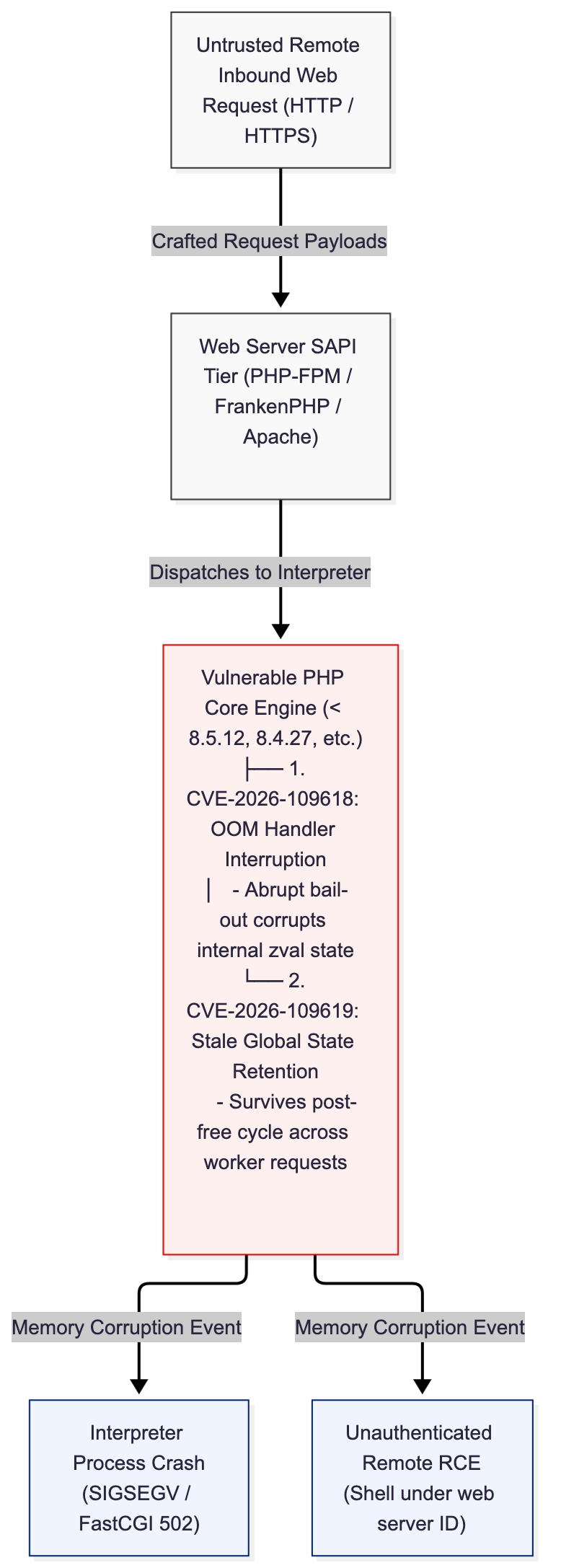
Deep Technical Breakdown of the October 2026 Vulnerabilities
1. CVE-2026-109618: Out-Of-Memory (OOM) Handler Interruption Corruption
- Vulnerability Class: CWE-119 (Improper Restriction of Operations within the Bounds of a Memory Buffer) / CWE-703 (Improper Handling of Exceptional Conditions)
- Severity Score: CVSS v3.1: 9.8 (Critical) | CVSS v4.0: 9.2 (Critical)
- Affected Versions: PHP 8.5 before 8.5.12, PHP 8.4 before 8.4.27, PHP 8.3 before 8.3.36, and PHP 8.2 before 8.2.35.
Technical Mechanism
When PHP processes inbound HTTP requests with large multipart payloads, deeply nested arrays, or heavy string manipulation operations, the memory manager allocates blocks through emalloc(). If an operation causes the memory limit to be exceeded (memory_limit), the Zend Engine initiates an asynchronous bail-out via zend_bailout().
Under specific conditions in unpatched versions, the bailout routine can interrupt critical pointer assignments within active hashtable allocations or object initialization routines. This interruption leaves pointers in an inconsistent half-initialized state.
When request shutdown handlers attempt to clean up Zend memory pool pages, the memory manager dereferences these corrupted pointers. An attacker transmitting specially crafted payloads designed to trigger memory limit exhaustion at deterministic boundary offsets can hijack instruction pointers, yielding arbitrary code execution within the web server user context (www-data, nginx, or nobody).
2. CVE-2026-109619: Stale Global State Use-After-Free
- Vulnerability Class: CWE-416 (Use After Free)
- Severity Score: CVSS v3.1: 9.8 (Critical) | CVSS v4.0: 9.2 (Critical)
- Affected Versions: PHP 8.5 before 8.5.12, PHP 8.4 before 8.4.27, PHP 8.3 before 8.3.36, and PHP 8.2 before 8.2.35.
Technical Mechanism
This flaw resides inside the global state lifecycle management between discrete request executions. In persistent execution models—such as PHP-FPM child workers, FrankenPHP Go workers, and LiteSpeed LSAPI—a worker process services hundreds of requests before recycling.
CVE-2026-109619 occurs when global runtime state pointers survive beyond the request cleanup phase (php_request_shutdown()) after the backing heap memory has been deallocated. When a subsequent request is processed by that same persistent worker, the engine references the stale, freed memory structure.
By sending a two-stage HTTP sequence—the first request shaping the freed heap layout and the second request invoking the stale global reference—an unauthenticated remote attacker can achieve controlled memory writes and arbitrary code execution.
Scope of Exposure Across SAPI Implementations
Because both flaws reside within the Zend Engine memory core, vulnerability exposure does not depend on specific third-party extensions. All standard Server Application Programming Interfaces (SAPIs) serving web traffic are vulnerable:
- PHP-FPM (FastCGI Process Manager): Highly vulnerable. Standard architecture for Nginx, Caddy, and Apache deployments. Persistent child workers expose both OOM interruptions and cross-request stale memory reuse.
- FrankenPHP: Highly vulnerable. Uses persistent Go-based CGO workers, directly exposing stale global memory structures across concurrent request threads.
- Apache mod_php: Vulnerable. Worker and prefork MPM processes expose memory corruption paths.
- PHP CLI: Low risk for web entry vectors, but vulnerable if executing scripts that parse untrusted user-supplied inputs in batch queues.
End-of-Life (EOL) Warning: Older PHP branches—including PHP 8.1, 8.0, 7.x, and 5.x—do not receive upstream security fixes. Systems still operating on PHP 8.1 or older remain permanently vulnerable to these vectors unless protected by third-party backported enterprise distributions.
Comparative Release Matrix
| PHP Branch | Pre-Patch Release | Patched Secure Release | Upstream Maintenance Status | Primary Operational Risk |
| PHP 8.5 | 8.5.11 | 8.5.12 | Active Support | Unauthenticated RCE via OOM / Stale State |
| PHP 8.4 | 8.4.26 | 8.4.27 | Active Support | Unauthenticated RCE via OOM / Stale State |
| PHP 8.3 | 8.3.35 | 8.3.36 | Security Fixes Only | Unauthenticated RCE via OOM / Stale State |
| PHP 8.2 | 8.2.34 | 8.2.35 | Security Fixes Only | Unauthenticated RCE via OOM / Stale State |
| PHP 8.1 & Older | Multiple | None (EOL) | Unsupported | Permanent Exposure to PHP2Shell |
Complete Automated Fix Scripts Across Application Stacks
Binary upgrades are mandatory to resolve the underlying engine vulnerabilities, but application-specific workarounds (process recycling, memory boundaries, and WAF rules) reduce exploitation risks while updates propagate.
Below are automated, production-ready remediation scripts for the four primary deployment environments.
1. Fix for WordPress (fix_wordpress.sh)
WordPress instances are frequent targets for RCE exploits due to file upload endpoints, XML-RPC, and heavy plugin memory footprints. This script updates the system binaries, hardens wp-config.php memory bounds, and tunes PHP-FPM worker recycling to prevent stale memory state retention across requests.
#!/usr/bin/env bash
# fix_wordpress.sh - Complete security patch and hardening for WordPress
set -euo pipefail

WP_PATH="${1:-/var/www/html}"

echo "=== [1/4] Upgrading PHP Core Packages on Host ==="
if command -v apt-get >/dev/null 2>&1; then
    sudo apt-get update -y
    sudo apt-get --only-upgrade install -y \
        php8.5* php8.4* php8.3* php8.2* || true
elif command -v dnf >/dev/null 2>&1; then
    sudo dnf upgrade -y php php-fpm php-common
fi

echo "=== [2/4] Hardening WordPress Configuration in ${WP_PATH} ==="
if [ -f "${WP_PATH}/wp-config.php" ]; then
    # Ensure memory limits are cleanly defined to avoid erratic OOM triggers
    if ! grep -q "WP_MEMORY_LIMIT" "${WP_PATH}/wp-config.php"; then
        sed -i "/<?php/a define('WP_MEMORY_LIMIT', '256M');\ndefine('WP_MAX_MEMORY_LIMIT', '512M');" "${WP_PATH}/wp-config.php"
        echo "[OK] Injected conservative WP_MEMORY_LIMIT into wp-config.php"
    fi
    # Disable XML-RPC if unneeded to prevent high-volume unauthenticated memory bursts
    if [ ! -f "${WP_PATH}/.htaccess" ]; then
        touch "${WP_PATH}/.htaccess"
    fi
    if ! grep -q "xmlrpc.php" "${WP_PATH}/.htaccess"; then
        cat << 'EOF' >> "${WP_PATH}/.htaccess"

# Block access to xmlrpc.php to prevent memory exhaustion attacks
<Files xmlrpc.php>
order deny,allow
deny from all
</Files>
EOF
        echo "[OK] Blocked xmlrpc.php in .htaccess"
    fi
else
    echo "[WARN] wp-config.php not found at ${WP_PATH}. Skipping WP config tweaks."
fi

echo "=== [3/4] Mitigating Stale State in PHP-FPM Workers ==="
# Recycle workers frequently to kill stale global references
for conf in /etc/php/*/fpm/pool.d/www.conf /etc/php-fpm.d/www.conf; do
    if [ -f "$conf" ]; then
        sudo sed -i 's/^;*pm.max_requests\s*=.*/pm.max_requests = 250/' "$conf"
        echo "[OK] Set pm.max_requests = 250 in $conf"
    fi
done

echo "=== [4/4] Restarting PHP-FPM & Web Servers ==="
sudo systemctl restart 'php*-fpm' 2>/dev/null || sudo systemctl restart php-fpm 2>/dev/null || true
sudo systemctl reload nginx 2>/dev/null || sudo systemctl reload apache2 2>/dev/null || true

echo "=== WordPress Remediation Completed Successfully ==="
php -v
2. Fix for Laravel / Symfony (fix_laravel_symfony.py)
Laravel and Symfony applications typically run under high-concurrency PHP-FPM or persistent FrankenPHP runtimes. This Python orchestrator verifies the running PHP version against minimum secure patch baselines, adjusts the PHP-FPM worker recycling policy (pm.max_requests = 500), clears the framework cache, and gracefully reloads the SAPI layer.
#!/usr/bin/env python3
"""
fix_laravel_symfony.py - Enterprise remediation script for Laravel & Symfony.
Verifies secure binary thresholds, optimizes worker recycling, and purges runtime cache.
"""
import os
import re
import subprocess
import sys

SECURE_TARGETS = {
    (8, 5): 12,
    (8, 4): 27,
    (8, 3): 36,
    (8, 2): 35,
}

def run_command(cmd, shell=True, check=True):
    res = subprocess.run(cmd, shell=shell, stdout=subprocess.PIPE, stderr=subprocess.PIPE, text=True)
    if check and res.returncode != 0:
        raise RuntimeError(f"Command failed ({cmd}): {res.stderr.strip()}")
    return res.stdout.strip()

def check_and_update_binary():
    print("[*] Inspecting host PHP runtime version...")
    raw_version = run_command("php -r 'echo PHP_VERSION;'")
    print(f"[*] Active CLI PHP Version: {raw_version}")

    m = re.match(r"^(\d+)\.(\d+)\.(\d+)", raw_version)
    if not m:
        sys.exit(f"[!] Unable to parse PHP version string: {raw_version}")

    major, minor, patch = int(m.group(1)), int(m.group(2)), int(m.group(3))
    key = (major, minor)

    if key in SECURE_TARGETS:
        target_patch = SECURE_TARGETS[key]
        if patch < target_patch:
            print(f"[!] VULNERABLE RUNTIME DETECTED: {raw_version} < {major}.{minor}.{target_patch}")
            print("[*] Executing system package upgrade...")
            if os.path.exists("/usr/bin/apt-get"):
                run_command("sudo apt-get update -y && sudo apt-get --only-upgrade install -y php*-cli php*-fpm php*-common")
            elif os.path.exists("/usr/bin/dnf"):
                run_command("sudo dnf upgrade -y php-cli php-fpm php-common")
            else:
                print("[!] Package manager not recognized. Please compile or update PHP manually.")
        else:
            print(f"[OK] PHP runtime meets secure criteria (>= {major}.{minor}.{target_patch}).")
    else:
        print(f"[CRITICAL] Unsupported or EOL PHP branch: {major}.{minor}. Immediate migration required.")

def harden_fpm_recycling():
    print("[*] Hardening PHP-FPM pool configs against stale memory reuse...")
    pool_dirs = ["/etc/php", "/etc/php-fpm.d"]
    modified = False

    for base in pool_dirs:
        if not os.path.exists(base):
            continue
        for root, _, files in os.walk(base):
            for file in files:
                if file.endswith(".conf"):
                    filepath = os.path.join(root, file)
                    with open(filepath, "r", encoding="utf-8", errors="ignore") as f:
                        content = f.read()
                    if "pm.max_requests" in content:
                        new_content = re.sub(r"^;?\s*pm\.max_requests\s*=.*", "pm.max_requests = 500", content, flags=re.M)
                        if new_content != content:
                            with open(filepath, "w", encoding="utf-8") as f:
                                f.write(new_content)
                            print(f"[OK] Updated pm.max_requests = 500 in {filepath}")
                            modified = True
    return modified

def clear_framework_caches(app_dir):
    if not os.path.isdir(app_dir):
        return
    # Laravel detection
    artisan_path = os.path.join(app_dir, "artisan")
    if os.path.exists(artisan_path):
        print("[*] Detected Laravel application. Flushing compiled state...")
        run_command(f"php {artisan_path} optimize:clear", check=False)
        run_command(f"php {artisan_path} config:cache", check=False)
        run_command(f"php {artisan_path} route:cache", check=False)

    # Symfony detection
    console_path = os.path.join(app_dir, "bin", "console")
    if os.path.exists(console_path):
        print("[*] Detected Symfony application. Purging cache...")
        run_command(f"php {console_path} cache:clear --no-warmup", check=False)

def restart_services():
    print("[*] Restarting application web daemons...")
    run_command("sudo systemctl restart 'php*-fpm' 2>/dev/null || sudo systemctl restart php-fpm 2>/dev/null || true")
    run_command("sudo systemctl reload nginx 2>/dev/null || sudo systemctl reload caddy 2>/dev/null || true")

if __name__ == "__main__":
    app_root = sys.argv[1] if len(sys.argv) > 1 else "/var/www/app"
    check_and_update_binary()
    harden_fpm_recycling()
    clear_framework_caches(app_root)
    restart_services()
    print("=== Laravel / Symfony Patch Workflow Finished Successfully ===")
3. Fix for Native PHP Applications (fix_php_native.sh)
For custom or vanilla PHP installations, legacy directory structures, and standalone scripts, this shell script automates package updates, resets FastCGI sockets, inspects php.ini directives to curb uncontrolled payload ingestion, and commits patched binaries to memory.
#!/usr/bin/env bash
# fix_php_native.sh - Universal remediation script for native PHP deployments
set -euo pipefail

echo "=== [1/3] Updating System PHP Packages ==="
if [ -f /etc/debian_version ]; then
    export DEBIAN_FRONTEND=noninteractive
    sudo apt-get update -y
    sudo apt-get --only-upgrade install -y \
        php8.5 php8.5-fpm php8.5-cli \
        php8.4 php8.4-fpm php8.4-cli \
        php8.3 php8.3-fpm php8.3-cli \
        php8.2 php8.2-fpm php8.2-cli || true
elif [ -f /etc/redhat-release ]; then
    sudo dnf upgrade -y php php-fpm php-cli
fi

echo "=== [2/3] Hardening Memory Bounds in php.ini ==="
# Find all active php.ini files
INI_FILES=$(find /etc/php /etc/php.ini /etc/php-fpm.d -name "php.ini" 2>/dev/null || true)

for ini in $INI_FILES; do
    if [ -f "$ini" ]; then
        # Limit memory_limit to realistic thresholds to allow graceful OS reclamation
        sudo sed -i 's/^memory_limit\s*=.*/memory_limit = 256M/' "$ini"
        # Bound max execution time to kill long-lived stalled processes
        sudo sed -i 's/^max_execution_time\s*=.*/max_execution_time = 60/' "$ini"
        echo "[OK] Applied bounds in $ini"
    fi
done

echo "=== [3/3] Committing Binary Updates to Active Memory ==="
# Kill active master process and restart cleanly to flush stale memory pools
sudo systemctl restart 'php*-fpm' 2>/dev/null || sudo systemctl restart php-fpm 2>/dev/null || true
sudo systemctl reload nginx 2>/dev/null || sudo systemctl reload apache2 2>/dev/null || true

echo "=== Verification ==="
INSTALLED_CLI=$(php -r 'echo PHP_VERSION;')
echo "[*] Active PHP Version: ${INSTALLED_CLI}"
echo "[OK] Native PHP Patch Complete."
4. Fix for Adobe Magento (fix_magento.sh)
Adobe Magento (Adobe Commerce) heavily utilizes asynchronous indexing, GraphQL APIs, and complex object graphs. In Magento environments, OOM crashes can leave Redis and Elasticsearch locks stalled. This script upgrades the PHP engine, sets compliant memory allocations (2G required for Magento compilers), flushes Redis cache keys, and re-executes dependency injection compilation safely.
#!/usr/bin/env bash
# fix_magento.sh - Security patch and state recompilation for Adobe Magento
set -euo pipefail

MAGENTO_ROOT="${1:-/var/www/html/magento}"

echo "=== [1/4] Upgrading PHP Engine ==="
if command -v apt-get >/dev/null 2>&1; then
    sudo apt-get update -y
    sudo apt-get --only-upgrade install -y php8.4* php8.3* php8.2* || true
elif command -v dnf >/dev/null 2>&1; then
    sudo dnf upgrade -y php php-fpm php-common
fi

echo "=== [2/4] Hardening PHP-FPM Configuration for Magento ==="
for conf in /etc/php/*/fpm/pool.d/www.conf /etc/php-fpm.d/www.conf; do
    if [ -f "$conf" ]; then
        # Magento needs high memory but benefits from worker turnover to prevent UAF leaks
        sudo sed -i 's/^;*pm.max_requests\s*=.*/pm.max_requests = 1000/' "$conf"
        sudo sed -i 's/^;*pm.process_idle_timeout\s*=.*/pm.process_idle_timeout = 10s/' "$conf"
        echo "[OK] Configured worker turnover parameters in $conf"
    fi
done

echo "=== [3/4] Restarting PHP-FPM Service ==="
sudo systemctl restart 'php*-fpm' 2>/dev/null || sudo systemctl restart php-fpm 2>/dev/null || true

echo "=== [4/4] Flushing Magento State & Recompiling DI ==="
if [ -f "${MAGENTO_ROOT}/bin/magento" ]; then
    cd "${MAGENTO_ROOT}"

    echo "[*] Flushing Magento application caches..."
    sudo -u www-data php -d memory_limit=2G bin/magento cache:flush

    echo "[*] Cleaning generated code classes..."
    rm -rf generated/code/* generated/metadata/*

    echo "[*] Running Dependency Injection Compilation..."
    sudo -u www-data php -d memory_limit=2G bin/magento setup:di:compile

    echo "[*] Re-enabling maintenance mode off..."
    sudo -u www-data php bin/magento maintenance:disable
    echo "[OK] Magento recompiled and restored."
else
    echo "[WARN] Magento binary not found at ${MAGENTO_ROOT}/bin/magento."
fi

echo "=== Adobe Magento Remediation Completed Successfully ==="
php -v
Step-by-Step Server Fleet Verification Workflow
To confirm that both CLI binaries and web-facing SAPIs are fully patched across your fleet, run the following diagnostic commands:
Step 1: Audit Active Running PHP Versions
# Check CLI binary version
php -v

# Check active PHP-FPM service version
php-fpm -v 2>/dev/null || php-fpm8.5 -v 2>/dev/null || php-fpm8.4 -v 2>/dev/null

# Inspect listening process sockets
ps aux | grep -E 'php-fpm|frankenphp'
Step 2: Verify Web SAPI State
CLI verification (php -v) only audits the command-line executable. Confirm that the web-facing SAPI process has also updated:
# Direct FastCGI probe to verify active FPM pool binary version
SCRIPT_NAME=/ping \
SCRIPT_FILENAME=/dev/null \
REQUEST_METHOD=GET \
cgi-fcgi -bind -connect /var/run/php/php8.5-fpm.sock 2>/dev/null || echo "Verify via application status endpoint"
SRE and Container Production Best Practices
- Rebuild Docker Base Images Immediately: Do not rely on running apt-get upgrade inside mutable production containers. Update Dockerfiles targeting official base images (e.g., php:8.5.12-fpm-alpine or php:8.4.27-fpm-bookworm), run local security scans via Trivy, and trigger image redeployments across your Kubernetes or ECS clusters.
- Deploy WAF Inspection Rules: If binary upgrades cannot be applied immediately across edge nodes, configure Web Application Firewall (WAF) rate limits and inspect deep nested request parameters to restrict malformed payloads intended to trigger OOM interruptions.
- Audit EOL Workloads in Staging and Development: Identify lingering legacy services operating on PHP 8.1 or older. Decommission these legacy runtimes or migrate them to PHP 8.3/8.4/8.5 to maintain vendor patch support.
- Tune PHP-FPM Process Recycling: Mitigate stale memory reuse by configuring process recycling limits inside /etc/php/8.x/fpm/pool.d/www.conf. Setting pm.max_requests forces child workers to terminate and release all memory pages after processing a set volume of requests:
; Force worker recycling to mitigate stale memory persistence
pm.max_requests = 500
Getting Started
To confirm your infrastructure posture and resolve exposures:
# Step 1: Check your active PHP CLI version
php -v

# Step 2: Check active PHP-FPM service status
systemctl status php*-fpm --no-pager

# Step 3: Run the system package upgrade
sudo apt-get update && sudo apt-get --only-upgrade install php*-fpm php*-cli -y

# Step 4: Restart FPM services to commit patched binaries to memory
sudo systemctl restart php*-fpm

# Step 5: Verify runtime version reflects the patched release
php -v
By systematically identifying vulnerable versions, deploying official PHP security updates, and executing environment-specific remediation scripts across WordPress, Laravel/Symfony, Magento, and native PHP runtimes, engineering teams eliminate critical memory corruption attack surfaces and protect production web applications against remote exploitation.