

The Problem of Runtime Telemetry and Allocation Overhead
High-concurrency Node.js applications frequently suffer from latent performance bottlenecks that are difficult to diagnose in production environments:
- Event Loop Jank Blind Spots: Standard timers and periodic polling tools cannot measure micro-delays occurring inside individual iterations of the event loop. As a result, sudden CPU-bound tasks or synchronous blocking operations remain invisible until severe latency spikes occur.
- Garbage Collection Pressure: Functions like fs.readFile() historically allocated new memory buffers on every execution, increasing memory churn and triggering frequent garbage collection cycles during high-throughput file I/O operations.
- Third-Party Dependency Vulnerabilities: Relying on external C++ native add-ons or npm packages for standard cryptographic operations (like Argon2 password hashing) introduces supply chain security risks and compilation friction across host architectures.
Node.js 24.19.0 "Krypton" addresses these core runtime challenges by embedding precise event loop sampling, pre-allocated buffer controls, and standardized security primitives directly into the core binary.
What Is Node.js 24.19.0 "Krypton"?
Node.js 24.19.0 is a feature update in the Active LTS release line. This version focuses on telemetry precision, memory allocation optimization, and cryptographic standardization.
By exposing deeper hooks into the V8 engine and the libuv event loop, Node.js 24.19.0 allows site reliability engineers (SREs) and backend developers to monitor runtime health with higher fidelity without incurring noticeable performance overhead.
Core Concepts and Features
1. Per-Iteration Event Loop Delay Monitoring (samplePerIteration)
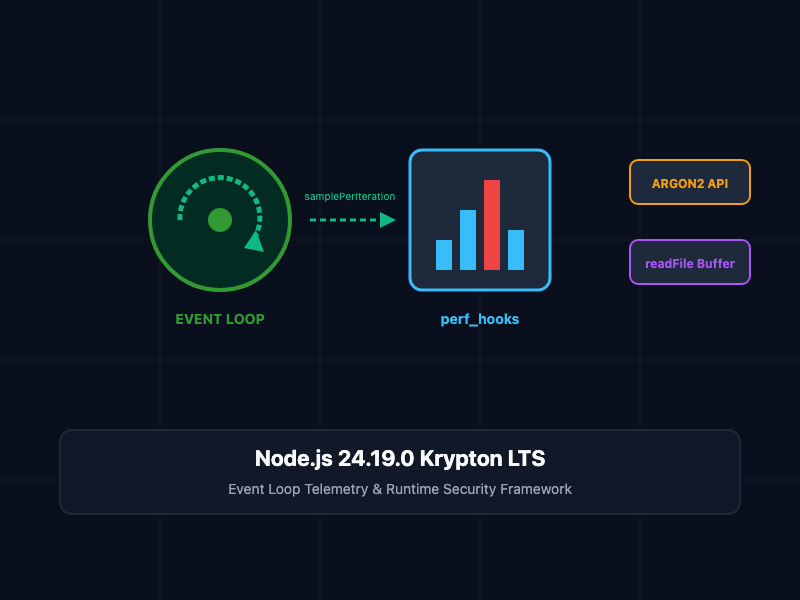
The perf_hooks module has been enhanced with the samplePerIteration option inside monitorEventLoopDelay(). Previously, event loop monitoring polled delays at fixed time intervals (e.g., every 10 milliseconds). With samplePerIteration: true, the runtime records delay metrics on every single iteration of the libuv event loop.
This provides exact visibility into micro-delays caused by synchronous tasks, heavy JSON parsing, or blocking operations.
// Telemetry service using Node.js 24.19.0 per-iteration sampling
import { monitorEventLoopDelay } from 'node:perf_hooks';

// Initialize event loop delay histogram with per-iteration sampling
const histogram = monitorEventLoopDelay({
  resolution: 20,
  samplePerIteration: true // New in v24.19.0
});

histogram.enable();

// Periodically log event loop latency metrics to APM dashboard
setInterval(() => {
  const meanDelayMs = histogram.mean / 1e6;
  const p99DelayMs = histogram.percentile(99) / 1e6;
  const maxDelayMs = histogram.max / 1e6;

  console.log(`Event Loop Metrics - Mean: ${meanDelayMs.toFixed(3)}ms | P99: ${p99DelayMs.toFixed(3)}ms | Max: ${maxDelayMs.toFixed(3)}ms`);

  // Reset histogram measurements for the next window
  histogram.reset();
}, 5000);
2. Caller-Provided Buffers for readFile()
To eliminate unnecessary heap memory allocations during file operations, fs.readFile() and fs/promises.readFile() now accept a pre-allocated, caller-provided buffer. This enables zero-allocation file reading loops in memory-constrained environments or high-frequency file streaming endpoints.
import { readFile } from 'node:fs/promises';

async function processFileWithReusedBuffer(filePath, sharedBuffer) {
  // Pass an existing pre-allocated Buffer to avoid heap allocation
  const result = await readFile(filePath, { buffer: sharedBuffer });

  console.log(`Successfully read ${result.bytesRead} bytes into pre-allocated memory structure.`);
  return result.buffer;
}

// Pre-allocate a 64KB shared working memory buffer
const reusableBuffer = Buffer.alloc(65536);

// Execute read operations using the pre-allocated buffer
await processFileWithReusedBuffer('data/log.txt', reusableBuffer);
3. Stable Argon2 Cryptographic APIs
Argon2 is the password hashing algorithm recommended by OWASP for resisting GPU-assisted brute-force attacks. Node.js 24.19.0 stabilizes native Argon2 bindings inside the node:crypto module, removing the requirement for external npm packages like argon2 or native node-gyp bindings.
import { argon2id } from 'node:crypto';
import { promisify } from 'node:util';

const argon2idAsync = promisify(argon2id);

async function hashUserPassword(plainTextPassword) {
  const salt = Buffer.from('a_secure_32_byte_salt_string_value');

  // Execute native, high-performance Argon2id password hashing
  const hashKey = await argon2idAsync(plainTextPassword, salt, {
    memoryCost: 65536, // 64MB memory limit
    timeCost: 3,        // 3 processing iterations
    parallelism: 1,     // 1 thread
    hashLength: 32
  });

  return hashKey.toString('hex');
}

const hash = await hashUserPassword('UserSecurePassword2026!');
console.log(`Native Argon2id Hash: ${hash}`);
4. Experimental Text File Imports and TLS Enhancements
Node.js 24.19.0 also expands module loading capabilities by supporting experimental text file imports via ECMAScript import attributes, alongside upgraded TLS features for stricter cipher configuration and renegotiation controls:
// Experimental text file import syntax
import textContent from './template.txt' with { type: 'text' };

console.log(`Imported file payload length: ${textContent.length} characters.`);
Architectural Feature Summary
| Feature | Pre-24.19.0 Behavior | Node.js 24.19.0 Behavior | Primary Benefit |
|---|---|---|---|
| Event Loop Telemetry | Fixed-interval time sampling | Per-iteration event loop sampling (samplePerIteration) | Uncovers hidden micro-jank and short blocking tasks |
| readFile() Memory | Allocates new Buffer on every read | Accepts caller-provided pre-allocated Buffer | Reduces garbage collection overhead |
| Password Hashing | Requires external native modules | Native node:crypto Argon2 implementation | Eliminates supply chain dependencies |
| Text File Imports | Manual fs.readFileSync calls | Native ES Module import attributes | Streamlines static asset bundling |
Best Practices
- Enable samplePerIteration in Production APMs: Configure your Application Performance Monitoring (APM) agents to leverage per-iteration sampling during load tests to pinpoint exact function calls causing event loop delay.
- Reuse Pre-Allocated Buffers in High-Throughput Routes: When serving static files or reading configuration logs inside hot execution paths, instantiate pre-allocated buffers to decrease memory allocation frequency.
- Migrate Password Hashing to Native Argon2: Replace third-party native C++ dependencies in your package.json with native node:crypto Argon2 functions to decrease container build times and security vulnerability footprints.
- Reset Histogram Samples Periodically: Always execute .reset() on monitorEventLoopDelay instances between reporting intervals to prevent historical latency data from skewing current telemetry metrics.
Getting Started
To upgrade your local workspace or container base images to Node.js 24.19.0:
# Step 1: Install or switch to Node.js 24.19.0 using Node Version Manager
nvm install 24.19.0
nvm use 24.19.0

# Step 2: Verify active version
node -v

# Step 3: Run your telemetry script with event loop monitoring active
node server.mjs
By leveraging these new runtime capabilities, you can build higher-performance microservices, reduce garbage collection pauses, and secure your authentication infrastructure using standard native APIs.