

The Architectural Challenges of Payment Gateways in Microservices
Integrating external payment gateways like PayPal into distributed microservice architectures introduces structural design challenges:
- Tight Business Domain Coupling: Directly coupling business domain microservices (such as Order, Subscription, or Invoicing services) to external payment SDKs forces every service to manage payment credentials, API updates, and gateway SDK versions.
- Latency in Internal Communications: Relying on traditional HTTP/REST calls for internal inter-service communication introduces heavy JSON serialization overhead and higher transport latency across internal network hops.
- Mixed Communication Vectors: Payment engines must handle two fundamentally different types of network traffic: high-speed internal RPC requests from upstream services, and external HTTP webhooks triggered asynchronously by the payment gateway.
- Environment Inconsistency: Local development setups often fail to replicate production gRPC network interfaces and environment variables, leading to deployment failures.
Decoupling payment processing into an isolated microservice using NestJS, Protocol Buffers (gRPC), and Docker resolves these failure points.
What Is the Dual-Transport NestJS Payment Architecture?
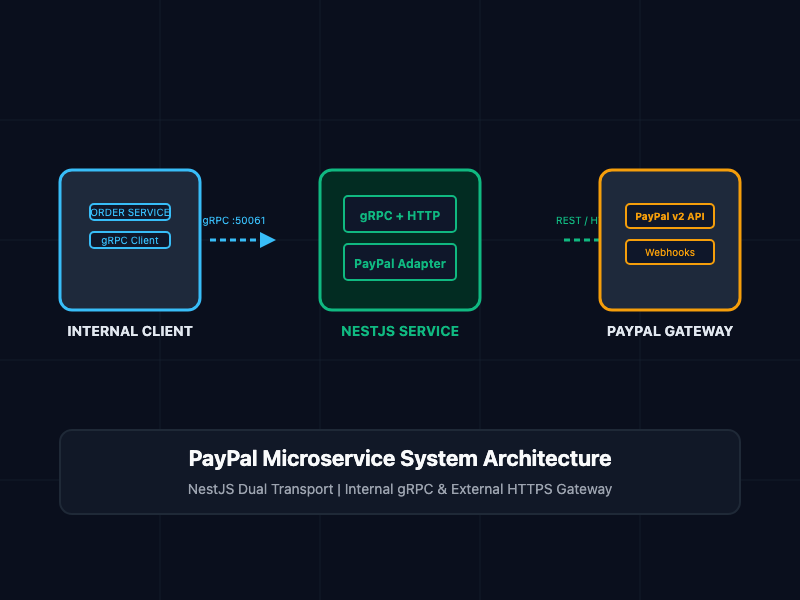
The NestJS Payment Microservice operates as an isolated processing engine utilizing a dual-transport architectural pattern within a single Node.js runtime process:
- Internal gRPC Interface (Port 50061): Exposes a strongly-typed Protocol Buffer service contract (PaymentService). Internal microservices (such as Order or Subscription services) execute fast, low-latency Remote Procedure Calls (RPCs) over HTTP/2 to create or capture payments.
- External HTTP/REST Interface (Port 3003): Exposes standard HTTP endpoints dedicated to health checks, administrative diagnostics, and processing incoming asynchronous PayPal webhook events.
- PayPal Gateway Adapter: Encapsulates PayPal v2 Checkout API integrations, token management, and payment execution logic.
Core Concepts and Implementation
1. Defining the Shared gRPC Contract (payment.proto)
To enforce strict, language-agnostic API contracts between internal microservices, define the service methods and message schemas inside a Protocol Buffers (.proto) file.
// libs/shared/proto/payment.proto
syntax = "proto3";

package payment;

service PaymentService {
  rpc CreatePayment (CreatePaymentRequest) returns (CreatePaymentResponse) {};
  rpc CapturePayment (CapturePaymentRequest) returns (CapturePaymentResponse) {};
  rpc GetPaymentStatus (GetPaymentStatusRequest) returns (GetPaymentStatusResponse) {};
}

message CreatePaymentRequest {
  string amount = 1;
  string currency = 2;
  string reference_id = 3;
  string return_url = 4;
  string cancel_url = 5;
}

message CreatePaymentResponse {
  string payment_id = 1;
  string status = 2;
  string approval_url = 3;
}

message CapturePaymentRequest {
  string payment_id = 1;
}

message CapturePaymentResponse {
  string payment_id = 1;
  string status = 2;
  string capture_id = 3;
}

message GetPaymentStatusRequest {
  string payment_id = 1;
}

message GetPaymentStatusResponse {
  string payment_id = 1;
  string status = 2;
  string amount = 3;
  string currency = 4;
}
2. Bootstrapping Dual-Transport Server in NestJS (main.ts)
NestJS allows a single application instance to bind both a standard HTTP server and a gRPC microservice listener during startup.
// apps/payment-service/src/main.ts
import { NestFactory } from '@nestjs/core';
import { MicroserviceOptions, Transport } from '@nestjs/microservices';
import { join } from 'path';
import { AppModule } from './app.module';

async function bootstrap() {
  // 1. Create primary HTTP NestJS application instance
  const app = await NestFactory.create(AppModule);

  // 2. Attach gRPC microservice transport to the same application
  app.connectMicroservice<MicroserviceOptions>({
    transport: Transport.GRPC,
    options: {
      package: 'payment',
      protoPath: join(__dirname, '../shared/proto/payment.proto'),
      url: `0.0.0.0:${process.env.GRPC_PORT || '50061'}`,
    },
  });

  app.setGlobalPrefix('api');

  // 3. Start all microservice transports and listen on HTTP port
  await app.startAllMicroservices();
  await app.listen(process.env.HTTP_PORT || 3003);

  console.log(`Payment HTTP service listening on port ${process.env.HTTP_PORT || 3003}`);
  console.log(`Payment gRPC microservice listening on port ${process.env.GRPC_PORT || 50061}`);
}

bootstrap();
3. Implementing the gRPC Controller in NestJS
The controller implements the gRPC interface methods using NestJS microservice decorators (@GrpcMethod), executing payment creation against the PayPal API adapter.
// apps/payment-service/src/payment/payment.controller.ts
import { Controller } from '@nestjs/common';
import { GrpcMethod } from '@nestjs/microservices';
import { PaypalService } from './paypal.service';

interface CreatePaymentRequest {
  amount: string;
  currency: string;
  referenceId: string;
  returnUrl: string;
  cancelUrl: string;
}

@Controller()
export class PaymentController {
  constructor(private readonly paypalService: PaypalService) {}

  @GrpcMethod('PaymentService', 'CreatePayment')
  async createPayment(data: CreatePaymentRequest) {
    const order = await this.paypalService.createOrder(
      data.amount,
      data.currency,
      data.referenceId,
      data.returnUrl,
      data.cancelUrl,
    );

    const approvalUrl = order.links.find((link) => link.rel === 'approve')?.href;

    return {
      paymentId: order.id,
      status: order.status,
      approvalUrl: approvalUrl || '',
    };
  }

  @GrpcMethod('PaymentService', 'CapturePayment')
  async capturePayment(data: { paymentId: string }) {
    const capture = await this.paypalService.captureOrder(data.paymentId);

    return {
      paymentId: data.paymentId,
      status: capture.status,
      captureId: capture.purchase_units[0]?.payments?.captures[0]?.id || '',
    };
  }
}
Comparative Analysis: REST vs. gRPC for Payment Microservices
| Architectural Dimension | Internal gRPC Transport | External REST/HTTP Transport |
| Primary Scope | Inter-service RPCs (Order -> Payment) | Ingress Webhooks & Health Checks |
| Protocol | HTTP/2 (Multiplexed streaming) | HTTP/1.1 or HTTP/2 |
| Data Serialization | Binary Protocol Buffers (.proto) | Text-based JSON payloads |
| Type Safety | Strict compile-time contract sharing | Dynamic schema / manual OpenAPI |
| Transport Latency | Low latency, reduced CPU overhead | Moderate latency |
| Browser Compatibility | Requires gRPC-Web proxy for browsers | Native browser compatibility |
SRE and Production Best Practices
- Enforce Strict Idempotency: Use deterministic reference_id values (combining tenant ID and internal order ID) when creating PayPal orders to prevent duplicate charge transactions during retry attempts.
- Validate Webhook Signatures: Always verify incoming PayPal webhook HTTP headers (PAYPAL-AUTH-ALGO, PAYPAL-CERT-URL, PAYPAL-TRANSMISSION-SIG) using PayPal SDK verification APIs before updating internal transaction ledgers.
- Isolate Credentials in Secrets Managers: Store PAYPAL_CLIENT_ID and PAYPAL_CLIENT_SECRET securely in environment vaults or Kubernetes Secrets rather than hardcoding credentials inside container images.
- Implement Circuit Breakers: Wrap external PayPal API HTTP calls with resilience patterns (such as Cockatiel or Resilience4j equivalent in Node) to fail fast during payment gateway outages.
Getting Started with Docker Compose
To orchestrate the payment microservice alongside a Redis instance and target dependencies, run the following Docker Compose stack:
# docker-compose.yml
version: '3.8'

services:
  payment-service:
    build:
      context: .
      dockerfile: apps/payment-service/Dockerfile
    container_name: payment_microservice
    restart: always
    ports:
      - "3003:3003"   # External HTTP / Webhooks
      - "50061:50061" # Internal gRPC transport
    environment:
      NODE_ENV: production
      HTTP_PORT: 3003
      GRPC_PORT: 50061
      PAYPAL_CLIENT_ID: ${PAYPAL_CLIENT_ID}
      PAYPAL_CLIENT_SECRET: ${PAYPAL_CLIENT_SECRET}
      PAYPAL_ENVIRONMENT: sandbox
    healthcheck:
      test: ["CMD", "curl", "-f", "http://localhost:3003/api/health"]
      interval: 10s
      timeout: 5s
      retries: 3
Execute the stack startup command:
# Start containerized microservice environment
docker compose up -d --build
By establishing this dual-transport architecture, engineering teams isolate third-party gateway dependencies, maintain high-speed typed inter-service communications, and scale payment infrastructure reliably.