

The Problem Modern Web Development Faces
Building enterprise-grade web applications requires balancing powerful backend processing with smooth, reactive user experiences. Traditionally, developers faced distinct operational hurdles:
- Tight coupling: Traditional monolithic views (like plain server-rendered templates) made it difficult to decouple the frontend logic or repurpose backend APIs for mobile apps.
- State complexity: Handling complex user interfaces with vanilla JavaScript or jQuery quickly devolved into unmaintainable spaghetti code.
- Monolithic bottlenecks: Scaling the user experience independently from server-side database logic was nearly impossible.
- Developer fragmentation: Teams often struggled to bridge the gap between backend database architecture and frontend interactive components.
Combining Laravel and React solves these challenges by creating a clean separation of concerns: Laravel operates as an ultra-reliable RESTful API engine, while React manages client-side UI rendering and interactive state.
What Is the Laravel + React Stack?
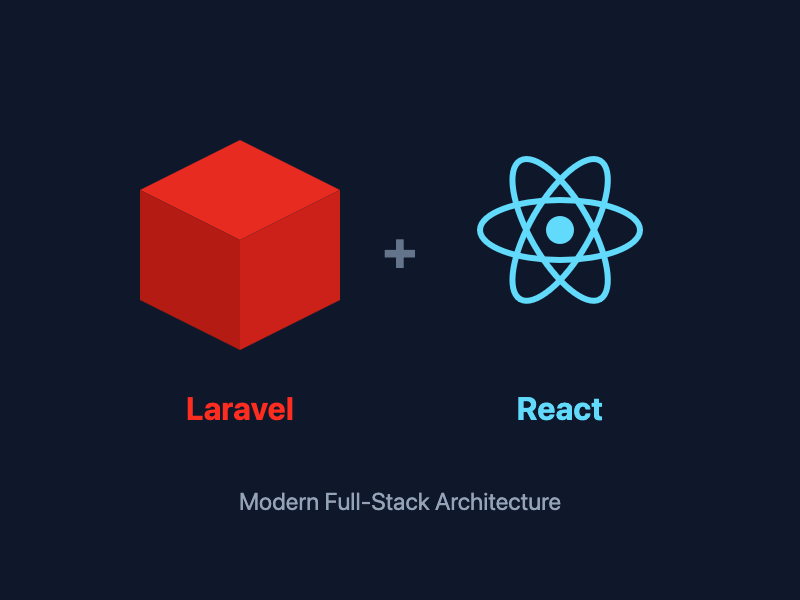
The Laravel + React combination pairs PHP's most popular full-featured framework with Meta's industry-standard UI library. In this architecture, Laravel handles routing, authentication, business logic, and database operations, while React builds reusable components to dynamically render state changes on the client side.
Whether integrated directly via tools like Inertia.js or decoupled via modern REST API patterns, this stack gives developers the speed of Laravel's ecosystem alongside the modularity of React's component-based UI.
Core Concepts
Laravel API Routing & Controllers
Laravel makes building REST endpoints clean and intuitive. API routes are defined in routes/api.php and map cleanly to dedicated controller methods:
<?php

use App\Http\Controllers\UserController;
use Illuminate\Support\Facades\Route;

// API endpoints for managing users
Route::get('/users', [UserController::class, 'index']);
Route::post('/users', [UserController::class, 'store']);
Inside the UserController, Laravel handles querying the database and returning clean JSON responses automatically:
namespace App\Http\Controllers;

use App\Models\User;
use Illuminate\Http\Request;

class UserController extends Controller
{
    public function index()
    {
        return response()->json(User::all(), 200);
    }
}
React Component & API Fetching
React consumes the JSON API exposed by Laravel. Using React Hooks like useState and useEffect, components fetch data asynchronously and update the UI cleanly without reloading the page:
import React, { useState, useEffect } from 'react';

export default function UserDashboard() {
  const [users, setUsers] = useState([]);

  useEffect(() => {
    fetch('/api/users')
      .then(res => res.json())
      .then(data => setUsers(data));
  }, []);

  return (
    <div className="p-6">
      <h1 className="text-xl font-bold">Users</h1>
      <ul>
        {users.map(user => (
          <li key={user.id}>{user.name}</li>
        ))}
      </ul>
    </div>
  );
}
Notice how useEffect executes the asynchronous fetch request on mount—updating state triggers an automatic UI re-render.
Authentication and State Management
Modern Laravel + React applications secure routes using Laravel Sanctum or Passport. Sanctum provides a lightweight authentication system for SPA (Single Page Application) frontends using API tokens or cookie-based session authentication.
// Protecting backend routes using Sanctum middleware
Route::middleware('auth:sanctum')->group(function () {
    Route::get('/user', function (Request $request) {
        return $request->user();
    });
});
Database Architecture & Migrations
Laravel provides Eloquent ORM to manage database structures and relations programmatically using migrations and model definitions:
// Database migration for users table
Schema::create('users', function (Blueprint $table) {
    $table->id();
    $table->string('name');
    $table->string('email')->unique();
    $table->timestamps();
});
The Full-Stack Workflow
Developing with Laravel and React follows a streamlined iterative workflow:
1. Define Backend Models & Endpoints (php artisan make:controller)
Set up database migrations, Eloquent models, and expose RESTful routes returning structured JSON payloads.
2. Test API Endpoints with Postman or Curl
Verify that your Laravel backend outputs correct status codes and HTTP headers:
GET /api/users -> 200 OK [ {"id": 1, "name": "John Doe"} ]
POST /api/users -> 201 Created
3. Build Frontend Components & Connect State
Create UI components in React, implement state hooks to store data, and style using CSS frameworks like Tailwind CSS.
Laravel + React vs. Next.js vs. Inertia.js
| Feature | Laravel API + React SPA | Next.js (Node.js) | Laravel + Inertia.js |
| Backend Framework | Laravel (PHP) | Node.js | Laravel (PHP) |
| Architecture | Decoupled REST/GraphQL | Full-stack JS | Monolithic SPA Glue |
| Routing | Client (React Router) | File-system / Server | Server-driven (Laravel) |
| Best Use Case | Multi-platform backends | Pure JS ecosystem | Rapid full-stack monoliths |
Best Practices
- Use Laravel Sanctum for seamless SPA token/session authentication.
- Format API outputs with API Resources to control JSON responses without exposing raw database attributes.
- Utilize Inertia.js if you prefer skipping client-side routing while keeping a pure React UI layer.
- Keep React components modular by separating UI primitives from data-fetching containers.
- Enforce strict validation on Laravel request classes (FormRequest) before accepting data into your database.
- Use Vite as your bundler for lightning-fast hot module replacement (HMR) during frontend development.
Getting Started
To kick off a modern Laravel and React project, create a fresh Laravel application, install Vite with the React plugin, build your API endpoints, and begin mounting React components inside your views or SPA entrypoint. In a short time, you’ll have a robust, scalable app backed by PHP’s best ecosystem and modern JavaScript.