
The Problem Standard RAG Systems Face
Naïve Retrieval-Augmented Generation (RAG) revolutionized enterprise search by connecting Large Language Models (LLMs) to private knowledge bases. However, single-pass RAG pipelines quickly hit major limitations in complex production environments:
- Poor multi-step reasoning: Standard RAG performs a single vector lookup and generates an answer, failing on complex questions requiring multi-hop reasoning or iterative clarification.
- Garbage in, garbage out: Raw web scraping or unparsed PDFs contaminate vector stores with noise, resulting in poor retrieval accuracy.
- Context drift & memory loss: Traditional RAG retains no long-term memory across sessions, making conversational continuity impossible.
- Hallucinations & lack of safety: Unchecked outputs can bypass security, leak private data, or produce inaccurate claims without validation guardrails.
Agentic RAG solves these issues by introducing autonomous agentic loops—enabling AI models to evaluate their own retrieval quality, execute multi-step tool calls, manage long-term state, and refine answers iteratively before output.
What Is Agentic RAG?
While traditional RAG acts as a static pipeline (Retrieve $\rightarrow$ Augment $\rightarrow$ Generate), Agentic RAG elevates the LLM into an active decision-making agent.
The agent uses tools, decides when and how to query vector databases, reformulates search queries if initial results are inadequate, parses complex unstructured data sources, and stores facts in persistent memory graphs.
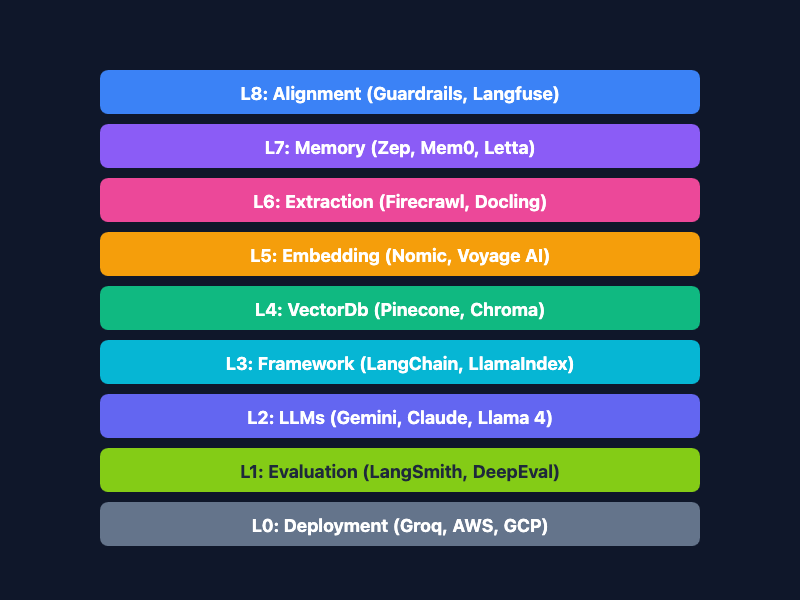
To build an enterprise-ready Agentic RAG solution, developers construct a multi-layered tech stack spanning low-level compute deployment up to top-tier alignment and observability tools.
The 9-Layer Agentic RAG Tech Stack
| Level 8: Alignment | Guardrails AI, Arize, Langfuse, Helicone |
|---|---|
| Level 7: Memory | Zep, Mem0, Cognee, Letta |
| Level 6: Data Extraction | Firecrawl, Scrapy, Docling, LlamaParse |
| Level 5: Embedding | Nomic, Ollama, Voyage AI, OpenAI |
| Level 4: VectorDb | Pinecone, Chroma, Milvus, Weaviate |
| Level 3: Framework | LangChain, LlamaIndex, Haystack, DSPy |
| Level 2: LLMs | Llama 4, Gemini 2.5 Pro, Claude 4, GPT-4o |
| Level 1: Evaluation | LangSmith, Phoenix, DeepEval, Ragas |
| Level 0: Deployment | Groq, AWS, Google Cloud, Together.ai |
Level 0: Deployment Infrastructure
Every AI stack begins with hardware compute and cloud infrastructure. High-performance inference requires specialized LPUs (Language Processing Units) or scalable cloud clusters:
- Groq: Ultra-low latency LPU hardware for instant inference loops.
- AWS / Google Cloud: Enterprise cloud platforms providing managed GPU instances, Kubernetes hosting, and VPC security.
- Together.ai: Scalable endpoint hosting for open-weights models.
Level 1: Evaluation & Observability
You cannot improve what you do not measure. Evaluation frameworks score retrieval precision, faithfulness, and answer relevance:
- LangSmith: Full-lifecycle tracing, debugging, and prompt evaluation.
- Phoenix (Arize): Open-source AI observability and evaluation notebook tooling.
- DeepEval & Ragas: Frameworks for automated RAG metrics ($RAGAS$ scores, context recall, faithness metrics).
Level 2: Core LLMs (Reasoning Engines)
The central intelligence engine that plans agent sub-goals, decides tool usage, and synthesizes context:
- Gemini 2.5 Pro: Google's massive context window model built for complex multi-modal reasoning.
- Llama 4: Meta's state-of-the-art open-weights frontier model.
- Claude 4 & GPT-4o: High-reasoning commercial APIs optimized for function calling and code execution.
Level 3: Orchestration Frameworks
Frameworks provide abstractions for chaining components, defining agent loops, and connecting tool interfaces:
- LangChain & LangGraph: State-machine orchestration for cyclic, multi-agent graphs.
- LlamaIndex: Deep data indexing and retrieval-first agent structures.
- Haystack by Deepset: Production-ready pipeline builder for NLP search.
- DSPy: Declarative programming framework that replaces prompt engineering with algorithmic optimization.
Level 4: Vector Databases
High-throughput vector databases store dense vector embeddings and execute approximate nearest neighbor (ANN) searches:
- Pinecone: Fully managed, cloud-native serverless vector database.
- Chroma: Lightweight, open-source embedded vector store.
- Milvus & Weaviate: Enterprise-scale vector engines supporting hybrid keyword-dense vector search.
Level 5: Embedding Models
Embedding models map unstructured text into dense mathematical vector spaces ($E \in \mathbb{R}^d$):
- Nomic & Voyage AI: Highly tuned embedding models optimized for code, financial, and multi-domain RAG.
- Ollama: Local embedding execution for privacy-first architecture.
- OpenAI: High-dimensional text embeddings (text-embedding-3-large).
Level 6: Data Extraction & Ingestion
Agentic RAG relies on clean, structured input parsed from raw web pages, PDFs, and API documents:
- Firecrawl: Converts full web domains into LLM-ready clean Markdown.
- Scrapy: Battle-tested Python web crawling framework.
- Docling & LlamaParse: Advanced document engines that extract complex tables, formulas, and structural layouts from PDFs.
Level 7: Dynamic Agentic Memory
Agents require persistent state across chat sessions to maintain context and user preferences:
- Mem0 & Zep: Long-term memory layers providing personalized context retrieval for AI agents.
- Cognee: Graph-based memory engine turning unstructured data into knowledge graphs.
- Letta: Memory-first agent architecture (formerly MemGPT).
Level 8: Alignment, Security & Guardrails
The final layer validates inputs and outputs to ensure safety, prevent prompt injection, and log billing usage:
- Guardrails AI: Enforces strict schema output structure and content policy safety.
- Arize / Langfuse / Helicone: Edge proxy gateways providing real-time cost tracking, rate limiting, and observability.
Agentic RAG vs. Standard RAG
| Feature | Standard RAG | Agentic RAG |
| Execution Flow | Linear (Single-pass $R \rightarrow A \rightarrow G$) | Cyclic / Iterative (Re-think, Re-query, Validate) |
| Data Ingestion | Simple text chunking | Multi-modal layout parsing (LlamaParse, Docling) |
| Search Method | Basic vector similarity | Hybrid (Keyword + Dense) + Dynamic Query Rewriting |
| State & Memory | Stateless (Per-session context window) | Persistent Graph / Fact Memory (Mem0, Zep) |
| Output Control | Raw LLM generation | Schema-enforced guardrails (Guardrails AI) |
Code Blueprint: Building an Agentic Retrieval Step
Below is an example showing how an agentic RAG flow uses tool selection and query reformulation in Python:
from langchain_core.tools import tool
from langgraph.prebuilt import create_react_agent
from langchain_openai import ChatOpenAI

@tool
def vector_search_tool(query: str) -> str:
    """Queries the Pinecone vector database for internal technical documents."""
    # Simulated vector store lookup
    return f"Retrieved documents related to: {query}"

@tool
def web_extract_tool(url: str) -> str:
    """Parses live web content using Firecrawl if internal docs are insufficient."""
    return f"Extracted fresh web markdown content from {url}"

# Initialize LLM reasoning engine
llm = ChatOpenAI(model="gpt-4o", temperature=0)

# Create an Agentic RAG loop with dynamic tool selection
tools = [vector_search_tool, web_extract_tool]
agent = create_react_agent(llm, tools)

# Query that triggers multi-step reasoning
response = agent.invoke({
    "messages": [("user", "Compare our internal API setup with external benchmarks.")]
})
Best Practices for Building Agentic RAG
- Implement Hybrid Search: Combine sparse keyword search (BM25) with dense vector search in your VectorDB layer (Level 4) to ensure high recall.
- Structure Ingestion First: Spend time tuning data extraction (Level 6). Bad PDF extraction degrades even the most advanced LLM reasoning.
- Use Graph-Based Memory: Integrate graph memory (Mem0 or Cognee) so your agents retain knowledge across multi-session conversations.
- Enforce Hard Guardrails: Always pass final LLM generations through output validators (Level 8) to prevent hallucinated data from reaching end-users.
- Trace Every Agent Step: Monitor token latency and tool calls using observability platforms like Langfuse or LangSmith (Level 1).
Getting Started
Building an Agentic RAG pipeline starts by selecting one core component from each layer. Start with an orchestration framework like LangChain or LlamaIndex, connect a vector store like Pinecone or Chroma, integrate LlamaParse for clean data extraction, and enforce safety using Guardrails AI. Within a few iterations, your RAG system will evolve from a simple search box into an autonomous enterprise knowledge assistant.