
The Problem Traditional Vector RAG Systems Face
Standard Retrieval-Augmented Generation (RAG) changed enterprise search by providing Large Language Models (LLMs) with dynamic access to external knowledge bases. However, relying solely on vector similarity search creates systemic failures when handling complex, interconnected enterprise datasets:
- Context fragmentation: Chunking long documents into isolated vector embeddings loses global structure and systemic context across different files.
- Inability to perform multi-hop reasoning: Standard vector lookups excel at finding top-$k$ nearest text snippets but fail when answering queries that require linking facts across multiple distinct entities ($A \rightarrow B \rightarrow C$).
- Lack of relational understanding: Vector distances represent semantic similarity, not explicit structural logic (e.g., distinguishing whether an entity owns, manages, or competes with another).
- Hallucinated relationships: When an LLM receives fragmented text chunks without explicit entity connections, it often invents logical relationships between concepts.
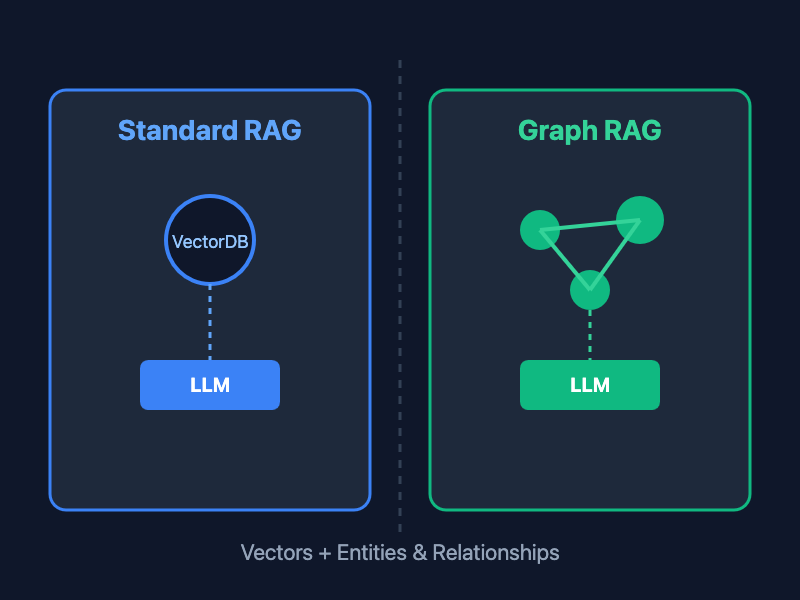
Graph RAG (Graph-based Retrieval-Augmented Generation) overcomes these limitations by constructing a Knowledge Graph of entities and relationships alongside vector embeddings, delivering structured context to the LLM.
What Is Graph RAG?
While traditional RAG converts unstructured text solely into dense mathematical vectors ($V \in \mathbb{R}^d$), Graph RAG extracts structured entities (people, products, places, concepts) and their explicit relationships (e.g., [Company] -> OPERATES_IN -> [Region]) using an LLM Graph Generator.
By indexing information in a Graph Database (such as Neo4j, FalkorDB, or Memgraph) alongside vector embeddings, Graph RAG enables dual retrieval: vector search for semantic proximity and graph traversals for structural, multi-hop reasoning.
RAG vs. Graph RAG Architecture Deep-Dive
                       TRADITIONAL RAG
[ Data (PDF/Doc) ] ➔ [ Embedding Model ] ➔ [ Vectors ] ➔ [ Vector DB ]
                                                              │
[ Query ] ────────────────────────────────────────────────────┘
   │
   v
[ Context ] ➔ [ LLM Engine ] ➔ [ Final Response ]


                     GRAPH RAG ARCHITECTURE
                     ┌─> [ LLM Graph Generator ] ─> [ Entities & Relations ] ─┐
[ Data (PDF/Doc) ] ──┤                                                        ├─> [ Graph DB ]
                     └─> [ Embedding Model ] ────> [ Dense Vectors ] ─────────┘
                                                                                    │
[ Query ] ──────────────────────────────────────────────────────────────────────────┘
   │
   v
[ Nodes, Relationships & Context ] ➔ [ LLM Engine ] ➔ [ Final Response ]
1. Traditional RAG Pipeline Flow
- Ingestion & Indexing: Raw documents (PDFs, DOCX, XLSX) are split into fixed-size chunks and passed through an Embedding Model to generate dense vectors. These vectors are indexed inside a Vector Database.
- Retrieval: User queries are embedded into vectors, and an approximate nearest neighbor (ANN) search retrieves the top-$k$ most similar document chunks.
- Generation: The retrieved chunks are formatted as context and passed directly to the LLM to generate the final response.
2. Graph RAG Pipeline Flow
- Dual Ingestion Engine:Entity & Relation Extraction: An LLM Graph Generator parses raw documents to identify domain entities and construct explicit triples (Subject $\rightarrow$ Predicate $\rightarrow$ Object).Vector Generation: Text chunks are simultaneously processed by an Embedding Model to preserve dense semantic representation.
- Entity & Relation Extraction: An LLM Graph Generator parses raw documents to identify domain entities and construct explicit triples (Subject $\rightarrow$ Predicate $\rightarrow$ Object).
- Vector Generation: Text chunks are simultaneously processed by an Embedding Model to preserve dense semantic representation.
- Hybrid Graph Database Storage: Entities, relationships, and vector representations are ingested into a unified Graph Database.
- Graph-Enriched Retrieval: The user query triggers both vector indexing and graph traversal (or community detection algorithms) to gather connected nodes and structural subgraphs.
- Enhanced Generation: The LLM receives both unstructured context snippets and explicit subgraphs (Nodes & Relationships), enabling precise, reasoning-driven answers.
Detailed Comparison
| Feature | Standard Vector RAG | Graph RAG |
| Data Representation | Unstructured vector chunks ($V \in \mathbb{R}^d$) | Structured Knowledge Graphs + Dense Vectors |
| Primary Storage Engine | Vector Database (Pinecone, Chroma, Milvus) | Graph Database (Neo4j, FalkorDB, AWS Neptune) |
| Relationship Handling | Implicit semantic similarity | Explicit typed relations (OWNS, DEPENDS_ON) |
| Query Capability | Fact lookup / Semantic Search | Multi-hop reasoning, Global summarization |
| Ingestion Complexity | Low (Chunk $\rightarrow$ Embed $\rightarrow$ Store) | High (Entity extraction + Graph construction) |
| Cost & Ingestion Latency | Lower compute cost | Higher initial LLM extraction cost |
| Hallucination Rate | Moderate to High on complex queries | Extremely Low due to grounded entity links |
Code Blueprint: Building a Hybrid Graph RAG Index
Below is a Python blueprint using LlamaIndex and Neo4j to build a Property Graph index that extracts entities and relationships while maintaining vector search:
import os
from llama_index.core import PropertyGraphIndex
from llama_index.core.indices.property_graph import ImplicitPathExtractor
from llama_index.graph_stores.neo4j import Neo4jPropertyGraphStore
from llama_index.llms.openai import OpenAI
from llama_index.embeddings.openai import OpenAIEmbedding

# Initialize LLM reasoning engine and embedding model
llm = OpenAI(model="gpt-4o", temperature=0)
embed_model = OpenAIEmbedding(model="text-embedding-3-small")

# Connect to Neo4j Graph Database
graph_store = Neo4jPropertyGraphStore(
    username="neo4j",
    password=os.getenv("NEO4J_PASSWORD"),
    url="bolt://localhost:7687"
)

# Construct Graph RAG Index with LLM-driven Entity Extraction
graph_index = PropertyGraphIndex.from_documents(
    documents=documents,
    llm=llm,
    embed_model=embed_model,
    property_graph_store=graph_store,
    kg_extractors=[
        ImplicitPathExtractor()
    ]
)

# Querying with hybrid graph traversal and vector search
query_engine = graph_index.as_query_engine(
    include_text=True,
    similarity_top_k=5
)

response = query_engine.query("What are the dependencies between Service A and Database B?")
print(response)
Best Practices for Implementing Graph RAG
- Use Community Detection for High-Level Queries: Implement algorithms like Leiden or Louvain community detection to summarize global themes across large document collections (as popularized by Microsoft GraphRAG).
- Combine Dense Vectors with Graph Traversal: Do not abandon vector search. Use hybrid retrieval where vector similarity identifies starting seed nodes, followed by $N$-hop graph walks.
- Define a Strict Ontology: Provide the LLM Graph Generator with explicit node types (Person, Organization, API) and allowed relationships (CALLS, AUTHORS, DEPLOYS) to eliminate noisy knowledge graph edges.
- Optimize Graph Pruning: Periodically merge duplicate entities (entity resolution) and prune low-confidence relationships to maintain fast graph traversal performance.
Getting Started
To get started with Graph RAG, spin up a local Neo4j instance using Docker (docker run -p 7474:7474 -p 7687:7687 neo4j), install orchestration tools like LlamaIndex or LangChain, and run entity extraction on your enterprise documentation. Upgrading from standard vector RAG to Graph RAG will turn fragmented document chunks into a unified, reasoning-capable knowledge engine.